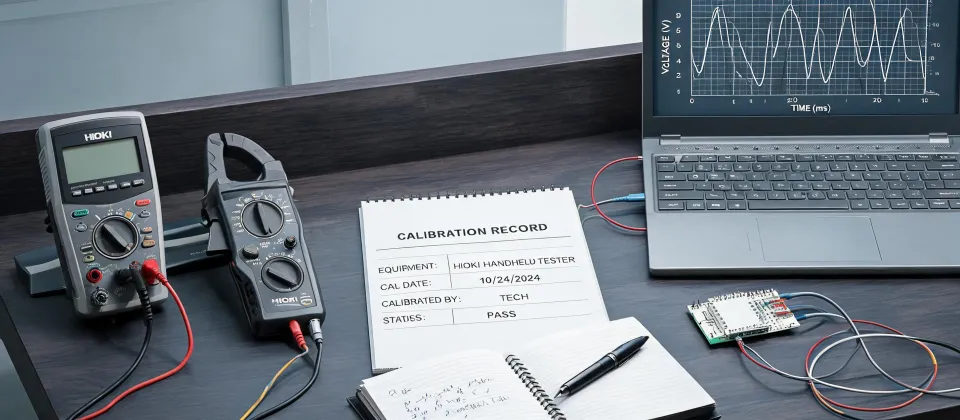
I used to believe that a cheap multimeter performed just as well as a premium one. For the first 11 months, I was right. Then the budget-priced unit failed during a routine motor circuit test, we lost a production day, and I had to stand in the plant manager's office and explain why our "cost-saving" procurement decision caused a $12,000 production loss. That was 2023, and I haven't allowed cheap test equipment on the plant floor for critical measurements since.
Here's my straightforward view: buying test equipment on price alone is the most expensive procurement mistake you can make in an industrial environment. Not because high-priced instruments are automatically better—they're not—but because the cost of a failed measurement is almost always vastly higher than the price difference between a premium instrument and a budget one.
The Price Tag Is Not the Cost
Let me clarify what I mean (as someone who learned the hard way): the purchase price of a multimeter is maybe a third of its true cost. The remaining two-thirds are hidden in downtime, re-tests, calibration issues, and lost credibility with your engineering team.
Here's something vendors won't tell you: instrument reliability doesn't show up on a spec sheet. Spec sheets list accuracy, resolution, and safety ratings. They don't tell you how the rotary switch behaves after 500 rotations, or whether the terminal inputs maintain good grip in a dusty panel environment. You only learn that from using a tool for months—or from people who have.
This is where the hioki multimeter price discussion usually goes off track. People compare Hioki's price against a generic import unit and conclude it's expensive. But the true question isn't "how much does it cost?"—it's "what does this instrument cost over a 5-year lifecycle, including failures, recalibrations, and rework?" If a Hioki DT4256 (roughly $200–260 depending on distributor) requires calibration twice over five years, while a $45 meter is replaced twice in the same period, the price gap looks very different.
An Honest Look at the Old 85 Multimeter
My predecessor left an old 85 multimeter in the panel shop. I'd often see newer technicians pull it out for "quick checks" because of its reputation. And yes, that 85 was a legitimate workhorse in its era. The problem is that the era has changed.
That multimeter was designed for a world before variable frequency drives, switch-mode power supplies, and non-linear loads were everywhere. It's good at what it was built for—stable sine wave voltage measurement. But modern electrical systems produce harmonics and transients that an older instrument simply can't detect. This was true 30 years ago when analog movement meters were the standard. Today, the measurement requirements have moved on, even if some well-meaning technicians haven't.
I'm not saying you should discard every legacy instrument. I am saying that "it still works" is not the same as "it meets today's measurement requirements."
The Mitutoyo vs. Starrett Caliper Argument Misses the Point
Every maintenance group has a loyalist who insists on Mitutoyo calipers, plus another who swears by Starrett. Ask them which company makes the better 12 dial caliper and you'll get passionate arguments about feel, scale contrast, and which one "holds zero" better.
I get it—good tools are enjoyable to use. But the Mitutoyo vs. Starrett calipers debate, while fun, doesn't help a buyer make better decisions. Both are credible manufacturers with comparable quality and pricing. Selecting between them is closer to a preference than a technical decision. The actual performance difference between equivalent models is minimal when both instruments are properly calibrated and used correctly.
And that's the point that matters: calibration traceability, not brand identity, determines measurement reliability. Per ISO/IEC 17025 laboratory practices, the instrument needs to be calibrated against standards traceable to a national metrology institute (like NIST in the U.S.). That's a process, not a purchase decision. Once you accept that, brand loyalty becomes a personal taste issue, and you can focus procurement on application requirements, service, and total cost.
In my experience, the tool matters less than the person using it—a careful technician produces valid measurements with a mid-tier caliper, while a careless operator can compromise results with the finest instrument available. (That's a training issue, not a vendor issue.)
Why I Approved the Hioki PQ3100-92 Purchase That I Initially Opposed
I'll admit it: the Hioki PQ3100-92 power quality analyzer was a budget request that I initially pushed back on. The line item was around $4,200 for the base system plus the cabling needed to actually perform a power quality study. That looked expensive when portable data loggers appeared in our search results at six or seven hundred dollars.
Then our facility engineer walked me through what we'd been chasing: production line resets occurring intermittently, with no discernible pattern, over four months. We had already spent an estimated $6,000 in diagnostic labor—overtime, rental instruments, outside consulting—without a definitive answer.
The PQ3100-92 recorded the supply for a week and identified the issue: a voltage sag from a neighboring tenant's heavy equipment startup. Honestly, this wasn't a pleasant finding—it meant the root cause was mostly outside our control. But it ended the guessing, gave us documentation to present to the building owner, and demonstrated its value in one three-week investigation. We've since used it for power factor studies and load profiling.
To be fair, the cheaper loggers could probably have caught that sag too. The differentiator was that the PQ3100-92 was designed for this type of long-term logging with power-quality-level accuracy. And the avoided cost of continued investigation was more than the instrument's price. Instrument price is defensible when the alternative is more uncertainty.
But What About the Simple Jobs?
Someone will inevitably say: "For a basic voltage check, a $40 meter works fine."
Granted. It does. I own one, and it lives in a tool drawer for rough checks. That's the appropriate place for it. The mistake isn't owning budget instruments—it's putting them in the hands of people making reliability-critical measurements.
The complication is that you don't always know in advance which measurements are critical. An outlet that looks like a simple 120V check might be feeding a control transformer on a circuit shared with a failing motor drive. Voltage distortion from the drive can make a standard meter read something that does not reflect what is actually happening. A more capable instrument, with true RMS and recording capability, tells you more.
Since the 2023 incident, our facility has had a straightforward rule: personal meters for personal use; calibrated instruments for plant work.
Three Rules I Use for Test Equipment Procurement
It took me six years and about 180 tracked orders to land on this framework. If you're building a test equipment purchasing strategy, here's what I'd pass along:
- Buy for the worst case, not the typical case. The extra $100 for a higher safety category rating or documented input protection is insurance, not an expense. It only "costs" money if you never have the incident—but if you do, it's the cheapest protection you'll ever buy.
- Track failures, not just prices. You can't know which vendor truly has the lowest total cost if you're not logging failure rates, calibration drift, and replacement cycles. I built a spreadsheet for this in 2022, and it changed our vendor decisions within a year.
- Compare total cost of ownership, not sticker price. A $300 instrument that performs correctly the first time is cheaper than a $40 one that contributes to a $1,000 redo. This applies as much to electrical testers as it does to calipers, micrometers, and every other precision tool.
The Bottom Line
Test equipment has changed because the electrical environment has changed—more power electronics, more non-linear loads, tighter compliance requirements. The old procurement habit of buying the cheapest instrument that meets listed specs is a holdover from a simpler measurement era. That era is gone.
I'm not writing this to defend Hioki at any price. There are good instruments from several manufacturers, and each purchase should be evaluated on its own. I'm sharing a practical view from a procurement desk: price is a fact; cost is a decision. And after watching cheap instruments cost our facility exponentially more than they saved, I make that decision differently now.