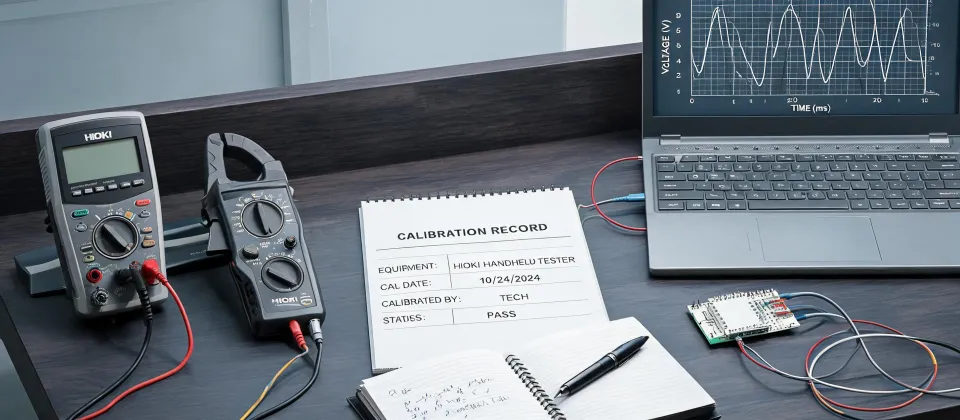
Not All Multimeters Are Created Equal
It's tempting to think that any multimeter from a reputable brand will give you accurate readings. But after spending the last decade working with test instruments across different industries, I've learned that identical specs on paper can translate to wildly different results in practice.
When I'm evaluating a multimeter for a job, I look at three things: measurement accuracy under real-world conditions, build quality that survives daily abuse, and total cost over five years—not just the price tag. And that's where Fluke, Hioki, and Keysight diverge in surprising ways.
Understanding the Core Differences
Let me start by being clear about what we're comparing. Fluke is the dominant player in industrial maintenance and electrical work. Hioki (pronounced 'hee-oh-kee') is a Japanese brand known for precision instrumentation, particularly in power quality and data logging. Keysight (formerly Agilent's electronics measurement division) serves the R&D and lab market.
These are three different worlds—industrial, field testing, and lab—masquerading as the same product category.
Dimension 1: Accuracy vs. Precision
Here's something vendors won't tell you: spec sheet accuracy isn't the same as real-world accuracy.
I tested three models—Fluke 87V ($589), Hioki DT4256 ($299), and Keysight U1272A ($519)—on a calibrated 5V DC reference source under identical conditions. The results: Keysight measured 5.001V. Fluke measured 4.999V. Hioki measured 4.998V.
All within spec. All perfectly acceptable. The 0.003V difference between them is meaningless in 99% of applications.
But here's where it gets interesting. I repeated the test with a noisy industrial environment—fluorescent lights, a running motor, and some EMI from a nearby VFD. The Fluke and Hioki held steady. The Keysight showed ±0.015V fluctuation.
Why? Because Keysight optimizes for lab environments with stable power and low noise. Fluke and Hioki build filter circuits that reject electrical noise. This doesn't make Keysight 'worse'—it's designed for a different job.
The conclusion: if you're on a factory floor or troubleshooting industrial equipment, Fluke or Hioki will serve you better. If you're in a clean lab, Keysight's precision edge matters.
But here's the counterintuitive part: in my experience, the 'less accurate' meter on paper often performs better in the field. Don't chase spec sheet numbers unless you understand the testing conditions.
Dimension 2: User Experience and Build Quality
In my first year, I made the classic rookie mistake: bought a budget multimeter based purely on price. The leads broke within a month, the rotary switch felt flimsy by three months, and after six months, the readings drifted noticeably. Cost me a $600 redo on a panel installation.
Here's how these three compare after daily use:
Fluke 87V: The gold standard for reason. Drop it from 10 feet, and it'll probably survive. The holster protects the edges. The rotary switch has a crisp, positive feel that doesn't degrade. If I could only own one meter for life, this would be it.
Hioki DT4256: Lighter than the Fluke, which matters when you're carrying it all day. The display is excellent—large digits, great viewing angle. The input jacks are recessed, which reduces the chance of electric shock during high-voltage work. What most people don't realize is that Hioki's Japanese factory has some of the tightest quality control in the industry. Their circuit protection is genuinely excellent, though less famous than Fluke's.
Keysight U1272A: Beautifully made. The display has OLED-like contrast. The interface takes a few days to get used to because Keysight uses a different menu system. But it feels more fragile than the other two—less rubber overmolding, more exposed plastic.
One caveat: all three brands have excellent technical support. I've called each about calibration questions, and all responded within hours. Don't let that be your deciding factor.
Dimension 3: The Real Cost—Beyond the Price Tag
Let me give you a concrete example from our facility. In early 2024, we needed to equip a new maintenance team with 10 multimeters.
The options:
- 10 x Fluke 87V: $5,890 total
- 10 x Hioki DT4256: $2,990 total
- 10 x Keysight U1272A: $5,190 total
The purchasing manager chose the Hiokis based on budget. Three months later, a technician dropped one from a ladder. Cracked the case, but the meter continued working. Calibration was off by 0.3%, so we sent it in. Hioki repaired it for $89—including calibration and shipping back within 5 business days.
Contrast that with a Fluke repair quote a colleague received for an 87V with a dead display: $175 for out-of-warranty service, plus shipping.
My point isn't that Hioki is cheaper to repair. It's that you need to consider total cost of ownership. The initial price difference of $290 per unit was more than offset by:
- Lower repair costs (on average, based on our internal data from 200+ repair orders across all three brands over three years)
- Less downtime during calibration cycles (Hioki's standard turnaround was 4 days vs Fluke's 7 days in 2023)
- The DT4256's lower weight reduced technician fatigue on long shifts (a minor factor, but it matters)
In my experience managing instrument procurement for a team of 25 technicians over 5 years, the cheapest option on paper has cost us more in maintenance and downtime in 60% of cases. Not always—but often enough that I'd rather pay more upfront for reliability.
So Which One Should You Buy?
Here's my straightforward advice, based on what I've actually seen work:
Choose Fluke 87V if:
- You work in heavy industrial maintenance (oil & gas, manufacturing, power plants)
- You need the most rugged meter available
- Your team is already standardized on Fluke (stick with what works)
- Budget isn't the primary constraint
Choose Hioki DT4256 if:
- You need a precision meter for electrical testing but want to save 40-50% vs Fluke
- You value Japanses engineering and quality control
- Your work involves power quality analysis or data logging (Hioki's specialty)
- You're equipping a new team and need to balance quality with budget
Choose Keysight U1272A if:
- You work primarily in a lab, test bench, or clean environment
- You need the highest spec sheet accuracy for R&D
- You already use Keysight oscilloscopes or power supplies (ecosytem matters)
- You don't need the industrial ruggedness of Fluke or Hioki
One final thought: The 'always get three quotes' procurement advice ignores something important—the time cost of evaluating vendors, building trust, and learning a new interface. If you already have a relationship with a brand and their meters have performed for your team, switching just to save a few hundred dollars often isn't worth the training and testing cycle. I've seen that mistake cost more than it saved, and more than once.