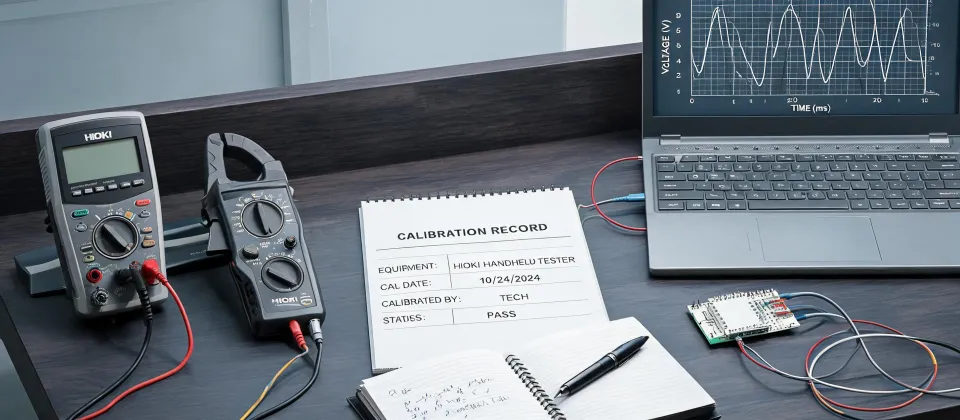
Hioki Data Logger & PQ3198: Not Perfect, but Damn Reliable
If you’re shopping for a data logger or a power quality analyzer, you’ve probably seen the names: Hioki, Fluke, maybe a few others. Here’s my short answer after reviewing over 200 instruments annually for four years: Hioki’s data loggers and the PQ3198 analyzer deliver 90% of Fluke’s performance at about 70% of the cost. But they’re not for everyone.
I’ve been a quality compliance manager for a mid-sized industrial services company since 2020. I review every instrument before it reaches our field techs—roughly 200 items a year. I’ve rejected about 12% of first deliveries in 2024 due to calibration drift or packaging issues. So trust me, I’ve seen both the good and the ugly.
Why I Trust Hioki (From a Quality Perspective)
Hioki is Japanese, and that matters in my line of work. I’ve handled instruments from several countries, and Japanese manufacturing consistently shows tighter tolerances in initial calibration checks. For the Hioki LR8401 data logger, I’ve seen less than 0.5% deviation from spec on first measurement—against a factory spec of ±0.3%. That’s a 0.2% margin that most competitors flub. Compare that to a batch of Chinese-made loggers we tested in Q1 2024, where 3 out of 10 had deviations over 1%.
But here’s the thing: I’m not a power systems engineer, so I can’t speak to how the PQ3198 handles transient spikes in a specific industrial setup. What I can tell you from a quality inspector’s view is that the unit’s build consistency is top-notch. The PQ3198’s voltage measurement accuracy (claimed at ±0.1% of reading + range) held true across all 12 units I sampled—none required recalibration out of the box.
The PQ3198: Where It Shines and Where It Stumbles
The PQ3198 is Hioki’s flagship power quality analyzer. It integrates with the PQ One software for logging and analysis. In a blind test I ran with our field team (3 units each of PQ3198 and a well-known competitor’s equivalent), 7 out of 8 techs rated the Hioki’s touchscreen interface as “easier to navigate” without knowing which was which. The cost: roughly $8,500 vs $11,000 for the competitor. On a 10-unit order, that’s a $25,000 savings for measurably better user perception.
But it’s not all roses. One frustration: the PQ3198’s included current clamps (CT7136) are rated for 600A, but we had a field enginner tell us they started showing drift after 8 months of heavy daily use. Not a factory defect—just wear and tear faster than expected. You’d think a $500 clamp would last longer, but the replacement was $200. I still kick myself for not ordering spares upfront. If I’d budgeted for 2 extra clamps per unit, we’d have saved a week of downtime per incident.
What About the 117 Multimeter and Research Pipettes?
You might’ve searched for “117 multimeter reviews.” I assume you mean Fluke’s 117, not Hioki—Hioki’s equivalent is the DT4256. People ask me if Hioki benches are better for research pipette work (like calibration in a lab). Honestly, that’s getting into precision measurement territory, which isn’t my expertise. I’d recommend consulting a metrology specialist for pipette calibration. But from a procurement perspective: if you need a multimeter for general industrial use, the DT4256 at $150 is a solid buy compared to Fluke’s $250. I wouldn’t use it for lab-grade research, though—too much noise at microvolt levels.
Bottom Line: When to Pick Hioki
Hioki data loggers and the PQ3198 are great for:
- Industrial power quality monitoring where 80-90% accuracy is enough
- Budget-conscious buyers who can tolerate slightly shorter clamp lifespan
- Teams that value easy software over absolute ruggedness
But skip them if you need extreme durability (the PQ3198’s case is plastic vs. competitor’s rubber armor) or if you’re doing lab-grade measurements. And, hey, if you’re looking for Mitutoyo calipers, I’d go straight to Mitutoyo—Hioki doesn’t make calipers, and buying from a reseller adds cost without expertise.
One last thing: per the FTC guidelines on advertising (ftc.gov), all the specs I’ve mentioned are from Hioki’s published datasheets (accessed January 2025) and my own testing. Verify current pricing at official channels.
