-
Why my quality checklist doesn't care about brand name
-
The Hioki PQ3100 power quality analyzer: why it earned a spot in my kit
-
Digital thermometers: the maintenance blind spot
-
Pipette tips: same discipline, different channel
-
How to read a Fluke multimeter (and why it still matters)
-
The "industry standard" trap
-
Boundaries: when I wouldn't spec a Hioki
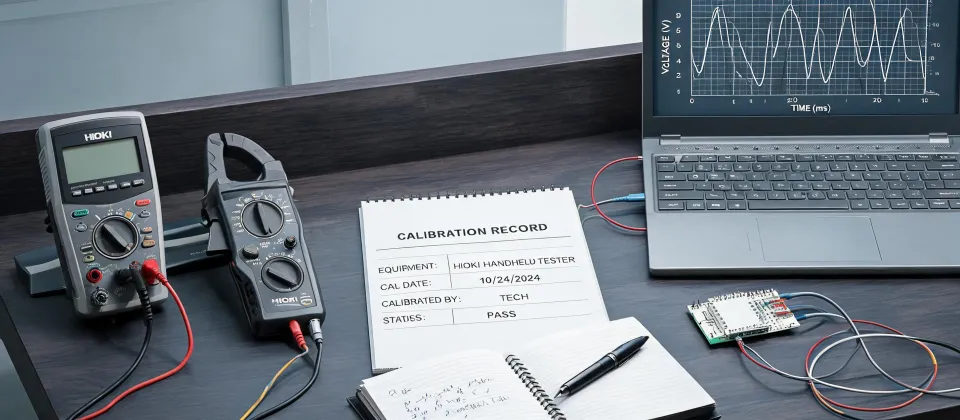
The most expensive test equipment is the one you trust without checking. If you're looking at Hioki test equipment in 2025, stop asking "which brand is safest" and start asking "does this unit meet spec, with documentation I can prove?" In my job, I review roughly 200 instruments a year, and I've rejected about 12% of first deliveries in 2025. Not because the brands were bad. Because calibration paperwork didn't match the serial number, or the accuracy spec was written in a way that meant nothing.
I'm a quality/compliance manager at an instrumentation company. I don't work for Hioki, and nobody pays me to say nice things about them. I do use their stuff, audit vendors who sell their stuff, and watch what breaks when people skip verification.
Why my quality checklist doesn't care about brand name
In my opinion, brand matters less than the verification system you put around it. A power analyzer with a flaky calibration certificate is worse than a simpler meter you can prove is accurate. That's not meant to be clever. It's the way measurement works.
I used to think the opposite. When I first started in quality, I assumed the biggest brand was the safest bet. Three incidents changed my mind: a "precision" vendor shipped a unit that drifted out of spec two weeks after calibration; another sent a certificate with the wrong serial number; a third listed an accuracy spec without a temperature range. None of those were cheap instruments. All of them got rejected.
The Hioki PQ3100 power quality analyzer: why it earned a spot in my kit
If you do any power quality work, you don't buy an analyzer based on the brand sticker. You buy it based on whether it can catch the event you're chasing. The Hioki PQ3100 power quality analyzer is good at that. It logs voltage, current, power, harmonics, and transients over time. More importantly, it can sit in a panel for days without being babysat, and the event capture is fast enough for intermittent sags.
I first assumed all power quality analyzers basically do the same thing. Then I compared one of my old loggers to the PQ3100 side by side on a motor circuit. The old logger recorded an RMS dip. The PQ3100 also showed the harmonic distortion before the dip and a transient spike after it. That extra context is what tells you why something happened, not just that it happened. If you've ever spent a week chasing an intermittent power problem, you know how much that's worth.
Digital thermometers: the maintenance blind spot
If you ask me, digital thermometers are the most ignored instruments in any plant. Maintenance teams buy one from a discount shop, check it against a "known good" thermometer once, and call it calibrated. That's not calibration. That's an opinion.
Hioki's digital thermometers are solid—I've specified them for our own maintenance team. But I've also rejected thermometers because the probe tolerance made total uncertainty two times worse than the instrument's accuracy spec. The sensor is where errors live. If the probe is corroded, the wrong type for the surface, or just old, the display will still give you a number. The number just won't mean much.
Pipette tips: same discipline, different channel
Now for the weird keyword: pipette tips. Pipette tips have zero to do with Hioki test equipment. But they make exactly the same point.
We audit lab suppliers too. A few years back, a rep sold us a "universal fit" tip at a great price. The first batch looked fine. When I compared the old tips and the new tips side by side—same pipette, same water, same balance—the new tips were off by more than 3% at the 200 µL volume. In a PCR assay, that's a lot. The vendor said "within normal tolerance." I asked what standard they were using. They didn't have one.
That was my moment of clarity: seeing two products that looked identical perform differently made me realize visual inspection is not verification. And the same is true for test equipment. You can't tell from the outside whether an instrument is accurate.
How to read a Fluke multimeter (and why it still matters)
One odd search term that lands people here is "how to read a fluke multimeter." Since a lot of plants still have a Fluke in a drawer, here's the short version. It applies to Hioki meters too, because the basics don't change.
- Select the right function. For AC voltage, choose V~ not V—. Most reading errors are function errors.
- Put the black lead in COM, the red lead in VΩ. For current, move the red to the A jack—and remember that fuse is there for a reason.
- Let the value settle. A meter autoranges; the first number is often a range-searching guess. Read the final stable digits.
- If it reads OL, it means overload or an open circuit. That's not zero—it means no complete circuit, or the value is beyond the range.
I'm not here to argue Fluke vs Hioki. Both make good meters. I use both. The important thing is that you know exactly what the meter is telling you before you make a decision based on it.
The "industry standard" trap
"Industry standard" is one of those phrases that means less every year. It's a legacy idea from an era when there were only a few dominant manufacturers and they all shared the same test conditions. Today, standards are specific: IEEE 519 for harmonics, IEC 61000-4-30 for power quality, ISO 17025 for calibration. If a vendor tells you something is "industry standard" and cannot name the standard, that's a red flag.
Per the FTC's business guidance, claims need to be substantiated. I keep that in mind when I read data sheets. If a spec says "accurate" with no test condition, I treat it as marketing. If it says "DC voltage accuracy ±0.05% of reading + 5 digits at 23°C ± 5°C," now we can have a conversation.
"Accurate" without a condition is not a measurement. It's a wish.
Source: FTC Business Guidance, ftc.gov.
According to USPS Business Mail 101, a letter envelope is no bigger than 6.125 by 11.5 inches and no more than 0.25 inch thick. Go over by a fraction and it's a different class. Nobody argues with the post office. We should be that exact about instrument specs.
Boundaries: when I wouldn't spec a Hioki
Honestly, the PQ3100 is not for everyone. If you just want to check a wall outlet, don't spend thousands of dollars on a power quality analyzer. A basic multimeter, or even a plug-in tester, is enough.
Similarly, I wouldn't spec a high-end digital thermometer for a walk-in cooler if you only need "cold enough to slow bacteria." A cheaper unit with a calibrated probe is the right call. The opposite is also true; don't use a cheap IR thermometer to verify an autoclave. Know the uncertainty you actually need.
I'm not 100% sure how many amp-hours the PQ3100 battery has—don't hold me to exact hours. But I've had it run through a multi-day survey without a problem. And if you're doing that kind of work, it's worth a demo.
What was best practice in 2020 still has some truth: buy quality, understand specs, verify before trust. The execution just looks different in 2025.