-
1. What makes Hioki test equipment different from Fluke or Keysight?
-
2. Is the Hioki DT4252 digital multimeter a good everyday meter?
-
3. Can I use a Hioki clamp meter as a clamp-on flow meter?
-
4. Which Hioki digital thermometer should I get for HVAC work?
-
5. How do I calibrate a Mettler Toledo pH meter with Hioki instruments?
-
6. Why is Hioki often cheaper than Fluke without being low-quality?
-
7. Is Hioki test equipment beginner-friendly or only for pros?
-
8. Where can I get my Hioki instruments calibrated with traceable standards?
I've been working with electrical test gear for over a decade. In that time I've bought the wrong spec, skipped calibration, and assumed 'clamp on' meant something different. Twice. So when people ask me about Hioki equipment, these are the questions I wish someone had answered clearly — before I wasted $400 on a mistake.
1. What makes Hioki test equipment different from Fluke or Keysight?
Hioki sits in a sweet spot. It's Japanese engineering — precision and reliability are real (this isn't marketing fluff). But they don't carry the same brand premium as Fluke. The result? You get a 0.5% basic DC accuracy meter like the DT4252 for roughly $200-250, while a comparable Fluke 117 runs $300+. Is Hioki better? For most industrial maintenance tasks, the difference is negligible. For high-end metrology labs, you'd pay for Fluke. The point: Hioki gives you 90% of the performance at 70% of the cost. (Not a perfect ratio, but close enough.)
2. Is the Hioki DT4252 digital multimeter a good everyday meter?
Yes — with one caveat. The DT4252 is a CAT III 600V, 6000-count meter with true RMS. It handles motor drives, VFDs, and power panels well. I've used mine for three years without a hiccup. The rotary switch feels solid (not the wobbly plastic you get on budget meters). But it lacks low-impedance (LoZ) mode. If you deal with ghost voltage often — say, troubleshooting long runs in industrial plants — you'll need to add a separate voltage tester. I learned this the hard way in 2022: spent $80 on a Solenoid tester after chasing phantom voltages for two days.
3. Can I use a Hioki clamp meter as a clamp-on flow meter?
Short answer: no. And I made this embarrassing mistake in 2019. Hioki's clamp meters — like the CM3286 — measure AC/DC current via the magnetic field around a conductor. A clamp-on flow meter uses ultrasonic or electromagnetic principles to measure liquid velocity in a pipe. Different physics entirely. If you need flow measurement, look at brands like Endress+Hauser or Siemens. One tool can't do everything. That's okay — specialists exist for a reason. (Note to self: read the product name twice before ordering.)
4. Which Hioki digital thermometer should I get for HVAC work?
For HVAC diagnostics, the Hioki 3447-01 or the infrared thermometer FT3355 are solid picks. The 3447-01 is a Type K thermocouple thermometer with dual inputs — good for delta-T across coils. The FT3355 is non-contact, great for quick surface temp checks on ductwork. I use both: infrared for initial scan, thermocouple for detailed readings. The cost? Around $150 for the 3447-01 (circa 2025). That's half the price of a Fluke 52-II, with similar accuracy (±0.1°C). One thing: the FT3355's emissivity is fixed at 0.95. If you're measuring polished metal, you'll get errors. Use electrical tape to normalize the surface (old trick my mentor taught me).
5. How do I calibrate a Mettler Toledo pH meter with Hioki instruments?
Here's the honest answer: you don't — at least not directly. The Mettler Toledo pH meter (e.g., SevenExcellence) needs certified pH buffers (4.01, 7.00, 10.01) for the actual calibration. A multimeter can't replace buffers. But a Hioki DT4252 can verify the voltage output of the pH electrode (in mV) as a sanity check. pH electrodes produce ~59.16 mV per pH unit at 25°C. If your electrode reads 177 mV in pH 4 buffer (theoretical: ~177.5 mV), you know the electronics are within 0.5%. That saved me a $200 electrode replacement in 2023 (surprise, surprise — the sensor was fine, the buffer had expired). For formal calibration, follow the Mettler Toledo procedure — don't skip it. Know what you're good at. Hioki handles voltage; pH calibration is the meter's job.
6. Why is Hioki often cheaper than Fluke without being low-quality?
Three things: marketing spend, distribution model, and feature targeting. Fluke spends heavily on brand awareness, distributor margins, and certification overhead (their meters are over-engineered for military specs many users don't need). Hioki focuses on industrial electricians and power quality engineers — a narrower audience. They skip the billboard ads and pass savings along. Also, Hioki doesn't include a premium for 'lifetime warranty' (Fluke's is a limited lifetime; Hioki offers 3 years). That warranty difference matters for heavy-use scenarios, but for occasional field use, it's overkill. I once compared a $280 Hioki CM3286 vs a $480 Fluke 375 FC — same basic functions, Fluke had Bluetooth. I paid $200 extra for a feature I used twice. Price isn't always value.
7. Is Hioki test equipment beginner-friendly or only for pros?
Mix of both. The DT4252 is straightforward — set the dial, read the display. No complex menus. But some Hioki models — like the 3196 Power Quality Analyzer — require understanding harmonics, transients, and sag thresholds. I bought a used 3196 in 2018 thinking I'd figure it out. Spent two weekends reading the manual. First measurement: wrong CT ratio setting, data garbage. Cost: 3 hours of rework. Beginner advice: Start with the handheld meters (DT4000 series). Move to power quality analyzers only after you've done at least 50 basic installations. And always read the manual's 'basic measurement' section before powering on. (Mental note: the 3196 manual is 400+ pages — print the quick start guide.)
8. Where can I get my Hioki instruments calibrated with traceable standards?
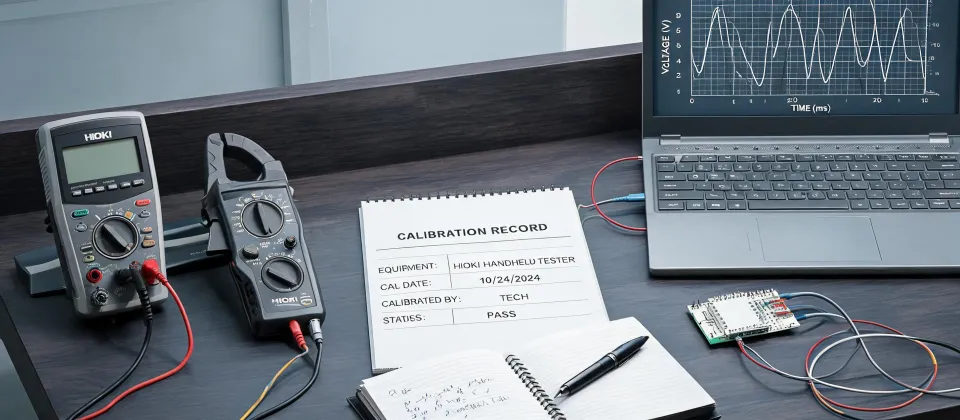
Hioki's own service centers (in the US: Hioki USA in Cranbury, NJ) offer ISO/IEC 17025 accredited calibration. Cost for a DT4252: roughly $85-120 depending on turnaround. Alternatively, third-party labs like Transcat or Tektronix can do it. I use a local lab with a 5-day standard turnaround — $95 flat (as of 2025). One trap: some budget calibration shops skip data points. Make sure they test at least 5 points per range and issue a NIST-traceable certificate. I once received a calibration sticker with 'Pass' but no raw numbers. Useless. Demand the data. It's the only way to prove your meter is good for critical measurements. (Not ideal, but necessary.)