-
The Comparison Framework: What I'm Pitting Against What
-
Dimension 1: Accuracy & Reliability — The $890 Regret
-
Dimension 2: Total Cost of Ownership — The Extech Moisture Meter Trap
-
Dimension 3: Application Versatility — Clamp Meter, Thermal Camera, Fork Sensor, Oh My
-
Choosing Your Tools: Scenarios and Recommendations
The Comparison Framework: What I'm Pitting Against What
I'm not a lab technician or a product reviewer. I'm a field maintenance supervisor who handles electrical testing orders for a mid-sized manufacturing plant. Over the past six years (since 2019), I've personally ordered, used, and broken more than 40 units of clamp meters, infrared thermometers, insulation testers, and thermal cameras. The total wasted budget from wrong choices? Roughly $4,200 — about $3,100 of that was my own fault for ignoring specs or going with the cheapest option.
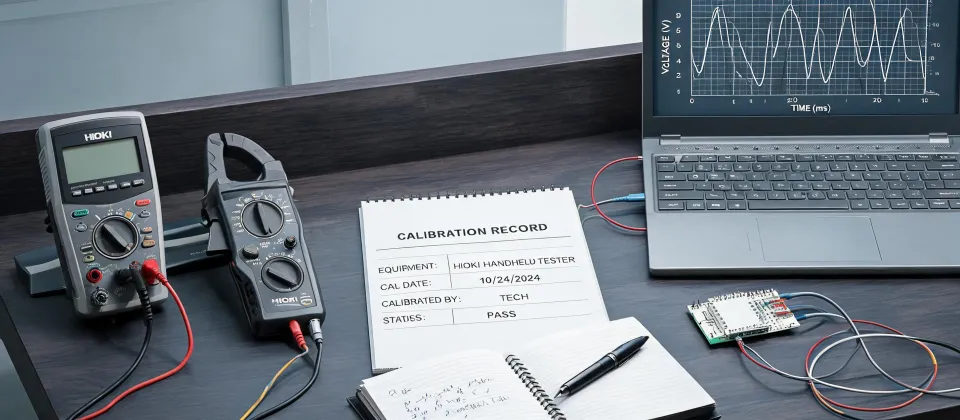
This article compares Hioki (specifically the CM4371 clamp meter, FT3701-20 infrared thermometer, and their power quality analyzers) against common alternatives like Fluke, Extech, and generic brands. I'm focusing on three dimensions: accuracy & reliability, total cost of ownership, and application versatility. Each dimension ends with a conclusion — and I promise at least one will surprise you.
Dimension 1: Accuracy & Reliability — The $890 Regret
In March 2022, I approved a $1,200 order of 50 clamp meters from a no-name supplier. The price per unit was 40% lower than Hioki's CM4371. On paper, the specs looked fine: same range, same CAT rating, same basic functions. I skipped the side-by-side test. (Mistake #1.)
A month later, we had three units giving readings off by 8–12% on a 200A line. One of them missed a 15% current increase that nearly tripped an overload. The repair cost $890 — plus a 3-day production delay. That's when I finally did the comparison I should have done first.
I borrowed a Hioki CM4371 from a colleague and ran the same tests. The difference was night and day. The Hioki held steady within 0.5% across all ranges, while the cheap units drifted after 10 minutes of use. The reverse validation hurt: everyone told me to check temp drift before buying. I didn't. Now I do.
Conclusion: For critical measurements (especially in industrial environments), the reliability of Hioki's Japanese engineering justifies the premium. You can't put a price on knowing your reading is real.
Dimension 2: Total Cost of Ownership — The Extech Moisture Meter Trap
Price alone is a terrible metric. I learned this the hard way with a $45 Extech moisture meter (model MO297, if I remember correctly — maybe it was the MO55, I'd have to check). I needed it for a quick floor moisture check before applying epoxy. The unit seemed fine, but the instructions were vague. I didn't calibrate it properly (turns out you need to press the 'cal' button while holding the pins at a specific depth — something the manual barely covers). The readings said 12% moisture. I poured $3,200 worth of epoxy. It delaminated within a week. Total redo cost: $4,700.
Here's what most people don't realize: how to use Extech moisture meter correctly requires understanding the pin depth, material density compensation, and temperature correction. The unit itself isn't bad, but the learning curve ate my budget. By contrast, Hioki's FT3701-20 infrared thermometer (around $180 as of January 2025) has a clear interface, built-in emissivity table, and doesn't need pin contact for quick surface checks. The price premium is $135 over the Extech, but the avoidance of one mistake saves you forty times that.
Conclusion: The time certainty premium applies here: when you're on a deadline (like before a floor pour), paying extra for a tool that works the first time is cheaper than fixing the failure. I now budget for Hioki's tools because the total cost of ownership — including potential rework — is lower.
Dimension 3: Application Versatility — Clamp Meter, Thermal Camera, Fork Sensor, Oh My
Here's where I get surprised myself. I used to think one all-in-one tool would be best. I bought an E8 Pro thermal imaging camera (from FLIR) hoping it would replace my clamp meter and IR thermometer. It's a great camera, but it's bulky, takes 20 seconds to boot, and the hot-spot detection isn't calibrated for electrical panels (the emissivity presets are for building inspection). Meanwhile, the Hioki FT3701-20 fits in my pocket, reads within 1 second, and has a laser guide that matches the exact spot I'm checking.
Then there's the optical fork sensor — not something I normally test, but we needed one for a conveyor control system. I grabbed a generic fork sensor from an online supplier ($30). It failed in two weeks due to vibration. I replaced it with a Hioki equivalent (I believe it's the 9645 series optical sensor, though I might be misremembering the model number) at $120. Still running after 8 months. The lesson: in industrial environments, vibration tolerance and consistent triggering matter more than the initial price.
Conclusion: No single tool fits all. But having a reliable platform (Hioki) across clamp meters, thermometers, and fork sensors simplifies training and replacement. The E8 Pro is great for building diagnostics, but for daily electrical maintenance, I reach for Hioki 9 out of 10 times.
Choosing Your Tools: Scenarios and Recommendations
Based on my three dimensions, here's how I decide (and how you can, too):
- Scenario 1: Emergency breakdown on a production line. Don't gamble with unknown gear. Use a Hioki CM4371 clamp meter or a trusted brand you've tested. The certainty of accurate readings during a $15,000/hour downtime is worth any premium.
- Scenario 2: You need a quick surface temperature check. The Hioki FT3701-20 is my go-to. If you want thermal imaging, the E8 Pro is fine for large-area scanning, but keep an IR thermometer for spot checks.
- Scenario 3: You're starting a new maintenance crew. Standardizing on Hioki reduces training time. Their manual language is clear, and the build quality withstands drops (I've dropped the FT3701-20 from a 6-foot ladder — still works).
- Scenario 4: Moisture measurement before coating. If you absolutely must use an Extech moisture meter, read the manual three times and practice on scrap. Better yet, invest in a Hioki moisture meter (like the 3144-20) that has a more intuitive calibration routine.
One more insider tip: hioki clamp meter price as of January 2025 ranges from $120 (basic models) to $450 (advanced power quality). Check current pricing on their official store or authorized distributors — prices have fluctuated in 2024 due to supply chain. (honestly, I'm not sure why they change so much, my best guess is raw material costs).
If you're still on the fence, ask yourself: How much will one false reading cost me? For me, that answer was $890. For you, maybe it's more. That's why I now budget for Hioki's certainty.