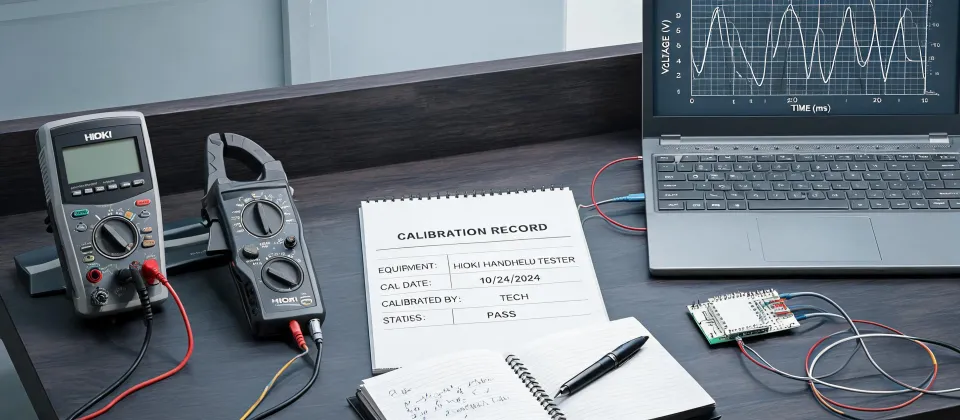
There is no single 'best' instrument
I'm an emergency maintenance specialist at an industrial equipment company. I've handled 200+ rush troubleshooting calls in 12 years, including same-day turnarounds for food processing and automotive clients. When I'm triaging a rush order, I don't start with brand names. I start with what we're actually measuring.
That sounds obvious, but most buyers focus on price and completely miss the measurement scenario. The question everyone asks is 'which meter is best?' The question they should ask is 'what fails if I get this wrong?'
Here's how I split it. Four scenarios cover maybe 90% of emergency maintenance calls: A) intermittent electrical faults and power quality, B) hot spots and non-contact temperature checks, C) position sensing in dirty or wet environments, and D) dimensional verification with digital calipers. Each one points to different gear.
What was best practice in 2020 may not apply in 2025. The fundamentals haven't changed, but the execution has transformed. Safety standards, sampling rates, and wireless data have moved. Still, old-school verification—checking with a second method—remains non-negotiable.
Scenario A: You're chasing an intermittent electrical fault
This is the classic 'it works until it doesn't' call. Motors trip at random. Breakers nuisance-trip. A standard digital multimeter can tell you voltage and continuity, but it won't catch a 2 ms voltage dip or a harmonic spike.
In March 2024, a client called at 11:40 p.m. needing a power quality survey for a packaging line. Normal turnaround for a full analysis was 5 days. We grabbed a Hioki PW3198 power quality analyzer, paid $400 extra in rush shipping, and delivered a report by 6 a.m. The client's alternative was another day of downtime at roughly $8,000 per hour. That analyzer caught a 3rd harmonic issue that a basic meter missed completely.
When I compared a $200 clamp meter and the Hioki PW3198 power quality analyzer side by side on the same panel, I finally understood why bandwidth and sampling rate matter. The clamp meter showed 'normal.' The PW3198 showed the transient that was frying a drive.
If your issue is fast, intermittent, or related to harmonics, sags, or swells, you need a power quality analyzer first. An oscilloscope can help for signal-level debugging, but for three-phase power work, a dedicated analyzer is usually safer and faster. Hioki's PW3198 is one option I trust for that job, though I should note it's overkill for simple voltage checks.
Scenario B: You need a fast temperature check
Thermal problems don't always announce themselves. A loose lug, a failing bearing, or a blocked vent can run hot for weeks before failure. This is where a non-contact infrared thermometer earns its place.
The Hioki FT3701-20 infrared thermometer is a good example of a tool that's simple but not trivial. It gives you spot temperature readings without touching live equipment. That matters when you're standing in front of a 480 V panel and the clock is ticking.
Never expected the biggest issue to be user error. Turns out most bad readings come from wrong emissivity settings or measuring too far from the target. The surprise wasn't the instrument's accuracy. It was how much technique affects the number on the screen.
Use infrared for quick scans: bearings, couplings, busbars, panels, and steam traps. For critical readings, verify with a contact probe or thermal camera. As of January 2025, Hioki's published specs for the FT3701-20 list a distance-to-spot ratio and laser pointer, but you should verify current details at Hioki's official site because specs can change.
Scenario C: You need position sensing in a harsh environment
Ultrasonic proximity sensors are the underrated workhorses of emergency maintenance. They detect objects without touching them, and they don't care about color, transparency, or surface finish the way optical sensors sometimes do.
I only believed this after ignoring it once. We had a wet, dusty packaging line where photoelectric sensors kept false-triggering. They warned me about condensation. I didn't listen. The line stopped three times in one shift. We switched to an ultrasonic proximity sensor and the false trips dropped to zero.
The catch: ultrasonic sensors have a wider beam and slower response than laser sensors. They're great for tank level, roll diameter, and web loop control. They're not ideal for tiny parts moving at high speed. If your target is small, fast, and clean, optical may still win.
This is a good place to think about total cost, not just unit price. A cheaper sensor that fails every 3 months costs more than a reliable one that lasts 5 years. Hioki doesn't make every sensor type, so for ultrasonic proximity sensors you may need a specialist. But for the electrical testing side, Hioki covers a lot of ground.
Scenario D: Your digital caliper is acting up
Dimensional checks are usually calm work—until a caliper starts flashing an error code before a first-article inspection. If you're searching for how to reset a Mitutoyo digital caliper, start with the manual for your exact model. On many Mitutoyo digital calipers, a common reset sequence is: remove the battery for 30 seconds, reinsert it, then press and hold the ORIGIN button until the display resets. For ABS models, pressing ORIGIN restores the absolute origin. For standard models, ZERO sets a temporary zero.
Don't force it. If the display flickers or shows 'E,' check the battery first. Low battery is the most common cause of weird caliper behavior. Clean the measuring faces and the slider with a dry, lint-free cloth. If the error persists, the caliper may need service.
I keep a Hioki digital multimeter in the same drawer for checking battery voltage. It sounds like overkill, but a 10-second voltage check has saved me from sending a perfectly good caliper out for repair. That said, this is not a Hioki caliper—Mitutoyo owns that space. Respect where the expertise lives.
How to tell which scenario you're in
Ask three questions:
- What is the failure mode? Intermittent electrical? Heat? Position? Dimension?
- What happens if I get a wrong reading? A nuisance trip is different from a safety incident or a scrapped production batch.
- Do I need a trend or a snapshot? Power quality and thermal issues often need logging. Dimensional checks usually need a single trusted number.
If you're still unsure, go with the tool that matches the worst-case consequence, not the lowest price. A $300 meter that misses a transient can cost $30,000 in downtime. A $1,200 analyzer that finds it pays for itself once.
Hioki's advantage is breadth: power quality analyzers, clamp meters, digital multimeters, insulation testers, data loggers, LCR meters, infrared thermometers. For oscilloscope work, you may choose a dedicated scope or a Hioki memory recorder depending on bandwidth and channel count. For ultrasonic proximity sensors, look at automation specialists. For Mitutoyo caliper resets, follow Mitutoyo's documentation.
The industry keeps evolving. Tools that were lab-only five years ago are now field-ready. But the best instrument is still the one that answers your specific emergency question. Pick the scenario first. Then pick the tool.