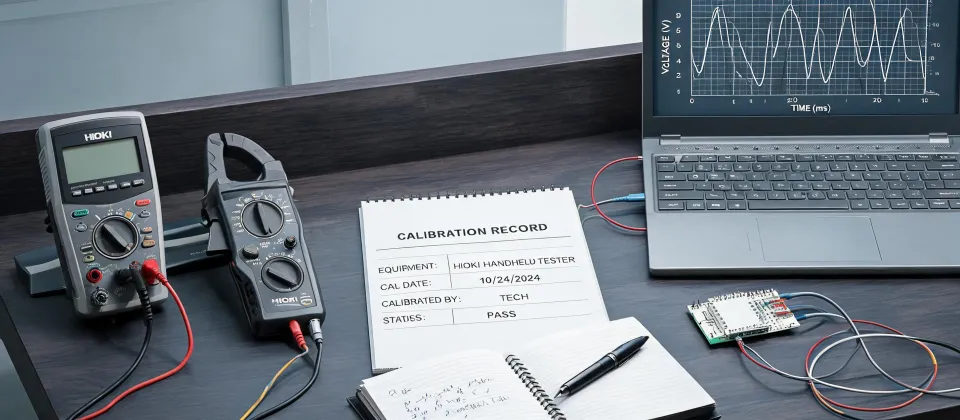
I remember the call vividly. It was a Thursday afternoon, and a client—let's call him, a senior electrical engineer at a large manufacturing plant—was panicking. He had two sets of readings: one from his old trusty clamp meter, and one from the shiny new industrial unit they'd just bought to be 'more accurate.' The discrepancy was 3.5%. Not a lot, you'd think. But for the harmonic distortion analysis he was doing, that 3.5% could mean the difference between a clean power system and millions of dollars in potential downtime costs. He asked me, 'Which one is right?'
That's the question nobody wants to ask themselves. And it's the exact problem we're going to unpack here. It’s not about which brand is 'better.' It's about a fundamental truth of field measurement: If your test tools don't agree, you don't have a solution. You have a new problem.
The Surface Problem: You Can't Trust Your Results
The surface problem is what my client experienced: conflicting data. He was losing time, second-guessing his own expertise, and wasting money on repeat site visits. This is the classic pain point. You invest in a Power Quality Analyzer, like the Hioki PQ3198, or a high-end Digital Multimeter, expecting total clarity. Instead, you get ambiguity. In my role coordinating instrumentation for critical infrastructure clients, I've seen this blow up budgets on at least six major projects in the last two years.
Most people stop here. They think, 'I need to buy a single, more expensive brand for everything.' But that's a simplistic fix. That's treating the symptom, not the disease. The assumption is that brand consistency equals measurement consistency. The reality is much more nuanced.
The Deep Cause: It’s Not the Brand, It’s the Reference
Here’s what most engineers miss: the accuracy of any field instrument—be it a Hioki Clamp Meter, a Flir Thermal Camera, or a universal weighing system for load cells—is a matter of traceability. It’s not just about a manufacturer's spec sheet. It’s about the chain of calibration back to a national standard (like NIST in the US).
People think [Brand A is more accurate than Brand B]. Actually, [One instrument was calibrated 2 months ago, and the other was calibrated 11 months ago]. The causation runs the other way. Even within the same brand, a unit that is due for calibration will drift. I’m not a metrology expert, so I can’t speak to the intricacies of 1-2 micrometer drift on a precision standard. What I can tell you from a field operations perspective is that the window sticker on the side of your meter—the one that says 'Cal: Paid'—is the single most important piece of data on the tool.
So the deep cause of your measurement conflict isn't 'Hioki vs Fluke.' It's 'Calibrated vs. Uncertain.' You are likely comparing a known quantity against a known unknown. This gets into internal company policy territory, which isn't my expertise. I'd recommend consulting your quality assurance lead. But I can tell you that a technician using a Hioki DT4256 Digital Multimeter that was certified last week will give a more reliable reading than a competitor's flagship unit that has been kicking around the back of a service van for a year.
The Price of Inconsistency: More Than Just Time
So, what happens when you base a maintenance decision on a measurement that's off by 1-2%? It depends. Worst case? You shut down a line for a fault that doesn't exist. A large-scale project I consulted on in March 2024 had a 36-hour deadline to commission a new substation. The engineer had a reading from a thermal camera—a Flir vs Fluke debate type situation—that showed a 'hot spot.' It was just a calibration drift on the older unit. We paid $1,500 extra for an emergency calibration service, but the alternative—pulling the switchgear based on bad data—would have meant a $50,000 penalty clause and a factory sitting idle for three days.
If you're working with luxury or ultra-budget segments, your experience might differ. But in my world of B2B infrastructure, the cost of uncertainty is always higher than the cost of the right tool. The $200 difference between a standard 1000V digital multimeter and a precision model like the Hioki DT4256 is negligible when you consider a 6-figure asset it’s protecting.
Your Toolkit: A Strategy, Not a Line Item
Here's my simple take. Don't fall for the 'Brand X vs Brand Y' trap. Those comparisons are useful for initial features, but they're toxic for operational consistency.
Standardize on a calibration schedule, not a brand. Pick a manufacturer—like Hioki—that offers a comprehensive product line from Power Quality Analyzers to standard Clamp Meters so you can manage that traceability chain. Use a comparator tool for features, but use your data sheet for the decision. And when you need to check a 1-2 micrometer tolerance on a part? Don't use your electrical meter. Use the calibrated weighing system or micrometer that is specifically rated for that job.
My experience is based on about 200 orders for critical field equipment. If you're working with luxury or ultra-budget segments, your experience might differ. But the principle holds: Trust the tool, trust the tech. But always verify the cert. That’s how you stop your data from lying to you.