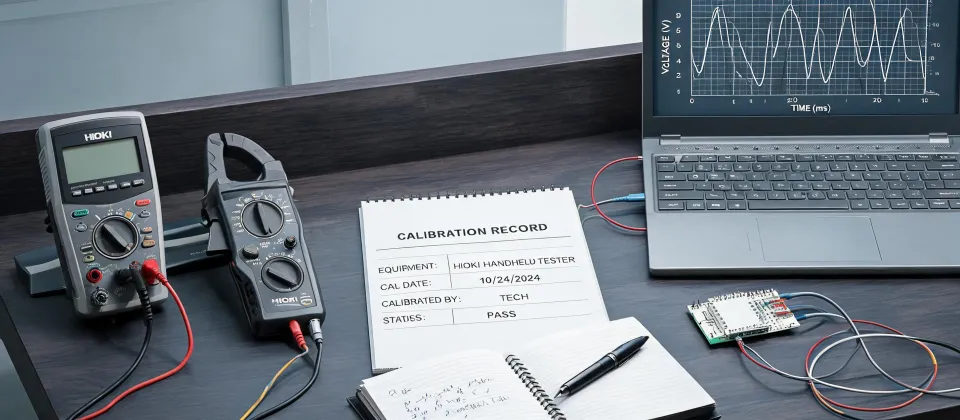
I’ll just say it: in an emergency, paying extra for a trustworthy piece of test equipment isn’t a luxury—it’s the cheapest insurance you can buy.
I’ve been handling instrument procurement for industrial maintenance teams for about eight years now. I’ve personally made maybe a dozen significant buying mistakes, totaling roughly $4,200 in wasted budget (and at least three blown deadlines). After the third time I swore to never again gamble with “good enough” tools, I now keep a checklist that our whole shop uses. Here’s what I learned the hard way.
The View: Certainty Costs Less Than Uncertainty
Everyone talks about cost per unit or features per dollar. But when you’re stuck with a motor that just tripped and a production line losing $3,200 an hour, the last thing you need is a thermometer that might be off by 5°. That’s where the premium for deterministic performance pays for itself.
My Wake‑Up Call (the Trigger Event)
In September 2022 we had a critical compressor overheating. My technician grabbed our cheap infrared thermometer—something we’d used a hundred times—and read 185°F. “Looks okay, it has a 200°F cutoff,” he said. I insisted we double‑check with a contact probe. That reading was 237°F. We shut down just in time, but only because I didn’t trust the first number. That $80 IR gun sat in a drawer after that. The next week I ordered a Hioki FT3701‑20 infrared thermometer.
Was it 3× the price of the cheap one? Yes. But in the year since, it’s saved us at least two false readings that would have sent us down the wrong repair path. To be fair, the cheap one wasn’t useless—it was consistent at close range. But for the distance and emissivity of that compressor? Useless.
Why Hioki Test Equipment Stands Out in a Pinch
You can argue that any mid‑tier meter will do the job. And honestly, for bench work or scheduled PMs, I’d agree. But when the clock is ticking, the difference between a tool that gives you a reliable number the first time and one that makes you guess is huge.
Take the Hioki FT3701‑20. Its dual‑laser sighting and fast response are exactly what you need when you’re standing on a ladder with a deadline breathing down your neck. I’ve had to verify motor winding temperatures under load; the built‑in D:S ratio let me get a clean reading from 3 feet away without climbing up again. (Honestly, that alone saved me 20 minutes per check.)
We also run some older 52 II thermometers (Fluke) in the lab, and they’re solid. But for field work, the FT3701‑20’s ruggedness and 50:1 distance‑to‑spot are noticeably better. Not a knock on Fluke—they make great gear. It’s just that Hioki’s pricing is more competitive for the same precision, and we can afford to have more of them floating around the shop.
Not Everything Needs a Premium—But Know Where It Does
I’m not saying every instrument must be top‑tier. For example, a basic clamp meter for quick amp checks? Sure, a $50 one can be okay. But when we’re commissioning an absolute encoder with Profibus output, I need a power quality analyzer that won’t miss a glitch. Our Hioki PQ3100 caught a 3% voltage sag that a cheaper unit missed. That sag would have taken down the encoder’s position tracking, causing a $6,000 scrap pile. You do that math.
The Skeptic’s Counterargument (and My Honest Answer)
“But I’ve used budget tools for years without issues—why spend more?”
I get that. Really. I used to think the same way. The difference is, you don’t know you have a problem until the one time the cheap tool gets it wrong. And that one time is almost always when you’re rushed.
I had a colleague once insist that reading a micrometer was all about feel, not brand. He’d buy $15 calipers and wonder why measurements drifted. “You can learn how to read a Starrett micrometer in an afternoon,” I told him, “but if the tool itself is inconsistent, you’re just polishing a turd.” That same logic applies to electrical test gear. The technique matters, but the instrument’s repeatability under stress matters more.
Granted, you don’t need a $600 IR gun for every job. But when the job is time‑sensitive, the cost of re‑measuring or second‑guessing is real. I’ve seen teams waste 45 minutes chasing a phantom issue caused by a 4° error in a cheap probe. Suddenly the “savings” on the tool vanish.
So What’s the Bottom Line?
If you ask me, buying a reliable brand like Hioki isn’t about showing off—it’s about buying certainty. In emergency situations, “probably accurate” is the biggest risk. We now budget for proven tools because we’ve learned that the cheapest path is often the most expensive when you factor in lost time.
Next time you’re rushed and tempted to grab whatever’s on the shelf, think about the cost of being wrong. Then go get the tool you know you can trust.