In my role coordinating emergency field service for industrial plants, I've handled 200+ breakdown calls in the last three years. Same-day turnarounds, 1 a.m. motor failures, weekend line stops. I've seen the same pattern enough times to recognize it in the first five minutes of a call.
Here's the first thing I learned: the fault is almost never where you think it is.
Take a situation from March 2024. A food packaging plant lost a servo drive at 11:30 at night. Their line normally runs six hours per shift, and they had a fully loaded contract the next morning. The maintenance team had already swapped the drive, verified supply voltage at the panel, and replaced the motor leads. Everything checked out. The new drive still tripped within fifteen minutes of startup.
So what was actually wrong? The motor's insulation had been degrading for months. A multimeter — even a high-end one — shows nothing because the test voltage is way too low. It's basically a surface check. What most people don't realize is that insulation breakdown only shows up when you hit the winding with 500V or 1000V.
If you've ever spent an hour testing a circuit with your multimeter and found everything 'fine' while the machine still won't run, you know that sinking feeling. Trust me on this one: it's rarely the tool that's lying. It's the testing strategy using the wrong tool for the question.
The Surface Problem: Everything Tests 'Fine' But Nothing Works
Here's what the average troubleshooting session looks like in a plant: grab the DMM, check phase-to-phase voltage, check continuity on the contactors, maybe check resistance on the motor windings. If the numbers look reasonable, the conclusion is 'the equipment is fine', and the real problem must be somewhere else.
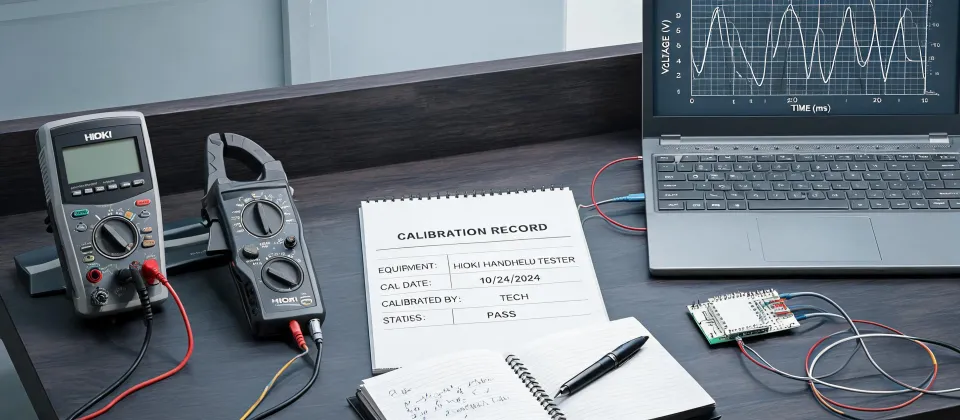
But here's the thing — a digital multimeter answers a very specific set of questions. Voltage. Continuity. DC resistance. That's basically it. A Fluke 17B+ or a Hioki DT4256 (honestly, any decent meter in your bag) is a workhorse for those checks. But it can't see what's happening at 1000 volts, at 100 kilohertz, or over time.
And that gap is where repeat failures live.
The Deep Problem: Four Misconceptions That Cause Most Repeat Failures
The goal of troubleshooting is to compress the time between 'something's wrong' and 'this is exactly what's wrong.' Every misconception below extends that time. Some cost you hours. Some cost you the whole night.
1. Your Multimeter Can't Measure Insulation
From the outside, it looks like testing insulation is the same as testing resistance. The reality is completely different. A DMM applies a tiny test voltage (usually under 1 volt) and measures whatever current flows through the conductor. That tells you if a wire is broken or shorted. It tells you nothing about the condition of the insulation around it.
Insulation is supposed to block current. As it ages, moisture and contaminants create leakage paths — but those paths aren't visible at 1 volt. They show up at 250V, 500V, or 1000V, when electrical stress forces the weak spots to reveal themselves.
What most people don't realize is that a motor winding can test perfectly on a DMM and still be dangerously leaky under stress. That's why the industry uses insulation resistance testers (megohmmeters) for this job. For motor testing, IEEE Std 43 recommends a 500V test for windings rated under 1000V, and a 1000V test for windings rated 1000V to 2500V. A specialized meter like the Hioki IR4056 gives you five test voltages (50V, 125V, 250V, 500V, 1000V) in a handheld package, so you're not dragging a lab instrument onto a dirty plant floor. Its CAT III 600V rating (per IEC 61010-1) is what makes it safe to use on distribution-level circuits — 480V motor feeders, panels, the works.
That servo drive in March? The winding tested at 0.4 megohms to ground at 1000V. The DMM showed infinite resistance. The motor was passing the 'basic check' and failing the only test that mattered.
2. Resistance Isn't Impedance
Here's something vendors won't tell you: a DC resistance reading from a multimeter can look perfectly fine on a capacitor, an inductor, or a filter, while the component is completely failing at the frequency it actually operates at.
Think about it this way. A DMM measures resistance at DC — no frequency. But motors, transformers, capacitors, and filters are frequency-dependent devices. Their behavior changes as frequency goes up. A capacitor might test fine at 1 kHz but show a low insulation resistance at 100 kHz. That's why harmonic filters fail in variable frequency drives while passing every 'test' a standard multimeter can throw at them.
An LCR meter (which stands for inductance, capacitance, resistance — Hioki's IM3536 is the one I usually recommend) measures components under actual AC test signals at multiple frequencies. It changes how you diagnose a drive fault. Instead of replacing the drive three times before finding the damaged DC-link capacitor in the filter, you find the capacitor on the first pass.
When a drive trips on overvoltage and all the voltages check out on paper, the filter capacitors should be the second thing you look at — right after wiring, and before you start replacing boards.
3. Spot Checks Miss Intermittent Faults
Some failures only happen when a machine is hot, under load, or two hours into a shift. You show up, test everything, and find it all working because the machine has had time to cool down. Classic intermittent fault trap.
This is where the efficiency argument comes in. The traditional response is: install a data logger, wait a week, come back, download the data. That's slow. And if the fault is vibration-related, the logger might not even be attached to the machine (think about how often you've strapped a vibration logger to a junction box because you couldn't reach the bearing housing).
Wireless vibration sensors — like the Hioki VWV002 — change that equation. It's a small sensor you mount directly on the motor or pump casing, and it streams acceleration and vibration velocity data continuously to your phone or computer. ISO 10816 sets the severity zones for machine vibration, but you can't apply it if you only have five minutes of data under no-load conditions. With the VWV002 running for a full day, you get the complete picture. Plus, you actually see the bearing fault developing in the velocity spectrum — no guesswork.
(As of January 2025, wireless transducers still carry a premium over basic data loggers. But compare that to the cost of one unscheduled shutdown and the math works out pretty fast.)
4. Thermal Cameras Can't See Through Glass
It sounds like a simple question: 'Can thermal cameras see through glass?' The honest answer is no. Glass reflects long-wave infrared — it doesn't transmit it. And since most thermal cameras, including FLIR's entire long-wave lineup, operate in the 7–14 µm range, what you see through a window is the temperature of the glass surface plus reflected radiation from your own body and nearby heat sources.
People assume thermal imaging gives you X-ray vision. It doesn't. In fact, looking through a glass panel to 'check' a motor or breaker is one of the fastest ways to get a misleading reading. The cold spot on your screen is likely a reflection, not a cold component.
The right way to inspect energized panels without opening them is an IR window — the good ones use germanium, not glass, precisely because germanium transmits IR. Open-panel inspection works too, if your facility safety protocol allows it. But glass is not a measurement window, no matter how clean it looks from the outside.
What This Actually Costs
The upside of skipping the insulation test was saving 10 minutes. The risk was a misdiagnosis, another shutdown, and a potential arc flash hazard. I kept asking myself: is 10 minutes worth getting it wrong again?
I've watched this loop play out in real time, more times than I can count. First visit: basic checks, no fault found. Second visit: replace the drive. Third visit: replace the motor. Fourth visit: someone finally brings an insulation tester and finds the cable between the drive and motor has been sitting in a water-damaged conduit for years. The repair cost $800. The downtime across four visits was the real cost — in that March 2024 case, the line stopped for 11 hours across two days. At that plant's revenue rate, that's well over six figures.
I track the root cause of emergency call-outs we receive. Last quarter alone, 47 rush orders. A full 30% traced back to one of the four misconceptions above. Not failed components — failed testing strategies.
The Fix: Asking the Right Question First
Bottom line: you don't need to buy every instrument Hioki (or Fluke, for that matter) makes. You need the right instrument for each type of question, and a clear trigger for when to switch:
- Basic checks. Voltage, continuity, resistance, frequency — your DMM (the Fluke 17B+ is still a solid workhorse, and Hioki's DT4200 series competes directly on this) handles it. Ask these first.
- Insulation integrity. Use an IR4056 or equivalent whenever a motor, cable, or transformer fails randomly — or before you condemn a component as 'good'. Keep IEEE 43's voltage guidelines in mind.
- Component-level diagnosis. When drives trip on overcurrent or overvoltage, grab an LCR meter and check filter capacitors and inductors at their operating frequency — not just at DC.
- Intermittent mechanical faults. Mount a wireless vibration sensor (the VWV002 works well here) and let the machine tell you what's wrong over 24 hours.
- Thermal inspection. Use an IR window or open the panel following your safety protocol. And repeat after me: glass doesn't transmit IR.
This is an efficiency issue, not a spending issue. Every tool on that list pays for itself the first time it prevents a second visit. The goal isn't to impress anyone with your equipment — it's to get from 'something's wrong' to 'here's exactly what's wrong' in the shortest, safest, most defensible path.
Bottom Line
When I'm triaging an emergency call, the first question is never 'what is the machine doing?' It's 'what did you test it with?' In my experience, that single question reveals the root cause more often than any measurement.
Take it from someone who's done 200+ of these: the tool doesn't solve the problem. The question does. But the right tool answers the question a lot faster than the wrong one ever will.