On a Tuesday morning in February 2024, I got an email with the subject line: “HPLC pump down—need your help.” I started typing a reply that said “wrong person?”, deleted it, and walked to the lab.
I'm the office administrator for a specialty chemical company with about 140 employees across two buildings. I handle purchasing and vendor coordination for operations and QC—roughly $200,000 a year in orders spread across 20-plus suppliers. I know POs, invoices, and calibration schedules. I do not know chromatography pump internals. But when a subject line like that lands in your inbox, “wrong person” isn't an option.
Kevin, one of our senior lab techs, filled me in. The preparative HPLC system was throwing pressure spikes every few minutes. The drive would run for a while, fault, and reset. The service company's first instinct was to quote a full pump head replacement—$4,800. Before we authorized it, the engineer on the phone asked a question that changed how I buy test equipment:
“Have you checked the incoming power and the pump motor insulation with a meter you trust?”
10 Multimeter Models Over Three Years, and Nothing We Trusted
I pulled our purchase history and found line items for 10 multimeter models in the prior three years.
Ten.
That should have meant we had meters everywhere. Instead, the lab tool drawer contained three generic units with scratched faces, one dead 9V battery, and a general sense that a multimeter is a multimeter until it isn't.
I'm not an electrician, so I used to buy by price. The spec sheets looked similar: AC/DC voltage, resistance, continuity. What I didn't know was that not all meters can catch an intermittent fault. Some don't have useful min/max recording. Some don't have the safety ratings you'd want around industrial equipment. And when Kevin tested the one we had left on the bench, it gave him a nice stable voltage reading that turned out to be misleading.
That's when I learned the difference between buying a thing and buying a measurement.
The Hioki Multimeter Price Question I Almost Got Wrong
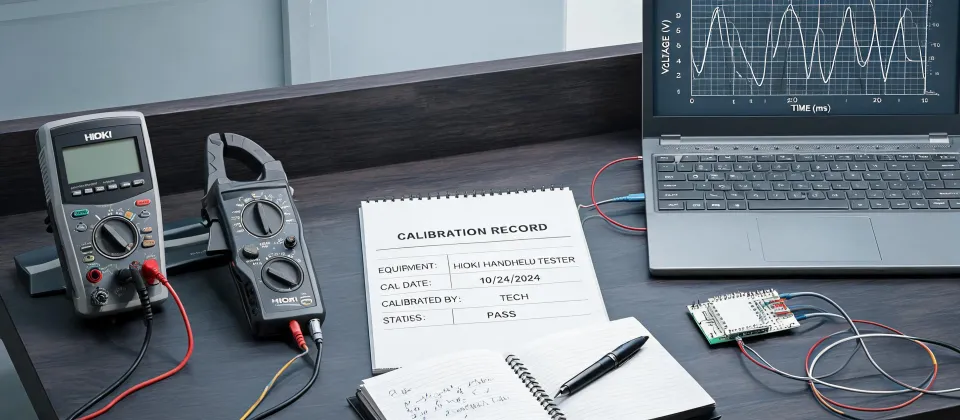
Kevin called our usual electrical distributor and asked for something reliable, fast. The distributor recommended a Hioki multimeter—the DT4256—and a Hioki insulation tester—the IR4056. I looked at the quote and did what any admin buyer would do: I winced.
Don't get me wrong—the Hioki multimeter price wasn't outrageous. It was mid-range compared to some of the alternatives I'd bought before. But I had budgeted for “a couple of cheap meters” and here I was staring at a quote for two instruments that came to about $620 including leads and a case. The distributor pointed out that one day of the service vendor's travel plus diagnostic time was already $1,200 before any parts. The quote I was hesitating on was half that. And if it kept us from paying for a $4,800 pump head we didn't need, it would be the best equipment purchase I made all year.
I approved it.
HPLC Pump Troubleshooting: What the Cheap Meter Missed
Dave, our senior electrician, started where the phone engineer pointed. Using the old generic meter, the HPLC pump's incoming voltage looked acceptable—around 208 V. The pump head theory seemed right. But when Dave switched to the Hioki multimeter and set it to capture min and max over a few minutes, he caught the supply dipping to 92 V for a second or two during every pressure spike.
Then he used the Hioki insulation tester on the pump motor. This is the part where I have to be careful, because I'm not a motor engineer. My understanding is that the motor winding's insulation had degraded over time—moisture and years of use. When the motor got warm, the leakage path got worse, the drive saw the fault, and the system started throwing the same pressure errors.
The generic meter couldn't show that, because an insulation resistance test isn't a normal resistance test. It applies a known test voltage—usually 500V or 1000V DC—and measures how well the insulation holds. A healthy motor might show tens or hundreds of megohms. Dave saw something that made him stop and call the motor shop.
Actual repair: a replacement motor and a few hours of labor, around $780. No pump head replacement. No $4,800 quote.
Here's the thing about HPLC pump troubleshooting that I didn't appreciate before: pump faults aren't always about check valves, seals, or pistons. Sometimes they're electrical, and if you don't have tools that can see the problem, you'll replace the wrong part. (Note to self: this is why the service engineer asked about the meter first.)
Then Someone Handed Me a Rice Lake Calibration Sheet
About a week later, while we were still closing out the HPLC repair paperwork, our QA coordinator asked me to look at a calibration certificate that came back with one of our lab balances. The balance was a Rice Lake unit used for QC sample weighing. She wanted to know if it met our internal acceptance criteria before she released the batch records that depended on it.
I opened the PDF and realized I couldn't actually read it.
I could find the “Calibrated” stamp. But the rest was a table of loads and readings that might as well have been in another language. I'm a buyer, not a metrologist. Yet I was the one who filed the paperwork and paid the invoice, which meant I was also the one who was supposed to confirm the service was acceptable.
The calibration provider was kind enough to walk me through it. Turns out it's not that complicated once someone explains it.
How to read a Rice Lake weighing systems calibration sheet
I don't claim to be an expert, and I'd still defer to a proper quality department on a formal decision. But for anyone like me who just needs to know whether to file the certificate or call the vendor back, here's what I check now:
- Instrument identity. The sheet should clearly show the scale's make, model, serial number, capacity, and readability—the smallest division it displays. If that doesn't match the asset tag on the physical scale, stop there.
- Test equipment used. There's usually a list of test weights, including nominal mass, weight class like Class F1 or F2, and the certificate number that traces those weights back to a national standard. No traceable weights, no valid calibration.
- Test points. A typical Rice Lake weighing systems calibration sheet will show readings at several points—commonly zero, quarter capacity, half capacity, three-quarter capacity, and full capacity. The “applied load” column should match what your process actually weighs. If you only weigh 5 kg but the calibration was done at 30 kg, ask for more test points.
- As-found versus as-left. This was the big one. The “as-found” reading is what the scale did before anyone adjusted it. The “as-left” reading is what it did after adjustment. If a technician only records the as-left values, you have no way to know whether the scale drifted out of tolerance during its service interval.
One more thing that surprised me: if the as-found values are outside tolerance, the scale can still be adjusted and pass as-left. But any measurements taken on that scale before the adjustment date might have been based on bad readings. Resolving that isn't the calibration lab's job—it's your company's job.
That's the kind of nuance you don't get when the certificate only says “PASS.”
Bottom Line: Buy the Tool, Read the Record
This whole sequence changed how I buy instruments for our teams.
I don't think I'll ever become the person who gets excited about true RMS specs. But I now understand that a meter is a tool for making decisions. If the decision is worth $4,800, you shouldn't be making it with a $20 meter that can't catch an intermittent fault. The Hioki gear paid for itself in one morning.
The calibration sheet lesson is similar. A piece of paper with a “PASS” stamp feels like compliance. But the real value is in the details: the traceable weights, the test points, the as-found versus as-left readings. That's what tells you whether the data from that instrument is something you can defend.
I'm still the office administrator who manages vendors and purchase orders. I still don't pretend to be an engineer. But I now buy test equipment the way I buy anything else that matters—by asking what it needs to do, what happens if it's wrong, and whether the “cheap” option actually saves money once you count the risk. It rarely does.