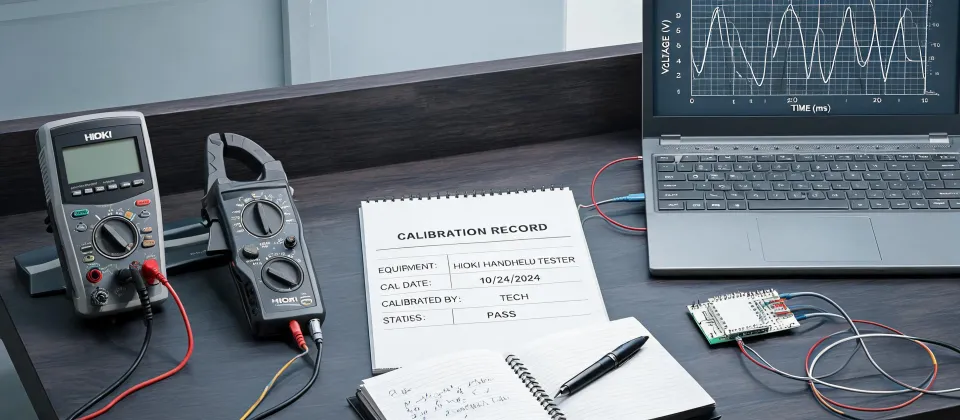
In February 2024, I nearly signed a purchase order for every test instrument our plant needed, all from one "convenient" distributor. If it hadn't been for one question about calibration paperwork, we'd probably be dealing with a failed audit right now.
I'm the office administrator for a 240-person pump rebuild company. People assume that means I order printer toner and book meeting rooms. It also means I manage industrial supply purchasing—roughly $300,000 a year across 12 vendor categories, reporting to both operations and finance. When our annual audit flagged that several calibration certificates in the maintenance department had lapsed, the job of fixing it landed on my desk.
That's how I found myself in the rabbit hole of electrical measuring instruments, bore micrometers, infrared thermometers, and pH meters. What I learned is that you can't buy test equipment like you buy office chairs. A specialist beats a "one-stop shop" every time.
The vendor who said "yes" to everything
My first move was familiar: find one supplier that could handle the whole list, negotiate a package price, and get everything on a single purchase order. That's smart buying for toner, furniture, and office supplies.
With test equipment, it's a trap.
I found a distributor whose website listed everything our audit required: electrical testers, thermal imagers, bore micrometers, and even lab pH meters. Their quote was 18% below the sum of individual specialist prices. I was almost ready to send the PO.
Then our QC lead, a veteran machinist who doesn't trust PDFs until he's printed them, asked me a simple question about one line item.
"What calibration certificate does the bore micrometer come with, and from which accredited lab?"
I forwarded the question to the distributor. The reply said: "Factory calibration certificate included."
I asked again: ISO 17025 accredited? Measurement uncertainty listed? Instrument serial number matching the unit we'd actually receive?
The silence lasted a week. Eventually, the sales rep sent a two-line email admitting they didn't operate an accredited calibration lab, and the "factory certificate" was simply the manufacturer's inspection sheet. That's not good enough for a precision bore micrometer used in certified rebuild work. Not even close.
I killed the deal. And then I had to start over, 60 days before the deadline.
Starting over: learning what actually matters
The first thing I did was break the project into categories and admit I wasn't qualified to compare specs. I'm not an engineer. I'm the person who can tell you the difference between vendor credit terms, not the difference between true RMS and average sensing. So instead of pretending to evaluate products, I asked the people who actually use them.
Three needs came up quickly:
- The electrical maintenance team needed a logging clamp meter, an insulation tester, and a power quality analyzer to chase intermittent breaker trips on three new CNC machines.
- The facilities crew wanted a drop-proof infrared thermometer for motor and panel checks.
- The QC department needed a mechanical bore micrometer with traceable calibration for measuring pump housings.
And separately, the lab's pH meter needed attention—but that turned out not to be a purchasing problem at all.
Why Hioki became our electrical testing supplier
For the electrical category, I started researching Hioki after two different engineers recommended them for power quality work. Hioki is one of those manufacturers that electrical engineers know well but most office administrators have never heard of—they've been around since 1935, are headquartered in Nagano, Japan, and have built their reputation on precision electrical measuring instruments.
The more I dug into Hioki electrical measuring instruments, the more their specs stood out. Their logging clamp meters capture inrush current data I could later export to a report—something many budget meters can't do. Their insulation testers had the safety ratings our electricians required. And the power quality analyzer they recommended came with on-site training, not just a thick manual nobody would read.
What won me over, though, was an application engineer who talked me out of spending more. I called with a list of requirements, expecting a quote. Instead, he asked what question we were trying to answer. When I said we needed to track down why CNC machines kept tripping breakers, he suggested a simpler configuration and told me to consider renting the analyzer first:
"If you only need a week of power logging to catch the event, a rental will cost a fraction of a purchase. Buy the analyzer once you know you'll be doing ongoing power quality monitoring."
Try getting that kind of honesty from a generic distributor.
Delivery took about two weeks. Before paying the invoice, I checked each unit against the serial numbers on the packing list and inspected the Hioki logo and labeling on the casing—there are convincing counterfeits floating around online marketplaces, and a fake insulation tester could endanger a technician. Everything matched, so the units went straight to our metrology coordinator for baseline calibration verification.
One thermometer, one micrometer, and one lab problem
Hioki doesn't claim to be a one-stop brand for every instrument category, and I respect that. This is exactly the kind of specialist honesty the procurement world needs.
For the facilities crew's infrared thermometer, the maintenance lead had used a Fluke 62 MAX IR thermometer at his previous job. He trusted it and knew its drop rating and temperature range by heart. It's a straightforward, dependable instrument. We bought two, and they passed the calibration check immediately.
The bore micrometer was another specialist purchase. We bought it from Mitutoyo's authorized distributor because our QC lead's confidence depended on calibration traceability—he knows the instrument, the gage blocks used to check it, and the paperwork trail that protects us during audits.
The pH meter in the lab was the biggest surprise. Our lab techs kept saying they needed a new meter. Instead, I spent 20 minutes reading Mettler Toledo's support pages and realized the real question was "how to calibrate Mettler Toledo pH meter" correctly. The existing meter was fine; the buffer solutions were expired, and the probe hadn't been stored properly. We bought fresh calibration buffers, followed the manufacturer's procedure, and got the meter reading accurately again. Total cost: around $40—not the $900 new meter we'd budgeted for.
What the audit found (and didn't find)
When the external auditor arrived in September 2024, he sampled three instruments: the logging clamp meter, the bore micrometer, and the pH meter. He requested calibration certificates and records covering the previous six months.
Everything traced back correctly.
He signed off with no findings. That was the moment I finally understood what "test equipment" actually means. It's not about owning expensive tools. It's about knowing, with certainty, what each instrument is telling you—and being able to prove it.
The crew noticed the difference too. For the first time in years, the maintenance team trusted their meters and stopped second-guessing readings. That trust has real value. In November, one of our millwrights used the clamp meter to catch an intermittent issue on a cooling pump before it turned into an unplanned shutdown. The instrument essentially paid for itself on that single call.
Lessons I'd share with another office buyer
I still kick myself for almost falling for the "buy it all from me" pitch. If I hadn't asked the calibration question, we'd have ended up with a drawer full of instruments that looked right but couldn't hold up under scrutiny. That mistake would have come out during the audit, and I'd have been the person explaining to the VP why we spent $30,000 on equipment we couldn't actually use.
The deeper lesson is about expertise boundaries, not brands. A vendor that says, "this is our specialty, and this other thing isn't—here's who does it better," earns your trust. The "we can supply everything" crowd usually can't deliver the thing that matters most: traceability.
If you're in a similar buying position, here's my practical checklist:
- Ask for the calibration certificate before you ask for the price. A legit supplier will offer it upfront.
- Assign each instrument category to a specialist supplier. Electrical testing, temperature measurement, dimensional measurement, and pH instruments each have their own leaders. Let each one own their lane.
- Verify authenticity. Counterfeit test instruments exist, and they're dangerous. Confirm serial numbers and manufacturer logos through an authorized distributor.
Bottom line? Buying test equipment isn't like buying printer paper. The upfront price is the smallest part of the cost—the real cost is whether you can trust the reading when a bearing is hot, a motor is humming, or a client's auditor is sitting in your conference room.
Best decision I made last year wasn't choosing a specific brand. It was knowing when to say, "this is not my area of expertise." That instinct saves more time and money than any deal.