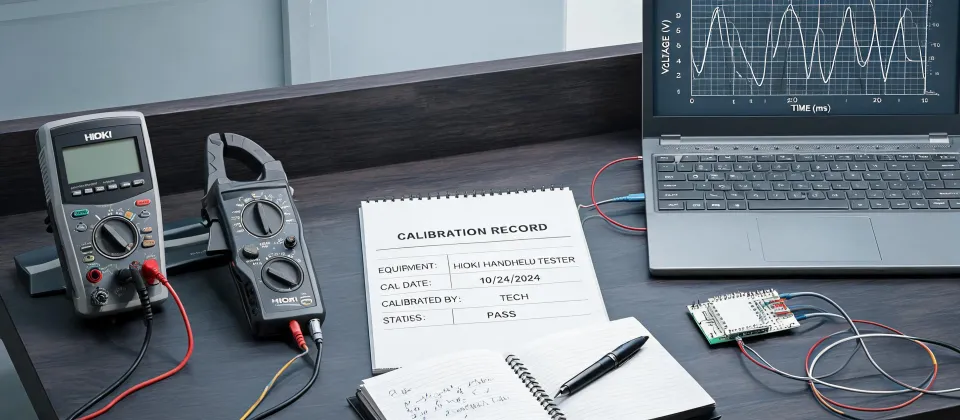
If you're about to write a purchase order for a power quality analyzer, an insulation tester, or a complete multimeter kit for your maintenance crew, here's my blunt advice: get a Hioki quote before you default to the premium brand you already know. Over the past six years I've managed roughly $180,000 in test instrument purchases for an industrial services company, and Hioki has consistently been the lowest total-cost bid on my spreadsheet while performing as well as the pricier tools it replaced. Hioki is not the answer to every measurement problem, but for power quality analysis, insulation testing, and everyday electrical troubleshooting, they're the benchmark I compare everything else against.
Let me establish why that opinion is worth anything. I'm not an application engineer. I'm the procurement manager at a 60-person company that rewinds and repairs industrial motors, builds control panels, and runs power quality studies for manufacturing clients. That means I've managed test equipment budgets of about $30,000 per year for six years, negotiated with 40-plus vendors, and logged every order in our cost tracking system. I've also made enough buying mistakes to be genuinely suspicious of my own instincts.
One audit in early 2023 changed how I compare instruments. When I broke down our spending, I found that nearly 17% of our budget overruns came from rush shipping and missing accessories, not from the price of the meters themselves. After that, I stopped comparing unit prices and started requiring vendors to quote the full package: instrument, current clamps or probes, leads, software, case, and calibration certificate. That one change completely reshaped our vendor list.
Why Hioki kept winning my RFQs
The clearest example was a three-phase power quality analyzer. We asked four suppliers to bid identical line items, including probes, software, and certification. A respected U.S. brand bid a capable analyzer. Hioki's distributor bid its equivalent. Hioki was not dramatically cheaper on the instrument alone, but once the components that were 'optional' in the fine print were added, the total gap exceeded 20%. Actually, it was 21.6% on a roughly $7,000 decision. I do not remember the exact dollar total, but I remember the percentage because it paid for our spare probe set.
Here is something vendors usually don't put in the first email: the headline quote is for the box. Leads, clamps, carrying cases, software licenses, and calibration certificates often come as separate line items that add 15-30% to the real cost. We did not expect the lower-priced bid to be the more complete one, but it was. That is how Hioki first made it onto my shortlist.
I have mixed feelings about Hioki's instrument software, and I'd rather say that upfront. It works, and it's stable, but the interface feels a generation older than the hardware. If you compare purely on screen polish, you'll find prettier options. I've learned to live with it because the measurement data is trustworthy, and in this line of work data matters more than decoration.
What I'd buy today, and what I'd skip
If our team were starting from zero tomorrow, this is roughly how I'd spend the budget. Yours will differ, but the reasoning might help.
A Hioki power quality analyzer: buy it if you troubleshoot power
If you chase harmonic distortion, capacitor failures, voltage sags, or nuisance trips on VFDs, buy a real Class A instrument per IEC 61000-4-30. Notice I said real. Many low-cost analyzers claim power quality measurement but don't meet a recognized classification. The unit in our shop is a Hioki PQ3100-series power quality analyzer. It is not the very newest model as of January 2025, but it has been reliable since the day we installed it, and our client reports carry weight because the measurement method follows an international standard. One boundary: if your real need is revenue-grade energy billing, buy a certified energy meter, not a power quality analyzer. They solve different problems.
Insulation testing: don't buy one combination tool when you need two
'Insulation multimeter' is a search phrase that points to a real misconception. A regular digital multimeter cannot stress insulation the way an insulation tester does. You need an instrument that applies 500V or 1000V to expose weakened winding insulation, and that's a different tool. We use Hioki's IR4056 insulation resistance tester for motor windings, and I would not go back to a 'combo' approach after seeing how often plain ohms readings miss an insulation breakdown. The tester costs a fraction of one emergency motor rewind, which makes it the easiest cost justification on this list.
Multimeter kit: standardize on something safe
Searching 'multimeter kit' mostly returns cheap all-in-one sets stuffed with accessories you'll never use. We do not buy those for the field. Each of our technicians gets one CAT-rated multimeter with quality silicone leads and a case, and we standardized on Hioki's DT-series meters because they are reliable enough to issue one per person. That might sound dull, but it stops the borrowing, the guesswork, and the 'I left it in the truck' calls that burn more hours than any spec sheet difference.
A Hioki oscilloscope: buy it only if you need long captures
A lot of people search for 'Hioki oscilloscope' because they trust the brand from clamp meters. One thing worth knowing: Hioki's waveform capture instruments, such as the Memory HiCorder line, are specialized and not a direct substitute for a general-purpose benchtop oscilloscope. We use one for capturing transients and long event windows during VFD startups, and it's excellent for that. But if your work is mostly board-level electronics repair, spend the money on a conventional oscilloscope instead and save the Hioki for when you actually need the long memory. That is the honest split in our shop.
The measurement skill nobody budgets for
If you repair motors, the measurement skill that saves the most money might not be electrical at all. It's mechanical. A technician who can't read a micrometer accurately can measure a shaft wrong, order the wrong bearing fit, and reinstall a part that was fine. We keep Starrett micrometers in our rebuild bay because they are mechanical, reliable, and don't need firmware updates. But the brand matters less than the reading skill.
If you've ever searched 'how to read a Starrett micrometer,' it breaks down like this: the sleeve has numbered marks for 0.100 inch and smaller marks for 0.025 inch. The thimble has 25 divisions around its circumference, each representing 0.001 inch; one full turn moves the spindle 0.025 inch. On micrometers with a vernier scale on the sleeve, find the vernier line that aligns exactly with a thimble line and add that many ten-thousandths of an inch. Add the sleeve reading, the thimble reading, and the vernier reading together.
I ran a quick skills check in our shop in 2024 using gauge blocks. Only two of seven technicians could read a 1-inch micrometer consistently within 0.0001 inch. That wasn't a tool problem. It was a training problem. If we had spent another $10,000 on analyzers that day, the shaft measurement would still have been wrong. These days, part of our instrument budget goes to plain old skills practice, including reading micrometers, and it has paid back faster than any single purchase I can name.
Where I would not choose Hioki
Now the boundary conditions, because there are some. If your company already has a large installed base of another brand and your technicians know those menus by heart, the switch cost might erase Hioki's price advantage. Retraining has a real price tag, and I respect that.
Second, service location matters. Hioki's support network is not as dense as some competitors in every region, so verify calibration turnaround time before you buy. If you need an accredited calibration lab with a fast local drop-off, that could change your decision. Finally, for ISO 17025 accredited laboratory work with full uncertainty budgets, don't rely on a field instrument alone; the whole traceability chain needs to be reviewed. In those situations, a different vendor may indeed be the right answer.
For the other 80% of industrial maintenance and troubleshooting, though, I'll keep ordering Hioki. The savings paid for better leads, spare probes, and training time. I will not claim that Hioki beats everyone in every specification, because I don't have the lab evidence to say that. But I can tell you what happened in our cost tracking system, and the numbers have been consistent for six years.
Models and prices mentioned reflect what we bought and saw as of January 2025; verify current availability and pricing at hioki.com.