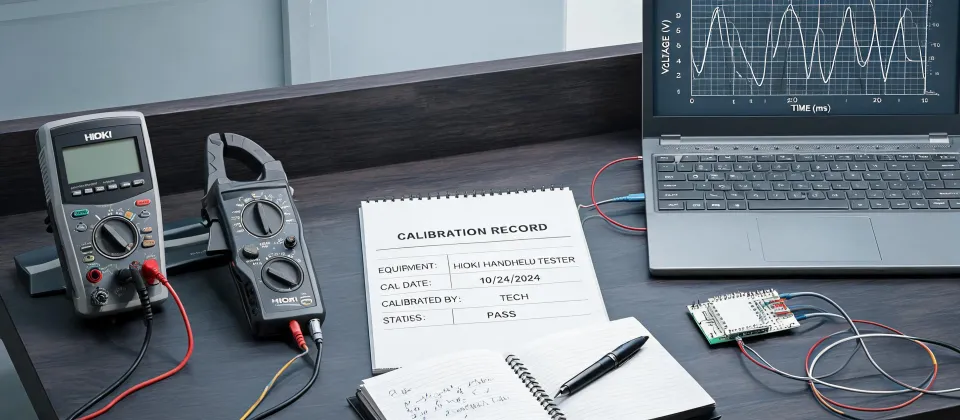
Every few weeks, someone asks which measuring instrument is “the best.” After more than six years of inspecting test gear before it ships to customers, my honest answer is a question: for which scenario? I review roughly 80 to 120 units each week. In our Q1 2024 intake audit, about 14 percent of first deliveries were rejected or sent back for review—not because they were broken, but because someone had chosen the right category on paper and the wrong tool for the actual job.
So this is not another “one meter to rule them all” article. The advice here is organized by situation. The first and most useful decision is the physical measurement category, and the second is who or what will consume the reading.
Scenario 1: The signal changes while you watch it
If you are measuring a stable DC voltage, any decent digital meter works. The tricky cases involve change: a relay that drops out intermittently, a battery voltage that sags under load, a motor that ramps down slowly, or a control loop that is hunting. A digital display gives you a number, then another number, then another. Unless you have a recording function, much of that sequence is lost.
This is where an analog multimeter still makes sense in 2025. A moving needle shows direction and rate of change, not just the present value. The category includes the Hioki 3030-10 analog multimeter, which I still see in technicians’ bags more often than people expect.
No, wait—let me be more precise. I am not claiming an analog needle is more accurate; generally it is not. But it is a better display when your eye has to follow a signal over time. If a signal flickers quickly, no analog movement will catch it; you need an oscilloscope. For slow trends, the needle is a naturally readable data visualization.
I do not have hard data on how many analog multimeters are still used daily in 2025, but our service bench sees a steady number. What I can say anecdotally is that the technicians who troubleshoot old relay panels and electromechanical systems are the ones asking to keep analog meters available.
There is a clear boundary, though. If the result has to be documented against a tolerance, an analog scale is the wrong evidence. Parallax and reading resolution make operator interpretation part of the measurement. I can watch a needle find a fault, then switch to a digital or recording instrument when it is time to certify the repair. That combined habit is the one I train.
Scenario 2: The output has to talk to a process system
Now let me be honest about the limits of what I recommend. Hioki’s catalog is built around electrical testing, not pressure transmitters. If the actual job is measuring process pressure for a 4-20 mA loop or a fieldbus network, specify a pressure transmitter—not another electrician’s handheld tool.
When I audit pressure transmitter requests, I check four things before I even look at a brand:
- Reference: gauge, absolute, or differential. The sensor has to measure against the right reference for the process.
- Output protocol: 4-20 mA analog is still common, but HART, PROFIBUS PA, or FOUNDATION Fieldbus change which transmitters you can consider.
- Wetted materials: the parts that touch the process fluid, not just the outer housing. 316L stainless steel is common, but aggressive media may require another alloy or a diaphragm seal.
- Overpressure range: what happens during a process upset or startup when pressure exceeds normal span. The sensor should not be the weak point in the loop.
My contrarian advice is to stop over-specifying accuracy. In Q1 2024, I reviewed a specification that demanded ±0.075% of span for a line where the plant calibration reference was ±0.1% and process noise was worse than both. The extra datasheet accuracy did not make the loop better; it made the purchase more expensive. If I cannot find a transmitter brand with a strong calibration history, I will take a stable ±0.1% unit over a slightly more accurate model with unknown drift.
I do not have hard data on long-term drift rates across transmitter brands; that would take a multi-year study we have not run. What I do have is calibration return data. The failures that come back are more often zero drift and calibration problems than dead sensors. Plan for calibration access and cost before paying for accuracy the rest of the loop cannot use.
To be fair, custody transfer and some safety-instrumented functions genuinely need tighter accuracy plus documented traceability. In those cases, follow the engineering requirement, not my general rule.
Scenario 3: A thermometer question: fever temperature, or equipment temperature?
This is the scenario I see misused most often. A non-contact thermometer shows a number, so people assume the same tool can measure a running bearing and a human forehead. It cannot, for two reasons.
First, an infrared thermometer measures surface temperature. Forehead skin temperature is not the same as body core temperature. Medical fever-screening devices are validated as complete systems for that use; an industrial IR device is not. Standards such as EN ISO 80601-2-56, plus equivalent medical-device regulations in your country, exist because half a degree matters at 37 °C. An industrial unit with ±1 to 2 °C tolerance is acceptable on a 70 °C busbar, but it is not acceptable for a fever temperature reading on a person.
Second, emissivity changes the answer. For equipment, you need to set the emissivity of the target surface: most insulating materials are around 0.9, while bare shiny metals are much lower. Point an IR thermometer at a reflective terminal and you may be measuring the background rather than the terminal.
The practical rule: if you need a fever temperature screening tool for people, buy a medical clinical thermometer. If you need to check electrical connections or machine surfaces, use an industrial infrared thermometer—Hioki makes several, and so do other reputable brands. Do not try to make one device do both jobs.
Scenario 4: How to use a Mettler Toledo pH meter correctly
If the job is measuring the pH of a liquid, you have moved from electrical testing into electrochemistry. A Mettler Toledo pH meter is common in labs and quality control, so let me give you a scenario-specific routine.
- Check the electrode first. The glass bulb and the reference junction must stay moist. If the electrode has dried out, it must be reconditioned or replaced. A dry electrode is the most common cause of strange readings.
- Use fresh buffers. Open a clean beaker of pH 7.00 buffer and a second buffer close to the expected sample pH: pH 4.01 for acidic samples, pH 10.01 for alkaline ones. If the buffer is old or cloudy, discard it.
- Calibrate in the right order. Start with pH 7.00. Rinse the electrode with deionized water, blot it gently, then place it in the second buffer. Wait until the reading stabilizes before confirming.
- Rinse between every measurement. Carry-over contamination ruins readings faster than almost anything else. Blot the electrode tip with a lint-free tissue; do not rub or wipe it.
- Respect temperature. Buffer pH values shift slightly with temperature. If the meter has automatic temperature compensation, use it. If not, bring the sample and buffers to the same temperature first.
- Store the electrode properly. Rinse it after the last measurement and put it back in electrode storage solution, usually 3 M KCl. Never store it in deionized water.
If you are looking for a model-specific key sequence, my advice is to learn this routine first. The menu layout on a Mettler Toledo pH meter differs from one product line to another, but the chemistry does not. When the probe and buffers are right, the electronics will do what they are supposed to do.
How do you know which scenario you are in?
When a purchase request lands on my desk, I filter it through four questions:
- What is the physical quantity? Volts, amps, ohms, frequency? Stay in the electrical test family. Pressure or differential pressure? Move to pressure transmitters. Temperature? Ask whether it is a human or an equipment surface. Acidity or alkalinity? Use a pH meter with a cared-for electrode.
- Who consumes the output? A human eye watching a dynamic signal may do better with an analog display. A PLC or control system needs a transmitter output. A lab or compliance record needs a calibrated digital instrument with a documented reading.
- Do you need to see movement, or capture history? If movement, a needle helps. If history, choose a logging or recording instrument.
- Can you prove the value later? If the reading goes into a report, calibration status matters more than the brand name.
So what is my final recommendation? There is no single product I would recommend for everyone. The Hioki 3030-10 analog multimeter is a good choice when an electrical signal is moving and a needle helps you understand the trend, but I would not certify a compliance reading with it. A pressure transmitter is selected by loop and process conditions. Fever temperature screening calls for a medical-grade thermometer. And a Mettler Toledo pH meter will serve you well if you follow the electrode care and calibration steps above.
That is the honest, slightly less glamorous conclusion: the instrument works when it matches the situation. Choose the scenario first, and the tool becomes obvious.