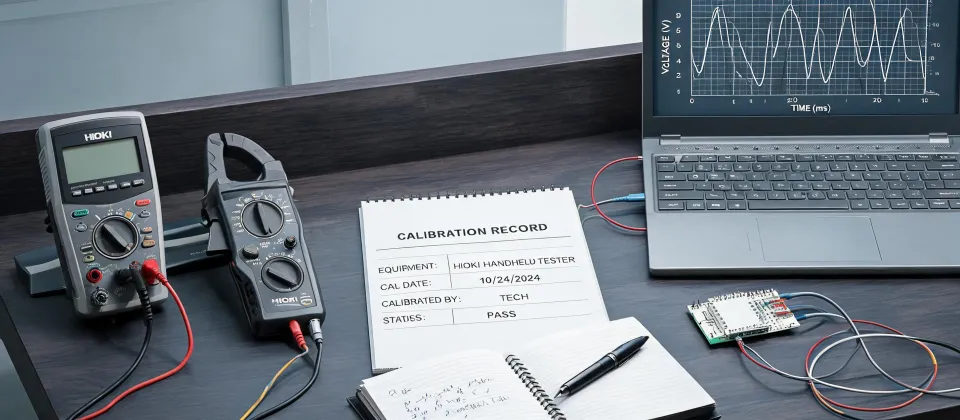
Let me start with something it took me a few years and a few expensive mistakes to learn: the best Hioki meter for you isn't the one with the highest specs—it's the one that fits your actual workflow.
I learned this the hard way in 2022 when I recommended a top-tier Power Quality Analyzer for a team that really needed a rugged, fast clamp meter for daily motor checks. The spec sheet won. The workflow lost.
So, there's no single 'best' Hioki meter. The right choice depends heavily on what you're measuring, where you're measuring it, and who is doing the measuring. Here’s how I categorize the most common situations.
Scenario 1: For Precision R&D and Lab Validation
If you're in a lab environment, characterizing components, or doing validation work, your priority is accuracy and resolution over portability and speed.
The strong choice: Hioki IM3536 LCR Meter
For anyone working with passive components—capacitors, inductors, transformers—the Hioki IM3536 LCR Meter is a workhorse. Its ability to sweep frequencies from 4 Hz to 8 MHz makes it incredibly useful for detailed impedance analysis.
- When to choose this: You need to measure ESR, DCR, or Q factor at various frequencies. The 0.05% basic accuracy is hard to beat for lab-grade component matching.
- A personal note: I once spent three hours trying to match two batches of capacitors using a handheld meter. The IM3536 would have done it in 20 minutes. (Ugh.)
The runner-up: Hioki DT4252 Digital Multimeter
Wait, a DMM? Yes. For general lab work and troubleshooting prototypes, the Hioki DT4252 Digital Multimeter is surprisingly capable. It's not an LCR meter, but it offers true RMS, a 60,000-count display, and a CAT III safety rating that makes it more than a basic meter.
- When to choose this: You need a reliable second meter for cross-checking measurements, or your primary task is voltage, current, and resistance checks, not detailed impedance analysis.
- My take: I keep a DT4252 on my bench as my 'go-to' for sanity checks. It's the workhorse you don't think about until it's not there.
Scenario 2: For Field Service and Troubleshooting (Power Quality)
This is where portability, ruggedness, and the ability to catch intermittent problems matter most. You're not spending an hour on a single component; you're diagnosing a whole system's behavior.
The primary tool: Hioki 1777 Power Quality Analyzer
When you need to understand why a critical machine keeps tripping, or when you suspect power factor issues are costing you money, the Hioki 1777 Power Quality Analyzer is the tool you want in your bag.
- Why it fits: It's designed for long-term logging (up to several days) across multiple phases. The EN 61000-4-30 Class A compliance means its data is trusted for formal reports. I've used it to capture voltage sags that lasted less than one cycle—something a handheld meter would miss entirely.
- A real example: In late 2023, we traced a recurring motor failure to a 2-millisecond voltage dip caused by a faulty contactor. The 1777 caught it on the third day of logging. The savings from preventing just one more motor burnout paid for the analyzer.
- Things to know: It requires a bit of setup. (To be fair, most power quality analyzers do.) Make sure your team is trained on the basic menus before sending it into the field.
Quick checks on the go: Hioki Clamp Meters
For a quick 'is this circuit live?' or 'what's the current draw on that motor?' the 1777 is overkill. For that, a reliable Hioki Clamp Meter (like the 3280 series) is your best friend. It's quick, it's safe, and it gives you a solid, immediate answer.
Scenario 3: For Maintenance and Safety Verification
This category is about ensuring safety and compliance, not chasing high-precision data. The tools need to be robust, simple, and trustworthy.
The essential tool: Hioki Insulation Tester
For checking motor windings, cable integrity, or any routine Megger test, a dedicated insulation tester is non-negotiable. I've seen far too many 'motor won't start' issues traced back to insulation breakdown.
- When to choose this: Any time you need to verify isolation resistance (IR) per safety standards. Most standards call for a 500V or 1000V test.
- A quick thought: Honestly, I'm not sure why some teams try to use a DMM for insulation testing. A DMM can't apply the test voltage required to reveal weaknesses. This is one area where the dedicated tool is a safety requirement.
Data logging over time: Hioki Data Loggers
If you need to monitor temperature, humidity, or other environmental factors over a shift or a week, a Hioki Data Logger with the right sensor (like a sensor 2511121 for temperature) is the way to go.
- Why it matters: You can't stand there with a stopwatch and a thermometer. A data logger records the trend. After years of doing this, I've come to believe that trend data is often more valuable than a single precise measurement. It tells you what's happening, not just what is.
- Note on calibration: Speaking of precision, I get a lot of questions about calibrating pH meters. While this guide focuses on Hioki electrical gear, the principle is the same after years of doing this: always calibrate at the start of a measurement session with fresh buffer solutions that are at the same temperature as your sample. If you're asking 'how to calibrate ph meter mettler toledo', the process is standard in the lab.
How to Decide: A Simple Framework
If you're still not sure, ask yourself these three questions:
- What's the primary measurement? (Voltage/Current/Resistance vs. Impedance/Capacitance vs. Power Quality over time)
- Where will you use it? (In a clean lab vs. a dusty factory floor vs. a bucket truck by the side of the road)
- Who will use it? (An experienced engineer with time to set up a test vs. a technician needing a quick, safe answer)
If your answer is 'Lab' and 'Impedance', the IM3536 is for you. If it's 'Field' and 'Voltage/Current', a good DMM (like the DT4252) or Clamp Meter is your tool. If it's 'Power Quality over time', you need the 1777.
(Prices as of early 2025; verify current rates with your distributor. Don't hold me to these exact figures, but the IM3536 is typically in the $3,000-4,000 range, and the DT4252 is well under $500.)
The core lesson is to match the tool to the task, not to the spec sheet. Your workflow will tell you the right answer.