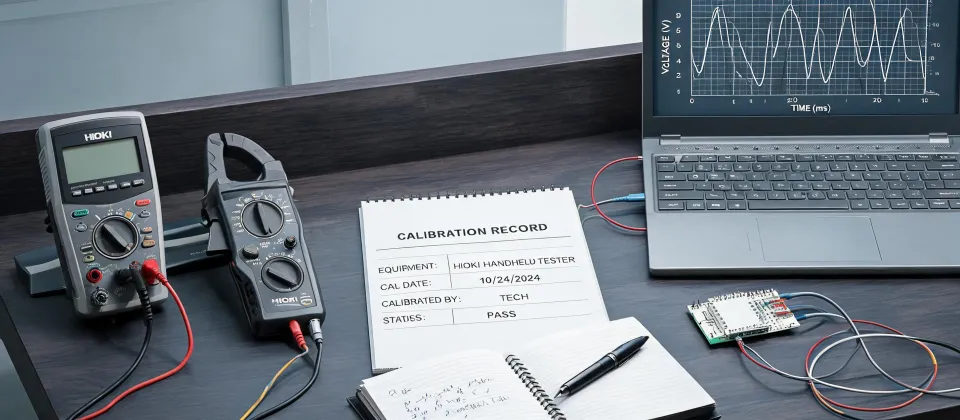
I've been managing procurement for a mid-sized industrial maintenance company for about 6 years now. Over that time, I've approved orders for everything from basic screwdrivers to $20,000 thermal imagers. And I've made plenty of mistakes.
Here’s the thing nobody tells you when you're stocking a maintenance team: buying the wrong test instrument—even if it's "cheaper"—costs you more in the long run. But so does buying a top-tier instrument for a job that only needs the basics.
So, how do you figure out what you actually need? It depends on your situation. There isn't one right answer for everyone. Let me break it down into three common scenarios I've seen in our shop and with sub-contractors we work with.
Three Real-World Testing Scenarios
Scenario A: The Basic Troubleshooter
You're checking if a household outlet is live. You're tracing a wire on a lighting circuit. Maybe you're figuring out why a conveyor motor won't start.
For this job, you don't need a power quality analyzer. You don't even need a CAT IV safety rating. What you need is a reliable, rugged digital multimeter that gives you a clear reading and won't break the bank.
I put a HIOKI DT4256 digital multimeter in our basic toolkits. Why? Because it’s tough (I've seen one fall off a 6-foot ladder and still read accurately), has a clear display that old-timers like myself can actually see, and the safety rating (CAT III 600V) is more than enough for 90% of our residential and light commercial calls. The price is about $200. For a tool that gets used daily for years, that's a no-brainer.
"The first year I was in procurement, I bought the cheapest meters I could find to save $30 each. We had 3 failures in 6 months. The rework and call-backs cost us more than the meter savings. Never again."
Scenario B: The In-Depth Investigator
Now, imagine you're diagnosing a VFD that keeps tripping. Or you're checking harmonics on a new production line. Or you need to log voltage fluctuations over a week to prove to the utility company that their power is bad.
This is where the conversation changes. You need something that does more than measure volts and ohms. You need to see the quality of the power. This is where a power quality analyzer comes in.
A few years ago, we were getting complaints about a CNC machine randomly shutting down. A $400 multimeter told us the voltage was 'within spec.' A HIOKI PW3198 power quality analyzer told us the real story: voltage sags of less than 10 milliseconds, multiple times a day. A standard multimeter won't catch that. It's like taking a single photo of a street and saying there's no traffic. The PW3198 is like a 24/7 traffic camera.
But here's the kicker—it costs about $8,000. Is that too much? For a one-off job, maybe. But if your facility has sensitive electronics, PLCs, or is paying for power factor penalties, that $8,000 pays for itself inside a year by preventing downtime and rework. Seriously.
Scenario C: The All-Rounder (The 'Megger vs. Multimeter' Debate)
This is the classic debate: do I buy a separate insulation tester (a 'megger') or just rely on my multimeter? Again, depends on your job.
A standard multimeter can measure resistance up to, say, 40 MΩ with a low voltage (like 1V). That’s fine for checking if a wire is broken. But it can't check the integrity of insulation under stress.
An insulation tester applies a high voltage (500V, 1000V, 2500V) to stress the insulation and measure its resistance. A reading of, say, 50 MΩ on a multimeter might look good. But if an insulation tester shows 1 MΩ at 1000V, you have a breakdown waiting to happen. It's the difference between checking if a tire has air and checking if it can handle 80 mph.
So, you need both. But you don't have to buy two instruments. Some manufacturers make combination units, but they often compromise on one function. The smarter play is to buy a good multimeter (like the DT4256) and a dedicated, solid insulation tester for when you need that high-voltage test. I don't have hard data on how much a motor failure costs industry-wide, but I can tell you the one time we replaced a 50 HP motor because of an undetected insulation breakdown... it cost us $4,500 in parts and a full day of downtime. A $600 insulation tester would have caught it.
How to Decide Which One Is Right for You
So how do you know which scenario applies to you? Here's my simple decision tree:
- If you only fix outlets, lights, and basic circuits: Get a solid CAT III digital multimeter like the HIOKI DT4256. That's it. Done. Invest the saved money in a good set of leads and fuses.
- If you work with motors, VFDs, or sensitive electronics in a plant: You need a power quality analyzer at least once to baseline your facility. After that, you'll know if you need it for ongoing monitoring or just periodic checks. The HIOKI PW3198 is the standard for a reason—it's thorough but not overly complex to set up.
- If you do motor repairs or work on high-voltage gear: Add a dedicated insulation tester to your kit. Don't try to make a multimeter do that job. It won't. And the results could be a fire or a motor failure.
The biggest mistake I see is people buying a single 'do-it-all' instrument and ending up with a tool that's too complex for simple jobs and not thorough enough for the tough ones. Pick a tool for your most common hard job, and a separate tool for your most common easy job. You'll save time, money, and headaches.
I'm not a test engineer, so I can't tell you the exact technical specs for every situation. What I can tell you, from a procurement perspective, is that the best tool is the one that fits the job and your budget—not the one with the biggest feature list.