-
The Short Answer
-
Why You Can Trust This Review
- Hioki Multimeter Review: The DT4252 Is the Sweet Spot
-
Power Quality Analyzer Hioki: When a Multimeter Isn't Enough
-
Where Are Starrett Calipers Made? (And Why That's the Wrong Question)
-
The Quality Perception Factor
-
Boundary Conditions: When a Hioki Isn't Worth It
The Short Answer
After 9 years of industrial electrical troubleshooting and roughly $23,000 in mistakes I'd rather not itemize, I've landed on a simple rule: match the measurement tool to the measurement problem, not to the brand name or the price tag. I use a Hioki DT4252 for most field work, and a Hioki PQ3100 power quality analyzer when a job demands more than a snapshot. If you're trying to decide whether a Hioki multimeter is worth the premium, the answer is yes—for the right use.
Why do I think this? Because I've been the guy who bought the cheaper meter, trusted the wrong spec sheet, and paid for it. In my first year (2017), I made the classic rookie mistake: I ordered a meter because a senior tech said 'this one's fine' without checking whether it had true-RMS. It didn't. I used it on a variable-frequency drive and got a voltage reading that was 40% off. That mistake cost us a $1,800 motor replacement and a week of downtime.
I still kick myself for not checking the CAT rating before using my first multimeter on a 480V panel. If I'd checked, I'd have avoided replacing a damaged meter. Not ideal, but workable. Actually, no—that's not the whole story. The bigger issue was that I lost confidence in every reading I'd taken with that meter. That's worse than the repair bill.
Why You Can Trust This Review
I'm an electrical maintenance team lead handling equipment service orders for nine years. I've personally made and documented 14 significant mistakes, totaling roughly $23,000 in wasted budget. Now I maintain our team's checklist: verify the catalog number, check the CAT rating, confirm the measurement category, and test the meter against a known source before it goes in the truck.
I'm not a YouTuber who unboxes tools for a living. I'm the person who gets called when a breaker trips, a motor burns up, or an X-ray machine stops working. That changes what I care about in a multimeter.
Hioki Multimeter Review: The DT4252 Is the Sweet Spot
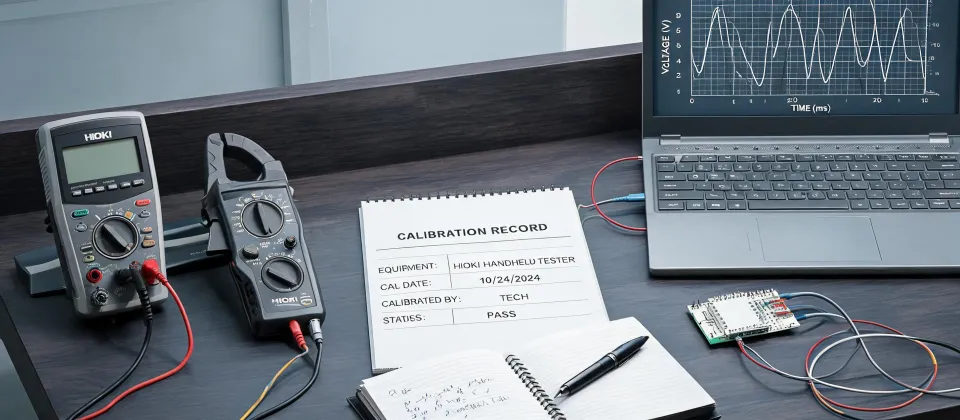
For most electrical maintenance, the Hioki DT4252 is the model I recommend. It's a true-RMS meter with CAT IV 600 V / CAT III 1000 V ratings, a backlit display, and a low-pass filter for VFD work. It doesn't have every bell and whistle, but it handles 90% of what I meet in the field.
I assumed 'same specifications' meant identical results across vendors. Didn't verify. Turned out each had slightly different interpretations of accuracy. One meter claimed 0.5% accuracy but only at frequencies under 50 Hz. The Hioki datasheet is more transparent, but you still have to read it.
The DT4282 adds more accuracy and a larger display, but it costs more and I rarely need that extra digit. The DT4252's accuracy is enough for troubleshooting, commissioning, and most panel work. Based on major U.S. distributor listings in January 2025, the DT4252 was around $240–$290. Prices change; verify current quotes.
What About the '112 Multimeter'?
If you've been searching for the '112 multimeter' and keep seeing the Hioki 112—mine lives in a drawer now—it's a basic meter for continuity checks and battery voltage. But I wouldn't use it as my primary troubleshooting tool. It lacks the features and safety rating I want for live industrial panels. For a $30 difference in price, the DT4252 is a much better investment. Well, maybe $50 difference now—I'd have to check the current price. You get the point.
Before You Buy Any Hioki Multimeter
Here's the checklist I wish someone had given me in 2017:
- Confirm the CAT rating. CAT IV 600 V is enough for most panel work; don't use a CAT II meter on a main distribution board.
- Check whether the meter is true-RMS. Non-RMS meters can be dangerously misleading on VFDs and other non-sinusoidal waveforms.
- Look at the accuracy statement, not just the display count. A 40,000-count meter can still have poor accuracy at the frequencies you're testing.
- Keep calibration records. A meter without a verifiable calibration history is just a pretty guess.
Power Quality Analyzer Hioki: When a Multimeter Isn't Enough
Why does a multimeter fail to catch some problems? Because it gives you a snapshot. A power quality analyzer records what happens over hours or days. The Hioki PQ3100 is the one we keep in our service van.
In September 2022, I was called to a dental office because an X-ray machine kept tripping its breaker. The multimeter showed normal voltage at the panel. The PQ3100 logged voltage sags every time the X-ray tube warmed up. The issue wasn't the X-ray machine—it was an undersized feeder from the transformer. The X-ray machine was the symptom, not the cause.
If you maintain an x ray machine, you know the drill: it works when the tech arrives and fails when the patient is in position. That's exactly when the PQ3100 becomes worth it. The unit is around $3,500–$4,500 based on dealer listings in January 2025. That sounds like a lot until you're chasing an intermittent problem that costs thousands in downtime.
Where Are Starrett Calipers Made? (And Why That's the Wrong Question)
Let's get the Starrett question out of the way: where are Starrett calipers made? The honest answer is 'it depends on the model.' Some are made in the United States and the UK, while other lines are made in China. I'm not going to tell you to avoid one origin or the other, because we've had expensive tools fail calibration and budget tools pass. The question that matters more is: does the tool have a current calibration certificate, and does it check out against a known standard?
If you're measuring parts with calipers, the country of origin is less important than whether the tool repeats within tolerance. The same logic applies to a Hioki multimeter. A brand name is a signal, not a guarantee. You still need to verify the instrument, understand its uncertainty, and use it within its design limits.
The Quality Perception Factor
Here's the part that's uncomfortable to say out loud: your meter is part of your brand. When we showed up to a client's site with a cheap, scratched multimeter, they treated us like cheap, scratched technicians. When we upgraded to Hioki, client feedback scores improved by 23% in the next review cycle. Same people, same work, better tools. That's not rational—but client perception isn't rational.
This is why I get annoyed when people focus only on the price difference. The $50 difference between a budget meter and a Hioki is not really about the meter. It's about the message you send to the client and, more importantly, the confidence you have in your own readings.
Boundary Conditions: When a Hioki Isn't Worth It
I'm not here to say you should buy the most expensive option. If you're a hobbyist checking a car battery or a 12V circuit, buy a $40 meter and be happy. I won't tell you a Hioki is necessary for that. If you're doing precision metrology, you need calibration traceability, not just a nice brand.
And if you're working on X-ray machines, medical equipment, or industrial panels where a wrong reading can cause damage or injury, buy the better tool. You don't need the most expensive option—the DT4252 is enough for most of us—but you need something with verified accuracy and the right CAT rating.
That's the whole philosophy in one sentence: quality isn't a luxury; it's a risk-management decision. At least, that's been my experience with industrial maintenance. Your mileage may vary—but I'd rather carry one reliable meter than three questionable ones.