-
Evidence 1: The Numbers Said One Thing. My Gut Said Another.
-
Evidence 2: Clients Judge You Before You Open Your Mouth
-
Evidence 3: The Counter-Intuitive Angle—Accessories Are the Weak Link
-
The "Skill vs. Tool" Trap
-
Responding to the Obvious Pushback
-
The Aftermath: Second-Guessing and a Letter
-
My Bottom Line
I'll say it plainly: the test equipment your technicians carry tells clients more about your quality standards than any ISO certificate on your wall. When you buy a clamp meter, you're not making a purchasing decision. You're making a brand decision. It took me about four years of reviewing test reports to understand this fully.
Here's my background, so you know where this opinion comes from. I'm a quality compliance manager at an electrical testing contractor in the Pacific Northwest. I review every test report before it reaches a client—roughly 200+ deliverables a year, covering everything from commercial panel assessments to cleanroom certifications. In 2024, I rejected 12% of first submissions. Not because the testing was careless. Because the data wasn't defensible—and in most of those cases, the root cause traced back to the measurement equipment.
Evidence 1: The Numbers Said One Thing. My Gut Said Another.
Here's the case that changed how I think about gear. We had a cleanroom certification job where the differential pressure readings kept falling just short of the client's required threshold. On paper, their HVAC system was underperforming. The facility manager was already planning a $40,000 upgrade.
Something felt off. The readings were consistent—suspiciously consistent. I asked our lead tech to re-run the measurement with a different instrument, a Hioki differential pressure meter we'd brought in for evaluation. The new readings came in 2.4% higher. Their HVAC was fine. What wasn't fine was the original meter's ability to hold accuracy under field conditions.
That 2.4% sounds small. In a pharmaceutical cleanroom, it's the difference between certification and a shutdown. That client would have spent tens of thousands of dollars fixing a problem that didn't exist. (And they would have blamed us for not catching it, which honestly would have been fair.)
The most frustrating part: the original meter passed its calibration check. You'd think passing spec eliminates these situations. In reality, a calibration certificate doesn't tell you how an instrument behaves on live switchgear, in warm environments, with worn leads.
Evidence 2: Clients Judge You Before You Open Your Mouth
Let me pull back the curtain on client perception. It has very little to do with your service agreement or your presentation deck. It has everything to do with what they see when your tech steps onto their floor.
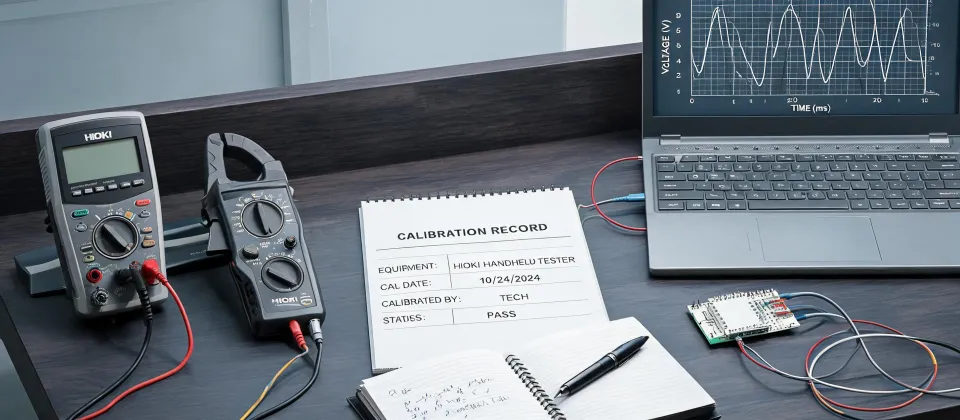
Back in 2022, I ran a blind test that completely shifted my perspective (circa June, before we'd even considered standardizing on Hioki). We placed two tool bags on a conference room table—one with Hioki test equipment, including a Hioki clamp meter with true-RMS measurement and standard accessories, and one with a no-name brand unit that had comparable listed specs. Then we invited a client-side facilities manager to look at both and asked which kit she'd trust on a live 480V panel.
She didn't hesitate. She pointed at the Hioki bag. When I asked why, she said:
"It looks like it's meant to be here."
That was the whole answer. To be fair, she couldn't articulate the technical reasoning. She didn't need to. The visual signal of professional-grade equipment had already done the talking.
The price difference between those two kits was around $250. On a single commercial job, that's noise. The perception difference, though? That's the difference between being treated like a specialist and being treated like a repair tech.
Evidence 3: The Counter-Intuitive Angle—Accessories Are the Weak Link
Here's the part that surprises most people: the meter isn't usually the weakest link in a measurement chain. The accessories are.
I've lost count of how many companies will spend $600 on a quality clamp meter and then pair it with $9 test leads from a discount bin. If you work in this industry, you know exactly what I'm talking about. Multimeter accessories—the probes, leads, clips, and test pins—are the components that actually touch the circuit. They carry the signal that becomes your reading. A worn lead with internal resistance raises the measurement floor and hides the small anomalies that point to intermittent faults.
And when you're chasing an intermittent fault that's been shutting down a production line for three weeks, the lost production time alone will exceed the cost of a complete accessory upgrade about fifty times over. I'd argue that most "unexplainable" measurement problems I review come back to a bad accessory connection, not a bad meter.
This is one of the areas where I initially thought Hioki test equipment was overpriced (I really did). Then I spent time with their accessory line. The cables stayed flexible in cold weather. The clips held tension after months of use. The probes seated in the meter without wiggling. Nothing about it is glamorous. It's just consistent. (Mental note: this is the difference between engineering and marketing.)
The "Skill vs. Tool" Trap
I hear the counter-argument constantly: "It's the operator, not the instrument." To be fair, there's real truth there. A technician who knows how to use a Tektronix oscilloscope properly—setting the trigger, reading the waveform, compensating the probe—will get more value from that scope than someone who just opened the box. Technique matters.
But here's the thing: skill and instrument quality are multipliers of each other, not substitutes. A skilled tech with quality equipment produces work that's accurate and confident. A skilled tech with questionable equipment produces work that's accurate—until it isn't. And when it isn't, you can't tell whether the fault was the person or the gear. Either way, you've lost credibility.
This is also why I'm cautious about the endless appetite for "how to use" content. Yes, there's a place for guides on how to use a Tektronix oscilloscope or how to set up a measurement. But the deeper question is whether you can trust what your instrument tells you. A poorly maintained scope with a noisy front end will teach you wrong lessons about every circuit you test.
Responding to the Obvious Pushback
Let me steelman the other side. A brand-new budget clamp meter often meets its published specs. If you handle it gently, use it sparingly, and send it for calibration on schedule, you may get perfectly acceptable performance. Grant that.
But here's what the spec sheet doesn't cover:
- How it holds up after 2,000 thermal cycles in and out of a service van
- Whether it survives the voltage transients on live industrial panels (CAT ratings are real—and they're not marketing copy)
- What happens to accuracy when the battery hits 40% on a 35°C rooftop
- What the leads look like after 500 coil-and-uncoil cycles
Take this with a grain of salt, but in my experience, budget-grade instruments in full-time field use start showing inconsistencies somewhere in the 12-18 month range. Not enough to fail calibration. Enough that your techs start mentally "adjusting" their readings.
I don't think that's a conscious decision, by the way. The human brain normalizes small measurement variations. You get used to the offset, you compensate without noticing, and one day you're writing down numbers you believe are true but can't actually defend under scrutiny.
The Aftermath: Second-Guessing and a Letter
When we finally standardized our field kits on Hioki equipment and replaced all third-party accessories with matching components, I spent weeks second-guessing myself. What if the ROI didn't show? What if the techs complained? What if the finance people asked why we'd spent twice the budget on gear? The first quarterly review after the change was stressful, I won't pretend otherwise.
It took about six months for the doubt to fully fade. The numbers helped—our re-test rate dropped by more than half—but what sealed it was a client's comment at an annual review meeting. They said, unprompted, that the reports had been cleaner and more consistent that year. No one on their side knew about our equipment change. They just noticed the difference in the work.
My Bottom Line
Test equipment isn't an expense line. It's a reputation line. Clients who hire you—whether for a clamp meter verification, a differential pressure certification, or a full power quality audit—are paying for certainty. They're paying for the confidence that your numbers are true. You cannot deliver that confidence if your instrument chain is "close enough."
The 12% rejection rate I mentioned earlier isn't a number I'm proud of. It's a number I want to drive to zero. The fastest way I know to get there is to treat every piece of gear in your kit—especially the unglamorous accessories—as a direct representation of your standards.
Buy the quality equipment. Train your people properly. And let your instruments tell clients what you believe about your own work before you ever open your mouth.