I'm the office administrator who handles purchasing for a 300-person manufacturing company. That means I buy everything from copier paper to CAT IV-rated test instruments—and the test instruments are the part I've learned to respect. I manage roughly $150,000 in annual equipment orders across 30 vendors, and I report to both operations and finance.
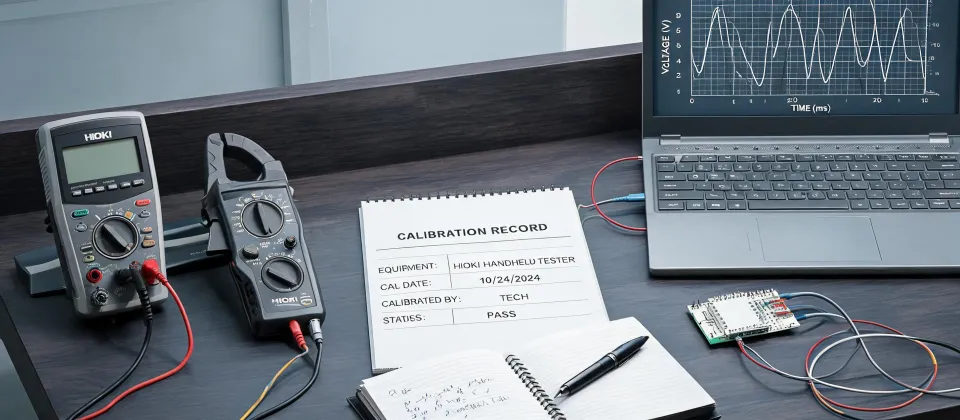
When I took over purchasing in 2021, my maintenance supervisor asked a question that turned into this article: "Can't we just buy one good multimeter and be done with it?" Fair question. A solid digital multimeter is familiar, portable, and affordable. The Hioki DT4256 we ordered has handled most of our daily troubleshooting since day one.
But "handles most of the work" and "solves every measurement problem" are different things. So I spent a month comparing four instrument categories—multimeters, insulation testers, power quality analyzers, and thermal imagers—using the same framework: what it measures, which problems it solves, how much training it takes, and what it really costs over its lifetime.
Multimeter vs. Insulation Tester: The Megger Question
If you look up "how to use a megger insulation tester," the procedure sounds simple: connect the leads, select the test voltage, press the test button, and read insulation resistance in megohms. The part that isn't obvious is why you need a megger at all when a multimeter has a resistance mode.
The difference is voltage. A multimeter's ohms function uses a tiny internal voltage—typically well under a single volt. Fine for checking continuity. Useless for testing insulation, because insulation failure often only shows up when the material is stressed at several hundred volts.
We learned that the hard way. A motor kept tripping its breaker. The electrician checked the winding with a multimeter: continuity looked acceptable. Not great, not terrible. Serviceable, we thought. Then the megger showed 0.2 MΩ at 500V—far below the 1 MΩ rule of thumb for a motor circuit. The multimeter said "it works." The insulation tester said "replace it." We replaced it during planned downtime instead of during a midnight emergency.
My conclusion: if you only troubleshoot small electronics, a multimeter is enough. If you maintain motors, cable runs, switchgear, or anything with real insulation, an insulation tester finds problems a multimeter can't. They're not competitors—they're a sequence.
General-Purpose vs. Automotive Multimeters: Why the Spec Sheet Matters
Here's a blind spot I had for the first two years: the multimeter that works for plant electricians is not automatically the multimeter that works for the automotive shop.
Searching "multimeter automotive" brings up a wall of options, and our fleet team showed me why the distinction matters. They needed to diagnose a parasitic battery drain on a van that wouldn't start after sitting overnight. A standard DMM set to DC amps can measure that drain, but with a low-resolution range and no in-rush handling, the reading was jumpy and unconvincing. Chasing a reading the tool can't produce is expensive.
For automotive work, you typically want high resolution on low DC current, duty-cycle or frequency measurement for sensors and injectors, and ideally a clamp meter that can handle in-rush current without breaking the circuit. For our maintenance team, the Hioki DT4256 multimeter has been a workhorse in production: the low-pass filter handles variable-frequency drives, the 4–20 mA loop range helps with process instruments, and it has survived field abuse that I won't describe in detail. The automotive shop, though, ended up with a DC-capable clamp meter and a separate unit with the frequency functions they needed.
The takeaway: don't buy "a multimeter" for the whole company. Buy the measurement capabilities the actual work demands, or plan on paying twice.
Multimeter vs. Power Quality Analyzer: What a Snapshot Can't Show
The hardest conversation I've had with finance wasn't about a $400 multimeter. It was about the Hioki PQ3198 power quality analyzer.
A multimeter is a snapshot. You hold the leads on a terminal and read 230V at that moment. The PQ3198 is a different category: a Class A power quality analyzer per IEC 61000-4-30. It records voltage, current, harmonics, sags, swells, transients, and unbalance continuously—for hours or weeks, plugged into the panel and left alone.
Here's why we needed one. A production line reset intermittently—every few days, sometimes in the middle of the night. The electrician put a multimeter on the panel, saw a steady 230V, and reported back the wrong conclusion: "Power's fine." What he meant was: the power is fine right now. The PQ3198 told a different story. Over a week of recording it captured a voltage sag below 180V lasting about 1.2 seconds every time the chiller compressor started. A sensitive controller on the line dropped out because of it.
The fix was a starting-circuit repair on the chiller. Total cost of that analyzer—well, I won't quote current pricing because it changes—was roughly one unscheduled production stop. Our finance team's downtime number is $2,800 an hour. The analyzer's recording period paid for itself before it was over.
Clear verdict: if your facility has intermittent resets or failures that "can't be reproduced," a power quality analyzer is a diagnostic instrument, not a luxury. If your problems show up as plain voltage or continuity faults, a multimeter and megger will cover you.
Thermal Imaging vs. Point Measurements: The Lens Decision
The last comparison surprised me. I expected to conclude that a thermal camera was an expensive nice-to-have. I changed my mind after a loose termination in one of our distribution panels showed up as a hot spot during a routine scan.
A multimeter tells you whether current is flowing. A thermal camera tells you whether a connection is running 40°C above ambient because it's failing at the contact point—something you won't see from voltage or current readings until it's already serious.
If you're evaluating thermal imagers, pay attention to lenses. The term "t865 thermal imaging camera lenses" comes up constantly in search results, and for good reason: interchangeable lenses change what the tool can do. A wide-angle lens covers a whole switchgear cabinet in a single shot. A telephoto lens reaches overhead buswork or infrastructure that would otherwise require a lift or a shutdown. When you build the total-cost comparison, include that second lens—it's often the difference between a camera that gathers dust and one that gets used monthly.
Budget order, from experience: multimeter first, insulation tester second, thermal camera when you have a preventive maintenance program that will use it, and power quality analyzer when downtime is expensive enough to justify it.
What I'd Actually Buy (and Why)
Here's the decision guide I wish I'd had in 2021:
- Basic electrical troubleshooting and general plant work: a quality digital multimeter—the Hioki DT4256 is the reference point I'd use after a year of field use.
- Anyone responsible for motors, cables, or panels: add an insulation tester. Learn how to use a megger insulation tester properly—the test voltage should match the equipment's rated voltage, and the readings should be trended over time.
- Automotive diagnostics: build the kit around low-current DC measurement and duty-cycle/frequency capability; don't assume a single generalist DMM covers it.
- Intermittent faults or critical production uptime: a Class A power quality analyzer such as the Hioki PQ3198 is the tool that ends the guessing.
- Preventive maintenance on critical infrastructure: thermal imaging with a lens strategy—wide-angle for cabinets, telephoto for distance.
I have mixed feelings about telling a small operation to buy several instruments, because a multimeter genuinely covers a lot of ground. But I've watched the lowest quote cost us more in about 60% of the purchasing decisions I've managed. The no-name multimeter our shop bought once couldn't handle a motor drive voltage check. The diagnosis from that tool burned through the savings within a week.
Buying the cheapest instrument means paying for the diagnosis twice—once for the tool, once for the misdiagnosis.
One more note, and it's the boring but important one: my pricing and product-line information is accurate as of early 2025. Test equipment lines change, and standards get updated—so verify current specs, safety ratings (IEC 61010 CAT ratings matter), and firmware options before you issue a PO. Fifteen minutes of checking beats a year of buyer's remorse.