-
The $90 Clamp Meter That Cost $12,000
-
What the Hioki CM4376 Specifications Actually Tell You
-
What the Fluke 15B+ Reviews Get Right (and Where I Went Wrong Anyway)
-
The Moisture Sensor: When I Repeated the Same Mistake
-
"Spend Money on Training, Not Tools" — I Call That a False Choice
-
Here's My Bottom Line: Quality Instruments Are Brand Protection
The $90 Clamp Meter That Cost $12,000
Here's my position, stated plainly: the cheapest test instrument is almost never the most affordable one. I manage an $80,000 test equipment budget, and I've tracked every instrument purchase for the past six years. The data is on my side.
In 2019, I approved a $90 clamp meter because its spec sheet looked identical to the Hioki clamp meter I wanted at four times the price. True RMS. Same measurement ranges. The whole checklist checked out.
Six months later, that decision came back to haunt us. The meter drifted. It read 238V on a circuit that was actually at 251V. Our technician trusted the reading, signed off on the installation, and the client's equipment failed within two weeks. Between labor, parts, and rush scheduling, the rework ran about $12,000.
A $90 savings. A $12,000 consequence. Simple math.
I should clarify: I'm not a brand loyalist. I'll buy from any manufacturer that can survive a real cost analysis. But after that incident, I went back through three years of purchase orders, calibration records, and replacement history. The pattern was unmistakable — cheap instruments weren't cheaper once you counted replacements, failures, and the occasional field incident. They were cheaper at checkout. That's where the benefit ended.
What the Hioki CM4376 Specifications Actually Tell You
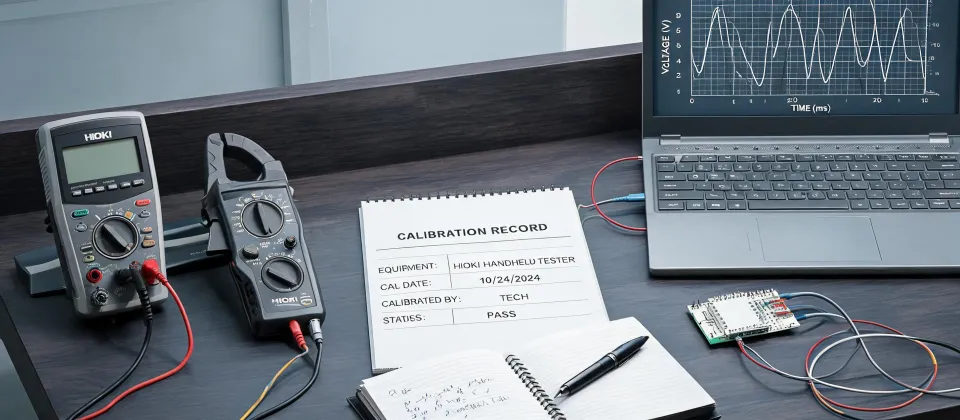
These days, the Hioki CM4376 clamp meter is the model we're buying for our field teams. And I'll be honest about its specifications: on paper, they don't look dramatically different from cheaper alternatives. True RMS. AC/DC current. A 1000A range. CAT III safety rating. A simple feature comparison table won't show you why I buy it.
What shows up is real-world behavior. Four things specifically:
- DC current measurement. The CM4376 measures DC current through its jaws. That's essential for our solar and battery work. A surprising number of budget clamp meters are AC-only, and their spec sheets are often vague enough that you won't notice until you're standing in front of a live DC busbar.
- Accuracy in noisy environments. Variable frequency drives, harmonics, mixed loads — the CM4376 holds its accuracy where cheaper meters start producing numbers that look plausible but aren't. That's the difference between catching a harmonic problem and missing it entirely.
- Safety engineering. The CAT III rating matters because it's defined by IEC 61010-1, a real safety standard for transient overvoltage protection. When our techs work in industrial panels, I want that engineering behind the display.
- Durability. We've had CM4376 units in the field for 18 months, including drops and dust. They still check out on the calibration bench. I can't say that about the $90 meters from 2019 — most of them are gone.
I'm not going to claim every Hioki instrument justifies its price in every situation. That would be indefensible. But for the work we do — industrial panels, distribution wiring, motor circuits — the CM4376's specifications reflect the conditions we actually work in. The cheap "equivalent" reflected a clean workbench, not a construction site. And if you're doing light residential work or hobby electronics, the cheaper tools might genuinely be fine. The math changes with the work — that's the point.
What the Fluke 15B+ Reviews Get Right (and Where I Went Wrong Anyway)
Maybe you're thinking: "But the Fluke 15B+ digital multimeter reviews are solid, and it costs less."
You're right, and I don't dispute those reviews. The 15B+ is a genuinely good multimeter for general electronics work. I have one in my office. It's served me well for bench testing and simple troubleshooting. If someone asks whether the 15B+ is a good buy for light professional use, I'd say yes.
But here's where I went wrong in 2021: I read those reviews, bought 15B+ units for several team members, and tried to treat it as a catch-all instrument. That was my error — not Fluke's. The 15B+ is not a clamp meter. It doesn't measure current without breaking the circuit. For motor circuits and distribution work, it's the wrong tool for the job, regardless of how well it performs at what it's actually designed for.
The lesson wasn't "the 15B+ is bad." It was: reviews describe how a tool performs within its intended category. They don't tell you which category you actually need. We still use multimeters for control circuits and general troubleshooting. For current measurement on live wiring, we use a clamp meter. End of discussion.
The Moisture Sensor: When I Repeated the Same Mistake
Here's a confession: I wasn't fully cured in 2019. I made the same mistake again in 2023, this time with a moisture sensor.
Our facilities team needed a handheld moisture sensor for post-water-damage inspections. I picked the economical option — not the absolute cheapest, but the budget-end unit. The specs looked right, and the price looked better. It wasn't until a contractor brought in a higher-tier instrument that we found out our unit was reading a concrete slab as dry when it was actually at 18% moisture. The flooring was sealed over a slab that was still wet.
(Thankfully, this one was caught before it became another $12,000 story.)
We replaced it with a better-grade moisture sensor, and the difference was immediate: stable readings, fewer false positives, and — this matters more than people think — trust. Our facilities techs stopped second-guessing every measurement. There's a hidden cost to a tool you don't trust: every reading gets verified twice. That's labor that just evaporates.
The reason I share this is that the moisture sensor lesson is identical to the clamp meter lesson, just in a different instrument category. It confirmed the pattern for me: spec-sheet equivalence isn't the same as performance equivalence.
"Spend Money on Training, Not Tools" — I Call That a False Choice
Here's the objection I get most often, and it deserves a direct answer: "A good technician can make any tool work. Invest in skills, not expensive equipment."
I partly agree, and I have a personal reason for it. A senior tech taught me how to read a Starrett micrometer when I first started in this field — lining up the vernier scale on the sleeve, counting the thimble divisions, understanding where the tenths of a thousandth land. That skill took time to develop and was worth every minute. I haven't forgotten it.
But about a year later, the same tech gave me a warning I now understand deeply: a skilled person with a bad tool is worse off than an average person with a good tool. Why? Because skill creates confidence. And confidence in a bad measurement is exactly what creates field failures. If you've spent years developing precision measurement skill, you will trust the number on the display. That trust is only safe if the tool behind it isn't drifting.
So when someone frames training and tools as competing investments, I reject the premise. Training makes a quality instrument more valuable. A poor instrument makes excellent training worthless. They're complementary, not competing.
Here's My Bottom Line: Quality Instruments Are Brand Protection
I've settled into a position I can defend: quality test instruments are an investment in how clients experience your work, not just a line in the maintenance budget.
Think about what your client actually sees. They don't see where you saved $200 on a clamp meter. They see whether every installation is done right the first time. They see whether your reports hold up under scrutiny. They see whether measurements are consistent across different technicians and different sites.
When I bought that $90 clamp meter in 2019, I saved a little money upfront and lost a client relationship that was worth far more. Every quality instrument we've bought since then hasn't just avoided that kind of loss — it's let our technicians stop wondering about the equipment and focus on the work.
Now, is every purchase in our test equipment budget going to be Hioki? Probably not. The framework I use now is what matters: compare total cost of ownership, not sticker price. Ask how a tool behaves on a real job site, not on a datasheet. And treat instruments as part of your company's reputation — because that's exactly what they are.
The $90 clamp meter was never a deal. It was a lesson. I just didn't realize it would take six years and $12,000 to learn.