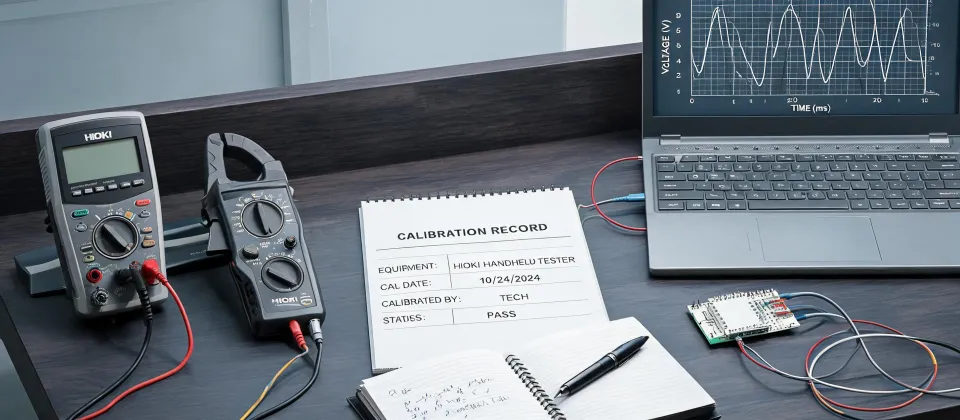
Here's the thing about buying testing equipment: there's no universal answer. I know because I review instrument purchases before they reach our engineers and techs—roughly 200+ unique items a year across quality and lab teams. I've approved six-figure orders and rejected batches over spec deviations that the vendor swore were "within industry tolerance." If there was one perfect toolkit for every company, I'd have found it by now.
What I can tell you is that the right choice depends on your scenario. What are you testing? How much does a wrong measurement cost you? Who's using the instruments? Answer those three questions and the equipment decision gets a lot clearer. Here are the three scenarios I see most often—find yours and the recommendation becomes fairly obvious.
Scenario 1: Electrical System and Component Testing
If you're checking motors, power distribution, wiring, PCB components, or insulation, you're in the electrical testing lane. The good news: this category has evolved significantly over the past few years. Data logging and Bluetooth connectivity—premium features in 2020—are now standard on mid-range instruments. What was best practice then may not apply now.
Clamp meters: where buying cheap gets expensive
Clamp meters are one of those tools where a bargain price usually means a hidden cost. A budget clamp meter might get you within ±2-3% accuracy under ideal conditions. That's fine for a quick check. But when you're verifying load balance on a 3-phase system, that margin starts to matter. We had a contractor using a budget meter to measure current draw across three phases. They reported a balanced load. When we re-measured with our own equipment, phase C was pulling 18% more than phase A. That miss, if it had gone undetected, would have overloaded a transformer—a $22,000 redo plus a delayed launch.
For most B2B applications, look for a clamp meter with:
- CAT III or CAT IV safety rating per IEC 61010. Non-negotiable if you're working near distribution panels.
- True RMS measurement, because non-linear loads are everywhere now and average-responding meters will lie to you.
- Data logging. You'll pay 15-25% more for it. You'll also get measurements you can actually defend in a report.
Hioki's clamp meter line covers this range well. I won't claim they're the cheapest—they're not, and they don't aim to be. The premium versus budget brands is usually in the 20-40% range, which on a $300-500 instrument is $60-200. That's a rounding error next to the cost of a missed electrical fault.
The hioki IM3523 LCR meter: why it keeps showing up in specifications
When you're testing passive components—capacitors, inductors, resistors—you need an LCR meter you can trust across different test frequencies. The hioki IM3523 is one I've seen specified in vendor qualification documents more than any other model. It covers 1 kHz to 100 kHz, which handles most passive component testing requirements.
What I care about, from a quality standpoint, is the 0.05% basic accuracy at low impedance. If you're qualifying components that go into a product you're shipping, that precision is the difference between "should work" and "will work." The surprise for me wasn't the specs, though—it was how much simpler the interface is compared to the LCR meters we had before. Fewer button combinations, fewer mistakes during training. That's the kind of thing that shows up in lower error rates but never makes it into the datasheet.
The hioki 3030-10 analog multimeter: the contrarian pick
Here's where I'll go against the grain: there is still a place for an analog multimeter in 2025. The hioki 3030-10 is one of the few analog models still manufactured, and it sells for roughly $50-80 based on current distributor listings (prices vary; verify before you order).
Why bother when digital is everywhere? Because an analog needle shows you trends and fluctuations instantly. A digital display gives you a number; a needle gives you motion. When you're chasing an intermittent connection or watching a signal drift, that motion tells you in real time. It's a scenario where the "obsolete" tool genuinely outperforms the modern one. Every time I demonstrate this to a technician who's never used an analog meter, they start to get it.
Scenario 2: Laboratory and Precision Instrumentation
If your testing happens in a lab rather than on a plant floor, the priorities shift. Accuracy is still the core requirement, but reproducibility becomes the focus. And you're dealing with equipment that has to hold calibration over long periods of use.
Take the centrifuge 5810 R as an example of what I mean. It's a high-capacity refrigerated centrifuge that's become a standard in clinical and research settings. When we evaluated it for our materials lab, the question wasn't "can it spin samples fast enough?"—any centrifuge can. The question was: does it maintain the same speed and temperature run after run? The 5810 R does, because the motor control and temperature regulation are built for consistency, not just peak performance.
A machine that's 95% accurate half the time is worse than one that's 90% accurate all the time.
That's the real lesson for lab equipment: test for consistency, not capability.
And something I wish I had learned earlier: check the service and calibration arrangements before you buy, not after. I said "we need a reliable centrifuge" in a procurement meeting, and the vendor quoted a price that seemed reasonable. What no one mentioned—until the first annual calibration invoice arrived—was that the service contract was separate. That oversight added roughly 12% to our first-year cost. I only believed in checking service costs upfront after skipping that step and paying for it.
Scenario 3: Mechanical Precision Measurement
If you're measuring physical dimensions—incoming parts, machined components, assemblies—you're in caliper territory. And that means you've probably hit the Starrett vs Mitutoyo question at some point.
Here's the honest breakdown after years of specifying both:
Mitutoyo has more consistent quality across their entire lineup, from entry-level calipers to high-end micrometers. Their digital calipers start around $100-150 (based on authorized distributor pricing, January 2025) and deliver ±0.02 mm accuracy. For most inspection work, that's plenty.
Starrett has a reputation for ruggedness that's well earned. The mechanical build—the beam, the jaw movement—feels more solid. But their digital calipers in the same price range don't always have as many features as Mitutoyo's equivalent models. Where Starrett genuinely shines is in the high-end mechanical tools that have stayed virtually unchanged for decades, because the design was that good from the start.
Never expected the split to be this clear, but it is:
- Most of your measurements are digital and you need consistent data output → Mitutoyo
- Your tools take abuse on a shop floor and need to survive years of heavy use → Starrett
One more thing on this topic: the brand comparison itself is less of a risk than the counterfeits. A genuine Mitutoyo caliper costs $100+, and fakes are all over online marketplaces at half that price. In 2024, we received a batch of calipers that appeared to be genuine Starrett. A verification check with the manufacturer showed roughly 60% were counterfeit. The vendor refunded us, but we lost 10 working days. Now every caliper order goes through an authorized distributor, and the contract explicitly requires manufacturer verification.
How to Determine Which Scenario Fits You
When someone on my team asks "what should we buy?", I walk them through this:
Step 1: Define what you measure. Electrical → Scenario 1. Biological or chemical samples → Scenario 2. Physical dimensions → Scenario 3. If it's a mix, prioritize by what's most critical to your product quality.
Step 2: Estimate the cost of a wrong measurement. If a bad reading means rework, scrap, or a safety risk, buy better instruments than your minimum-viable instinct suggests. In 2024 alone, I rejected 8% of first deliveries because of test equipment that didn't meet specification. Every one of those rejections traced back to an instrument chosen on price alone.
Step 3: Calculate total cost, not sticker price. Calibration contracts, service plans, accessories, training time—all of it counts. In Q1 2024, we evaluated four vendors for an annual instrument purchase and found a 35% spread in total cost of ownership for equivalent specifications. So when you see a price difference, ask what's not included in the quote.
And if you're still unsure, talk to someone who does what you do at a larger scale and ask what they'd buy again. That one conversation—a real-world recommendation from someone who's lived through the purchase—is worth more than any spec sheet.
Testing equipment has genuinely evolved in the last five years. Digital interfaces, data capture, safety standards—all better than they were. But the fundamentals haven't changed: buy the right tool for your scenario, verify it works as promised, and count the costs that come after the purchase. Get that right, and the investment pays for itself.