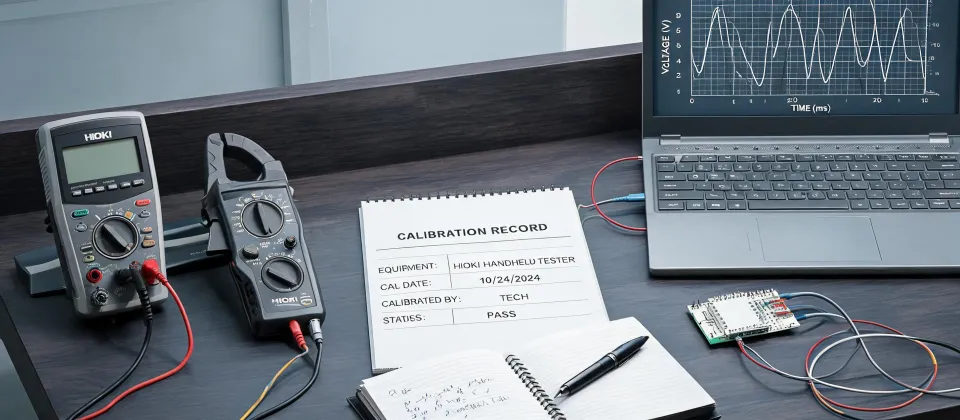
The morning of March 14 started with a text from our senior maintenance tech that I'd been dreading for weeks.
"Motor four is down. Again."
Not "again" as in a recurring issue. "Again" as in we'd just rebuilt that motor two weeks prior. We thought the first failure was age — the motor had run for 12 years without major work. So we replaced the bearings, replaced the seals, cleaned it up, and celebrated our good planning.
Two weeks later, the same breaker tripped.
How cheap multimeters cost us a motor
I'm the office administrator for a 400-person manufacturing plant. I manage purchasing across eight different vendor categories — roughly 60 to 80 orders a year. When the maintenance team needs test equipment, it's my job to research, negotiate, and buy. I report to both operations and finance, which means I'm constantly squeezed between "we need this to work" and "we need this to not cost money."
That pressure is exactly how we ended up with a drawer full of cheap meters. When I took over purchasing in 2020, the maintenance carts had a grab-bag of no-name multimeters — the kind you'd buy for $14 online. I didn't think much of it. A multimeter is a multimeter, right?
Wrong.
Here's what happened with the motor. The tech tested the windings with one of those $14 meters and got a resistance reading that was technically within range. Everything looked normal. So we capped it as an age-related failure, rebuilt the motor, and went back to work.
The most frustrating part is that the meter wasn't obviously broken. It was just slightly off. You'd think a cheap multimeter would stop working if it was out of spec. Instead, it gives you a reading that's almost right — plausible enough to send you in the wrong direction. Twice.
Our contracted electrical engineer finally brought in his own insulation tester. He found that the motor windings had absorbed moisture through a cracked conduit fitting, and the insulation resistance was far below where it should be. The motor wasn't tired; it was wet. And our cheap multimeters couldn't measure insulation resistance at all — that's not a fault of cheapness, it's a difference in instrument type. To measure the health of a motor's insulation, you need a tool that applies a known DC voltage and measures the leakage current. A standard multimeter simply doesn't do that.
That's when the search for a real insulation tester began.
Finding the Hioki IR4053-10 insulation tester
The electrical engineer recommended we buy an insulation tester for the maintenance team. He gave me a clear spec: 500V/1000V test voltages, MΩ measurement range, and a safety rating of CAT III 600V. That last one matters more than most people realize. CAT III 600V means the instrument is designed to handle the transient overvoltages that happen on distribution circuits — motor control panels, branch panels, fixed industrial wiring. Under IEC 61010-1, that's the safety category you want for industrial electrical testing. Instruments without a proper category rating can arc internally or deliver false readings when a circuit does something unexpected.
That spec led me to the Hioki IR4053-10 insulation tester. It matched everything we needed: compact, reliable, easy to read, and with a measurement range wide enough for real plant use. No unnecessary complexity.
I'll admit, I hadn't bought Hioki equipment before. The electrical engineer vouched for the build quality. And the price was fair for the category — noticeably less than the equivalent from the big-name American brand, for essentially the same spec. I checked with two authorized distributors; both were in the same ballpark.
The sensor side quest
While I was deep in tester research, another request landed on my desk. The automation engineer needed two IFM inductive sensors and one long-range distance sensor for the packaging line. It was time-sensitive — the line was running with a temporary setup and he didn't trust it.
Now, if you're wondering where to buy IFM inductive sensors online, the answer is: carefully. IFM is a well-known German sensor brand with authorized distributors, but when you search the web you'll also find marketplace listings that look legitimate and aren't. We learned that the hard way — a suspiciously cheap "IFM" proximity sensor that looked right but had the wrong sensing distance. It almost caused a collision on the line.
This time, I went to IFM's website, used their distributor locator, and bought from an authorized online reseller. It cost about 30% more than the marketplace listing. Worth every penny for documentation and warranty alone. That experience shaped my approach to the Hioki purchase too: verify the source before you hit buy.
The bigger call: Hioki 3196 power quality analyzer
Okay, here's where this story goes from a manageable purchase to a real capital decision. The engineer raised a second issue during our conversations: the plant had intermittent voltage sags. Lights flickered. A CNC controller randomly reset. By the time anyone looked, everything appeared normal.
He explained we needed a power quality analyzer — an instrument that logs voltage, current, harmonics, and transients over days or weeks. You connect it, walk away, and come back to data that shows exactly what happens the moment an anomaly occurs.
The Hioki 3196 power quality analyzer kept coming up in his research. It had the logging capabilities we needed, and its software was straightforward enough that a busy engineering manager wouldn't need a two-day training session to figure it out.
This is where I hit my decision crossroads. I went back and forth between the 3196 and the equivalent from the big-name American competitor for about two weeks. On paper, they were close. The American brand had stronger recognition in the plant. But the Hioki offered comparable measurement performance with a better equipment bundle — the current clamps, test leads, and software we actually needed came included. No nickel-and-diming for accessories. Total cost of ownership was noticeably lower.
Here's something vendors won't tell you: at this tier of test equipment, spec sheets are nearly identical. The difference shows up in the daily workflow — how the instrument boots, how you configure a logging session, how the software exports data. The 3196 felt designed for real-world use, not for spec-sheet bragging.
I chose Hioki.
The results came faster than I expected
The IR4053-10 paid for itself in the first week. Our techs tested every motor in the facility and found two more with insulation resistance at borderline levels. Catching them early meant planned replacement work during a scheduled shutdown instead of emergency failures on a running line. I'd ballpark the avoided downtime at around $8,000.
The 3196 took a bit longer to prove itself, but when it did, it solved a mystery we'd been chasing for months. After six days of logging, the data showed a clear pattern: every voltage sag coincided with the startup of a large exhaust fan. The fan's current draw was dragging down the shared electrical bus just enough to reset the CNC controller. The data also confirmed the sag magnitude and duration fell into the danger zone on the ITIC curve — the standard that shows how much voltage dip sensitive electronics can tolerate.
The fix was a soft starter on the fan motor — a small change that cost under $1,200. It eliminated the problem completely. That's when I became a believer in measuring before guessing.
What I think about Chinese multimeters now
I want to be fair here, because the reputation of Chinese multimeters has genuinely improved. The cheap no-name meters are still a gamble, but mid-range Chinese brands have gotten a lot better in the last five years. For basic continuity checks, battery voltage readings, and general wiring work, they're perfectly serviceable.
But here's the distinction I learned the expensive way: a $40 multimeter is a fine everyday tool. It's not a diagnostic instrument for a plant that runs three shifts. The cost of being wrong isn't the meter's price — it's the failed motor, the production downtime, the emergency service call. The consequence cost dwarfs the instrument cost every single time.
Measurements are only as trustworthy as the instrument that makes them. That is not a slogan. It's a procurement rule now.
The fundamentals of electrical testing haven't changed. But the execution — and the expectations around reliability, safety certification, and traceability — has transformed. What was considered acceptable test equipment in 2020 doesn't cut it anymore, at least not for critical measurements.
Bottom line for other buyers
I've been managing purchasing for five years now, and the biggest shift in my thinking is this: I don't sort purchases by price anymore. I sort them by the cost of being wrong.
If you're evaluating an insulation tester, the Hioki IR4053-10 is a solid choice. If you need to catch intermittent power issues, the Hioki 3196 power quality analyzer is worth a serious look. And if you're trying to figure out where to buy IFM inductive sensors online or need a replacement distance sensor — use the manufacturer's authorized distributor list, and don't gamble on marketplace listings.
Test equipment isn't an expense. It's an insurance policy. And the cheapest policy is only cheap until you need it.