Let me start with a take that might sound odd coming from a purchasing person: I don't actually care that much about getting the lowest price. When I buy test equipment, I care about certainty—knowing the instrument is genuine, calibrated, and going to arrive when I need it. I'll pay for that every single time.
Before you think I'm just a brand snob, let me explain who I am. I'm the office administrator for a 120-person engineering services firm. I manage all equipment and supply ordering—roughly $150,000 annually across 14 vendors. I report to both operations and finance, and my real job is making sure the techs have what they need when they need it. That mostly comes down to two rules: don't buy junk, and don't miss deadlines.
The $28 Meter That Cost Us a Full Day
I didn't always buy quality first. When I took over purchasing in 2021, I trimmed instrument costs by ordering budget-brand multimeters that matched the basic specs on paper. It looked great on the quarterly savings report. Then, in March 2023, it all blew up.
One of our technicians was doing a final resistance check before an electrical audit. The meter—a $28 unit with a safety label that had already started peeling off—gave him a reading that looked perfectly acceptable. It wasn't. The auditor caught the discrepancy, and within an hour our "savings" had turned into a $2,400 rush re-inspection plus a half-day of downtime while the crew re-tested everything with a better instrument.
Nobody on the floor blamed the technician. They blamed the guy who ordered the meter. That guy was me.
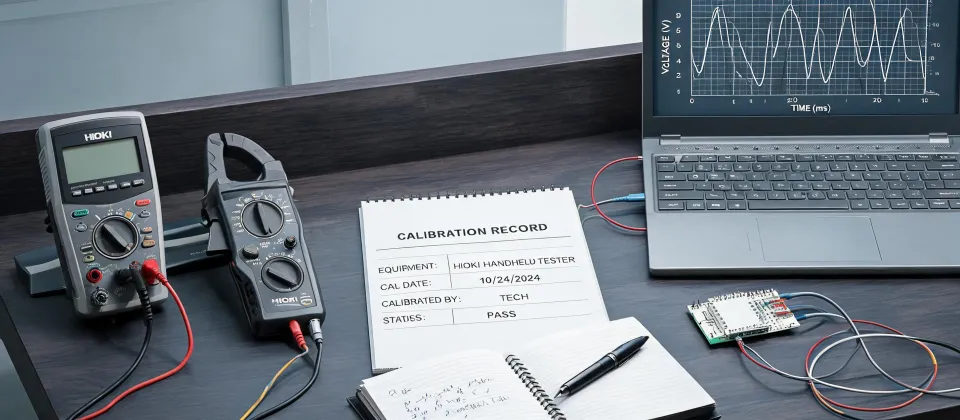
I sat at my desk that afternoon doing the math: one cheap meter had cost us more than an entire set of quality meters would have. That event changed how I think about test gear. It's the reason I now specify instruments like the Hioki DT4252 digital multimeter instead of hunting for the lowest bid.
What a Spreadsheet Doesn't Tell You About Accuracy
Here's the part that never shows up on a spec sheet: a new meter can be accurate on day one and drifting by month six. Budget instruments tend to hold their tolerance for a while, and then they don't. Worse, they fail in ways that don't look like failure—they just give you a slightly wrong answer.
That's the real difference. The DT4252 is not the flashiest-looking meter—the display is fairly plain, honestly. But it's a solid, straightforward instrument for daily electrical work: AC/DC voltage, resistance, continuity, and a safety rating printed right on the front per IEC 61010. No guessing about whether it's rated for the circuit. The budget meter had a safety claim on its label too—until the label peeled off.
I'm not a metrology expert, so take this with a grain of salt: in my experience, the repeatability of a good meter saves more time than any spec sheet suggests. A technician who trusts the reading works faster and makes better calls.
I know some techs are used to the 114 multimeter, a popular entry-level model from another well-known brand. It's a solid instrument. When we compared it side by side with the Hioki, the DT4252 gave us more of what we actually needed for the money—especially since our distributor throws in calibration reminders, not just invoices.
Clamp Meters, Thermometers, and the "Authorized Dealer" Question
The same logic applies to the rest of the test gear. Our electricians carry a Hioki clamp multimeter for current measurements on live panels. Our facilities team uses infrared thermometers to scan motor and breaker temperatures during preventive maintenance. I could buy cheaper versions of every one of those. I stopped doing that.
Why? Because in my first year, I thought I'd found a great deal on an instrument from a third-party marketplace seller. Every spreadsheet line said buy it—it was about 30% below the usual distributor price. My gut said something was off, starting with the seller's insistence on a wire transfer instead of a normal purchase order. I ignored the gut feeling. Turns out the seller wasn't authorized to sell the brand at all.
The serial number didn't match the paperwork, the manual looked photocopied, and finance rejected the invoice. I spent three weeks untangling a chargeback and explaining to the VP why we'd paid for something we couldn't actually use. Lesson learned: I don't ignore that feeling anymore.
Here's the angle people don't usually think about: the administrative cost of a bad purchase is real money too. When I order through an authorized Hioki distributor, I get proper quotations, traceable calibration documents, and an invoice that doesn't make accounting twitch. That alone is worth a premium.
It's the same question our lab team asked before a recent microscope order: "Is Microscope World an authorized Zeiss dealer?" Different product line, same principle. If you're going to verify authorized status for a microscope—which you absolutely should—why wouldn't you verify it for a meter that gets used on live circuits?
When Certainty Is the Product
The biggest reason I pay for certainty, though, is time. In August 2024, a client requested a production line re-commissioning over a weekend. The crew needed an extra Hioki clamp meter and a spare set of thermometers on site. Normally I'd get quotes and wait a week. We had about 36 hours.
I called our distributor, paid for expedited handling and overnight freight, and had everything shipped that same day. Someone from finance—let's call him Ted—questioned the rush charge. I told him: "The certainty is the product."
"If the gear didn't arrive, the client's missed-window penalty was $4,500, and we'd likely lose the next contract to someone more prepared."
Ted stopped questioning. The meter arrived the next morning, calibrated, documented, ready to use. The crew finished on schedule. That $85 rush fee was probably the best money we spent all year.
What if You Only Need a Meter Once a Month?
I can hear the objection: "Not every purchase needs a premium. If you're just checking a battery once a month, the $15 meter is fine."
Honestly? You're not entirely wrong. For non-critical, low-voltage checks, a budget tool is acceptable—I buy them for the storeroom myself. What I'm saying is this: before you make the call on price, ask what the instrument is actually for, and what it costs when it's wrong.
If the answer involves safety, compliance, or a client deadline, then the premium is not a luxury. It's insurance with a display on it. And if the answer is "we need it by Thursday," then the cheapest option is the one that actually shows up. A meter that sits in a warehouse for six days isn't a deal—it's a problem. A meter that gives you a different answer every time you test the same circuit? A technician isn't gonna trust it—and then it's worse than useless.
My Bottom Line
Three years into this job, I've learned that my value to the company isn't measured by how much I save on line items. It's the number of problems that never happen. A reliable multimeter doesn't cause a safety scare. An authorized distributor doesn't generate invoice drama. A delivery that arrives when promised doesn't become a $4,500 phone call on a Friday afternoon.
When I say certainty, I do not mean a brand logo. I mean documentation, traceability, and a person who answers the phone at 4:30 p.m. on a Friday.
So yes—I'll keep paying for certainty. The Hioki clamp meter costs more than the no-name alternative. The DT4252 is not the cheapest digital multimeter in the catalog. And next year's budget will include a line for the distributor who shows up when it matters.
Because in my job, the real savings are the disasters you never have. That's a price I'm glad to pay.