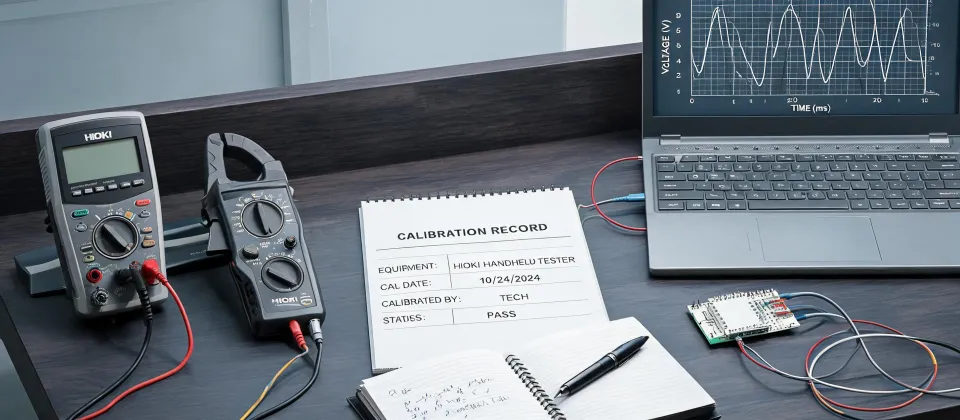
After managing a $180,000 test-equipment budget over six years, here's my blunt conclusion: the brand on the front matters less than the calibration schedule on the back, and Hioki gives the best total cost of ownership for most electrical testing needs. I've bought Fluke, Hioki, Mitutoyo, Starrett, and a few cheap things I still regret. The cheapest meter I ever bought ended up costing us $1,200 in rework. The expensive ones, with proper calibration, paid for themselves within a year.
The short answer, if you're in a hurry
If someone asked me today what to put in a first-year maintenance toolbox, I'd spec a Hioki 3030-10 analog multimeter for troubleshooting, a Hioki insulation tester IR4056 for motor and cable checks, a basic pH meter with a calibration routine, a digital micrometer set from Mitutoyo, and calipers from either Mitutoyo or Starrett—but only after committing to a check process.
- Hioki 3030-10 analog multimeter: roughly $80-100 based on our January 2025 distributor quote; verify current pricing. It needs no battery for voltage readings, and its needle shows slow changes better than any digital bar graph.
- Hioki insulation tester IR4056: small, reliable, and our go-to for routine motor-insulation checks. We paid around $400 on our January 2025 quote, though I might be misremembering the exact line item.
- pH meter calibration: the area where people waste the most money. A $250 meter calibrated daily is worth more than a $1,200 meter checked monthly.
- Digital micrometer set: buy a set in a protective case. The set price is usually lower than buying individually, and you're less likely to lose a piece. Mitutoyo is my default.
- Starrett vs Mitutoyo calipers: either brand works. Differences are feel and price, not accuracy in normal shop conditions. Details below.
That's the short version. Now let me explain why I trust these choices, because you shouldn't take a stranger's recommendation without receipts.
Where my opinion comes from
I'm a procurement manager at a 40-person electrical contracting company. We spend about $30,000 a year on test equipment, tooling, and calibration services. I've tracked every purchase order and repair invoice in a spreadsheet for six years—maybe more, I'd have to check—and that history has changed how I buy.
One of my biggest regrets: early on, I bought a cheap no-name multimeter to save $40. It read 120 V on a line that was actually 208 V. That was a $1,200 redo when a technician used the reading to commission a subpanel and we had to pull a crew back. I still kick myself for not checking the meter's accuracy before handing it out. The cheap meter failed, but the real failure was my process.
We didn't have a formal verification process for new instruments then. It cost us when a calibrated shipment didn't include certificates and we didn't catch it until an auditor asked. Since then, I've implemented a checklist: every new tool gets logged, zero-checked, and assigned a calibration due date before it goes to the truck.
The math I actually use
When I compare tools, I put five numbers in a spreadsheet: quoted price, calibration cost per year, expected repair rate, downtime cost if it fails, and rework liability if it reads wrong. The first number is the easiest to see and the least important.
Take digital calipers. A $20 caliper and a $150 Mitutoyo both read 1.000 inches on a gauge block the day you buy them. But the $20 one drifts after a few months, and if a machinist doesn't zero-check it, a bad part can cost more than the caliper. That's why I separate price from cost.
Why Hioki for electrical test gear?
I'm not going to pretend Hioki is objectively better than Fluke in every way. That'd be a dumb argument. Fluke has an excellent support network and some genuinely unique models. But in side-by-side quotes, Hioki consistently comes in lower for equivalent specs, and in our field use, the measurements line up. From a TCO perspective, Hioki has saved us roughly 25-30% compared to the equivalent Fluke orders in our 2023 purchases. That's not a knock on Fluke—it's just arithmetic.
The Hioki 3030-10 analog multimeter
You're probably wondering why I'd recommend an analog meter in a digital world. Fair question. I use the 3030-10 as a troubleshooting secondary meter because the needle shows fluctuations you'd miss on a blinking digital screen. It's also simple: no battery needed for voltage, less to fail in damp environments. We bought three in 2024, and they've held up. The needle takes some getting used to if you've grown up on digital, but it's a skill worth learning.
The Hioki IR4056 insulation tester
The IR4056 is, to be honest, the tool I spec when the boss asks the safest and least painful way to check insulation. It has a compact body, a bright digital readout with a bar graph, and, according to Hioki's spec sheet, insulation test voltages up to 1000 V. We use it for routine checks on motor windings and cable insulation. It's not glamorous. It just works. Our field crew hasn't complained about it once, which is the highest praise I can give a test instrument.
The boring money saver: calibration
Let's talk about pH meter calibration, because it's the one item on this list where you can save money by spending money. A pH meter is only as good as its last calibration. Electrodes drift, buffers age, temperatures change. If you're using a pH meter to check a plating bath or wastewater, that drift means your readings are guesses.
In 2023, I checked our calibration log and saw that one pH meter hadn't been calibrated in six weeks. The buffer solution was expired, too. That meter had been generating normal readings for a process that was actually out of spec. The rework bill was $2,800. I still can't believe I let that slide.
Now we follow a simple rule: calibrate pH meters at the start of every shift, verify with a second buffer, and log the reading. It takes five minutes. It saves us from ever having a mystery cost like that again. Five minutes of verification beats five days of correction.
Calibration is not just for pH meters
Your digital micrometer set and calipers also need checks, but not as often. If they're used daily, a quick zero check with a gauge block is enough between annual calibrations. For the cost-conscious buyer: don't skip annual NIST-traceable calibration for anything you use for acceptance testing. It's brutal to explain to a client why your measurements aren't defensible. We send our micrometers and calipers to an ISO 17025 accredited lab every 12 months. It costs around $75 per tool, which is cheaper than trying to defend an untraceable measurement in a dispute.
Starrett vs Mitutoyo calipers: the real answer
This is probably the most-searched comparison in our industry, so let me give you the answer I'd give a colleague over coffee. Both Starrett and Mitutoyo make calipers I'd trust for daily shop use. The difference is feel, price, and service, not accuracy at the 0.001-inch level. Per their published specs, both are within that tolerance for standard shop measurements.
We own both in our QC toolbox: a Starrett 1202M and a Mitutoyo 500-197. They measure the same. The Mitutoyo was about 30% less expensive in our last quote, and its housing feels a little more plastic-y. The Starrett has a heftier beam and a nicer feel in the hand, but it costs more. If I needed to equip five technicians tomorrow, I'd buy Mitutoyo calipers for four of them and let the pickiest one get the Starrett. That's not a technical victory—it's a budget decision.
I have mixed feelings about recommending Starrett over Mitutoyo. On one hand, the Starrett feels better in my hand and I enjoy using it. On the other, I can't justify paying 30% more for that feeling when the measurement results are identical. If I'm spending your budget, I'll get the Mitutoyo and spend the difference on calibration.
For a digital micrometer set, I'd skip the debate entirely and standardize on Mitutoyo. Why? The set comes in a fitted case, the ranges match, and the consistency across tools makes training easy. A micrometer set is a long-term purchase. I'd rather have all mics from one manufacturer so spare parts and calibration procedures are uniform. Starrett mics are great tools—I just don't see enough advantage to mix brands across a set.
When I say digital micrometer set, I mean the standard range of mics from 0-1 inch up to 3-4 inches in a fitted case. We bought a four-piece Mitutoyo set last year. It cost more than two individual mics, but the case keeps everything together and the calibration due date tag in the lid has saved me from at least one audit finding. A set is not just a collection of tools; it's a small system.
The boundary conditions: when I'd ignore all of this
Not every situation needs a $400 insulation tester or a calibrated micrometer set. To be fair, the folks doing occasional DIY projects can get away with a $30 multimeter and a cheap caliper. Budget realities exist.
If you're a one-person shop doing hobby builds, buy the Hioki 3030-10 because it's dependable and affordable, but don't build a full calibration program. If you're a startup doing prototype work, spend your money on a good pH meter and calibrate it often. If you're running a certified machine shop, you should already have a metrology program—and if you don't, a Starrett vs Mitutoyo decision is the least of your worries.
Also, if you need ultra-precise measurements below 0.0001 inch, a digital micrometer set isn't the answer. You need a bench micrometer, gauge blocks, and controlled environmental conditions. Know your tolerance before you buy your tooling.
And to restate the point I made at the start: the highest-cost item in the maintenance budget is usually the cheap tool that creates rework. Buy quality, calibrate it, and log it. That's the whole essay.