Thursday, 3:47 PM. My phone did that rattle that means 'not another emergency.' The voice on the other end was a lab manager at a food plant about 90 minutes away. They had a new production line being commissioned on Monday, and the maintenance team had just realized the existing electrical meters were not going to get them through it. The old voltage tester was giving nonsense readings around a variable-frequency drive, their backup multimeter was missing a fuse, the QC department needed calipers with actual calibration certs, and the lab needed a new centrifuge for oil sample prep because the old one had stopped spinning two days earlier.
If you've ever had a supply order go sideways, you know that feeling: the one where the calendar stops being a suggestion. I've handled 200+ rush orders in seven years of coordinating urgent equipment sourcing. This one had a $50,000 penalty clause attached to the Monday deadline. So my first question wasn't 'what's your budget?' It was 'how many hours do we have?'
The shopping list wasn't the problem. The choices were.
Here's the thing: basically every item on that list had a cheap version and a responsible version. And the cheap version always tries to argue with you.
Clamp meter: Hioki CM4376 vs the 'good enough' option
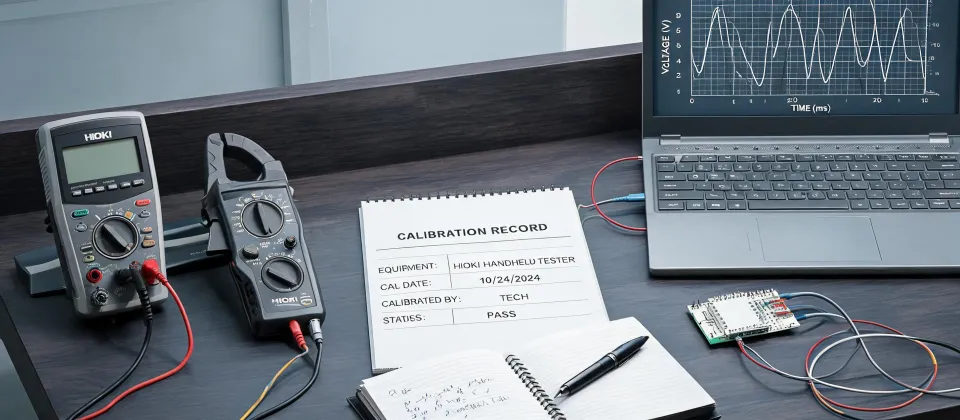
The electrician wanted a clamp meter that could handle a VFD without throwing a bad reading. I pulled up the Hioki CM4376 clamp meter specifications as of January 2025, and two features stood out: a low-pass filter for VFD applications and a CAT IV rating for the breaker panel they'd be working near. The spec sheet also said true RMS, which sounds obvious, but it matters when the waveform isn't a clean sine wave. The CAT rating follows IEC 61010, not marketing. If a meter doesn't have that rating, it doesn't go near a panel.
Then I looked at the price. Honestly, the Hioki multimeter price compared to the generic import was ... more. Not a little more. Enough that I could see the buyer's eyebrow rising from across the room.
But here's the math that mattered. The cheap clamp meter was in stock at a local warehouse. The Hioki needed overnight freight, which added $40 to the order. The total difference was about $200. The risk if we saved that $200? A bad reading, a misdiagnosed drive, a missed deadline, and a $50,000 penalty. That's not a gamble. That's setting money on fire and calling it a budget.
This wasn't just theory. In 2023, a $2,000 'savings' on a rush replacement part turned into a $12,000 problem when we had to pay for express freight and a contractor's idle time. The quote sheet said buy the cheap one. My gut said no. I went with my gut.
Then came the fuse
This should have been the easiest item. The backup multimeter on the shelf was missing a fuse. Specifically, a 115 multimeter fuse—a small part, maybe $8. The plant had three options: standard shipping at $6 in five days, expedited at $22 in two days, or overnight at $38.
The admin almost chose standard shipping. I caught myself saying 'whoa, wait.'
We weren't ordering that fuse for fun. It was the backup for a primary meter that was already unreliable. If the primary failed on Monday and the backup was still waiting for a fuse, we were done. So we paid the $38. Did I feel silly? A little. Did I regret it later? No—because Tuesday morning the primary meter died. That little fuse turned a potential crisis into a twenty-minute fix. A no-brainer, in hindsight.
Calipers: Starrett vs Mitutoyo digital calipers
The QC tech asked a question I hear a lot: Starrett vs Mitutoyo digital calipers—which one should we get? My answer was: 'Depends on what you're measuring and how long you plan to keep them.'
For this job, the QC team was doing incoming inspection on machined parts with tolerances they didn't fully trust. We looked at two models: a lower-cost Starrett and a Mitutoyo Absolute. Both are solid brands. I'm not going to tell you one is universally better, because that's not true. But the maintenance department already used Mitutoyo on another line, so the training cost was zero. The Starrett had a nicer case and a slightly more familiar feel for some techs. In the end, we made the call based on existing tooling and training, not on the price tag.
(Full disclosure: my experience with calipers is from the maintenance and QC side, not from machining 4,000 parts a day. If you're in a production CNC environment, your priorities might be different.)
The centrifuge 5702 and the 'safe' upsell
The lab manager didn't ask me to compare brands for the Eppendorf centrifuge 5702. She specified it. But her purchasing department pushed back: a competitor offered a similar-looking centrifuge for $300 less. I let them go back and forth for a bit, then asked one question: 'Does the cheaper one use the same tubes and rotor as your existing method? And will the service contract cover a 72-hour response?'
Neither answer was yes. The centrifuge 5702 wasn't a luxury choice. It was the standard the lab's procedures were already built around. Switching to save $300 would have meant new tubes, new validation, and a week of downtime. The 'upsell' was actually the least expensive option.
What arrived, and what happened
Everything landed by 10:30 AM Monday. Not early, but not late. The CM4376 found the VFD issue in the first hour—a misconfigured carrier frequency that was sending harmonic current through the motor leads. The calipers passed the QC manager's check. The centrifuge 5702 clicked into place with the existing rotor. The fuse sat in the drawer, looking unimpressive and priceless at the same time.
If we'd gone with the cheaper alternatives, any single failure among those four items could have killed the deadline. Instead, we had one good reading, one working backup, one pair of calipers the QC team could trust, and one centrifuge that didn't make the lab revalidate anything.
The takeaway
The price tag is the smallest part of an instrument's cost. The real cost is the cost of being wrong. I've watched the Hioki multimeter price question come up in meetings, and I understand it. These tools aren't cheap. But neither is finding out on a Monday morning that the number on the screen doesn't match what's actually in the wire.
So next time you're comparing two options and one is $200 less, ask yourself: if this one fails, what does it actually cost?
If you can't answer that, you're not comparing prices. You're just gambling.
This was accurate as of January 2025. Instrument specs and prices change faster than most of us expect, so verify current product details before you sign a PO. Also, my experience is based on mid-size industrial maintenance and lab support. It may not translate 1:1 to every industry—trust someone who lives in your specific environment.
