-
How I became the test equipment buyer
-
The twist: our "trusted" IR thermometer was lying to us
-
Doing the homework: Hioki multimeter review threads and spec sheets
-
The Fluke vs FLIR thermal cameras decision
-
The lab side: a 5804r centrifuge and a vendor who wasn't qualified
-
What this taught me about buying test equipment
It was a Tuesday morning in March 2024 when Mark from maintenance appeared at my desk holding a multimeter with a cracked display and leads that looked like they'd been chewed by something. The thing wasn't even that old. But it had stopped reading correctly, and he'd trusted it twice—once it nearly got him a shock, and the second time it cost the crew an entire afternoon troubleshooting a motor that was fine.
"Order me three replacements," he said. "And this time, get something decent. We're kinda done with cheap tools around here."
That's easier said than done when you're the person who has to justify every line item to finance.
How I became the test equipment buyer
I've been the office administrator for our company since 2020—about 200 employees across three locations. I handle purchasing for maintenance, facilities, and some lab supplies. Roughly 60 to 80 orders a year, spread across eight or so vendors, totaling somewhere around $80,000 annually. I report to both operations and finance, which means I live and breathe the tension between "get it cheap" and "make it last."
When I first took over purchasing, I made mistakes that still sting. I once chose a vendor based on a price quote alone and ended up with a handwritten receipt that finance rejected. I ate $2,400 from the department budget on that one. It taught me to verify invoicing capability before placing an order. But more importantly, it taught me that the cheapest option has a way of becoming the most expensive one.
The twist: our "trusted" IR thermometer was lying to us
Here's something most people don't realize about IR thermometers: they're genuinely useful tools, but they have known blind spots. Reflective surfaces can throw off readings by 20 degrees or more unless you account for emissivity. Our maintenance team didn't know that. Neither did I.
We had a cheap IR thermometer—about a hundred and twenty dollars—that had lived in the tool room for years. It looked fine. It had a laser pointer. The readings seemed plausible. But when Mark's crew used it to check a circuit breaker that kept tripping, it read "normal" every single time.
That wasn't a fun day. The electrician eventually pulled the panel apart anyway, found a loose bus bar connection, and the whole investigation cost us about $3,000 in downtime and labor. All because nobody fully trusted the readings, yet nobody could prove they were wrong fast enough either.
When we finally compared that cheap unit side by side with a quality instrument, the truth was hard to miss. On a painted surface it was close. On a copper bus bar, the cheap one read 23 degrees low. Twenty-three. That's not a rounding error.
Everything I'd read about budget tools suggested they were "90 percent as good" as professional ones. In practice, for our specific use case, that was wrong. A tool that gives you false confidence isn't 90 percent as good. It's worse than no tool at all.
Doing the homework: Hioki multimeter review threads and spec sheets
So I started researching in earnest. I spent more hours than I care to admit scrolling through forums, spec sheets, and customer reviews. I wanted data, not marketing.
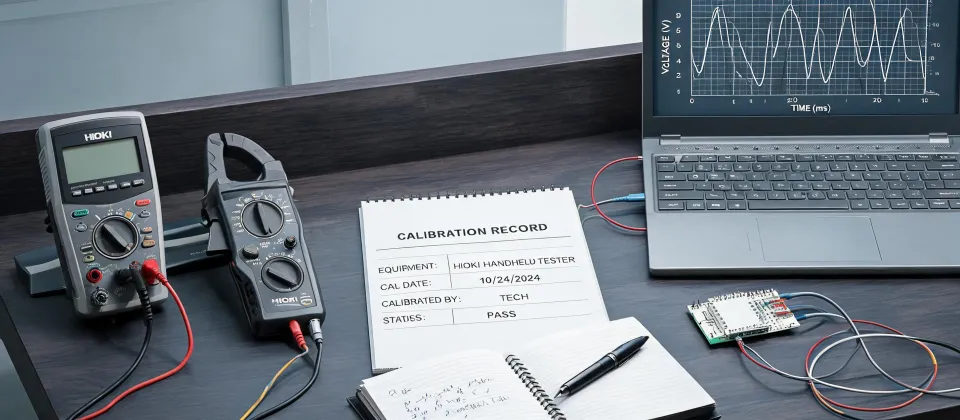
Hioki kept coming up. Their multimeters were consistently mentioned as accurate, reliable, and—this matters when finance pushes back—reasonably priced compared to the go-to brand our team had always used. Reading through dozens of Hioki multimeter review threads, the pattern was surprisingly consistent:
- Safety ratings met IEC 61010-1 standards with solid CAT III and CAT IV coverage for the models we needed.
- Accuracy specs held up well against the competition, at a price point roughly 20 percent lower for the equivalent configuration.
- Build quality got a lot of mentions—Japanese engineering, a reputation for instruments that survive the field.
- Documentation was complete, with clear calibration intervals and proper paperwork. That made vendor qualification easier for our finance team.
Nobody said the Hioki multimeter was perfect. A few reviewers mentioned the button layout takes some getting used to, and one electrician on a forum said his old meter was more intuitive. Fair enough. No tool is perfect for everyone. But for our maintenance techs, the Hioki multimeter offered everything we needed and nothing we didn't. We ordered three, and if they hold up even close to what the reviews suggested, they'll pay for themselves in a year.
The Fluke vs FLIR thermal cameras decision
The thermal camera was the hardest call.
Mark's first instinct was Fluke. He'd used Fluke meters since trade school and trusts the brand deeply. But when I started comparing Fluke vs FLIR thermal cameras within our budget, it wasn't as obvious as he expected.
Fluke's imaging tools are heavily tuned for electrical work—the measurement presets, the interface language, even the included software assume you're looking at breaker panels and motor drives. The integration with their other instruments is genuinely nice if you're already in that ecosystem.
FLIR, on the other hand, tends to offer more resolution per dollar. Their cameras are broadly used across building inspection and mechanical applications, and the entry pricing is often lower. On paper, we could save maybe 15 percent going with FLIR.
We were about to go with FLIR purely on cost. Then I remembered the IR thermometer and forced myself to look at the full picture: software licensing, training time, and whether the camera would match our team's actual workflows. For our specific use—electrical panels, occasional mechanical checks—Fluke made more sense. The software license was included, the interface was closer to what the techs already knew from their meters, and the measurement tools were tuned for electrical diagnostics.
I'll be straight with you: for a general-purpose inspection team, the FLIR camera was probably the better value. But for us, it wasn't. We went with Fluke.
The lab side: a 5804r centrifuge and a vendor who wasn't qualified
While I was buried in spec sheets, our lab manager walked into my office with her own headache. The 5804r centrifuge in the lab—that's the refrigerated model, about five years old—needed its annual service. A third-party company had approached her with a quote roughly 40 percent below the certified service contract.
"Can we take it?" she asked.
The centrifuge isn't technically in my portfolio, but she knew about the handwritten receipt disaster and wanted my take.
Everything about that quote reminded me of the IR thermometer. The third-party vendor couldn't document that their technicians were certified by the manufacturer. They couldn't guarantee genuine parts. The price was tempting—40 percent is real money. But if they misdiagnosed a sealed refrigeration system, the repair cost would blow right through those savings.
We stuck with the certified service. It cost more upfront. It also came with a written report, a warranty, and a vendor who would actually answer the phone when something went wrong. What most buyers miss in these situations isn't the obvious cost difference—it's the cost of being wrong. A 5804r centrifuge that goes down mid-experiment can ruin samples, delay research, and burn way more than 40 percent of anything you saved.
We retired the cheap IR thermometer, too. Replaced it with one that has adjustable emissivity settings, proper documentation, and a price tag that made finance wince for about five seconds. It's now the reference unit for the maintenance team.
The old one? I kept it around for a while as a reminder. Then I threw it out. Every time I looked at it, I thought about that $3,000 lesson.
Mark asked me once if I'd do it differently now that I know better. "Yes," I told him. "I'd have questioned those readings instead of accepting them because the price was right." There's something satisfying about watching the crew use tools that just work. No second-guessing. No "is it the meter or is it the circuit?" No late-night calls about readings that don't make sense.
What this taught me about buying test equipment
If you're shopping for a multimeter, an IR thermometer, a thermal camera, or lab equipment like that centrifuge, here's my honest advice from five years of doing this:
First, set a budget but don't sort by price. The cheapest option rarely turns out to be the cheapest. Look at total cost of ownership: calibration cycles, replacement timelines, downtime from a wrong reading. A bad measurement can cost more than the instrument itself.
Second, check the safety ratings before the discount. For electrical testing, IEC 61010-1 and CAT safety ratings are non-negotiable. I don't care how good a deal a multimeter is if it's not rated for the work it's doing.
Third, talk to the people who'll actually use the tools. Mark wanted Fluke because he'd always used Fluke. When we looked at the Hioki multimeter review evidence together, he could see why it made sense for our budget. The Fluke vs FLIR debate also ended with the team's actual workflow, not with brand loyalty. Know the brand reputation. But know your use case better.
Fourth, watch for the hidden costs. Software licenses, service certification, technician training, calibration documentation. These add up faster than the price difference between two tools.
In my experience managing these purchases for over five years, the lowest quote has come back to cost us more about 60 percent of the time. That's not an exaggeration, and it's not a sales pitch. It's just the math of buying things that need to work, in environments where failure is expensive.
If you're in a similar position, I hope you learn this lesson without your own $3,000 infrared story. But if you're like me, you probably need to get burned once first. Some lessons just aren't cheaper.