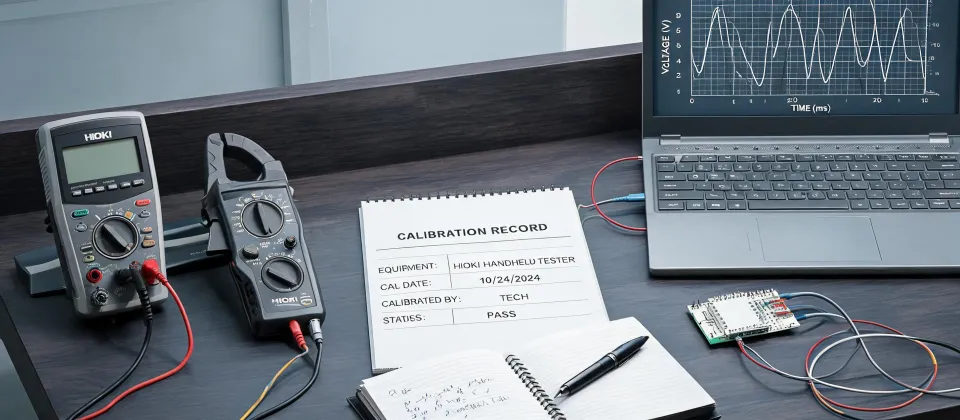
June 2017. I'd just been promoted to maintenance supervisor at a food processing plant in the Midwest. My first serious project: equip a brand-new maintenance workshop. Tool cabinets, benches, testing gear—everything. I had a budget, a three-week deadline, and a purchasing team that made it clear every choice had my name on it.
At the time, I thought being a responsible budget owner meant one thing: spend as little as possible. I went through that instrument list for three days and managed to trim 31% off the total. I remember typing the number into my monthly report and feeling genuinely proud. In hindsight, that 31% "savings" was one of the most expensive bargains of my career.
I bought one thermal camera—the cheapest one that would connect to my phone—one no-name clamp meter from an online marketplace, and a budget digital multimeter. While I was at it, I also signed for the QC lab's order because their lab manager was out on leave. I negotiated the 5 ml pipette quote down from the brand-name model to a generic one. Same volume, supposedly. A third of the price.
Total saved: about $400. Total cost of that decision over the next eight months: $15,400 in documented losses, one burned-out motor, one welded contactor, and a lab manager whose look could peel paint.
The Thermal Camera and the Glass Problem
The thermal camera made me feel like a superhero. I swept motors, breakers, busbars, and bearing housings like I'd been doing it forever. Then I scanned the main motor control cabinet through its glass window. Clean. Green. "Panel OK," I wrote in the inspection log.
Here's what you need to know: thermal cameras cannot see through glass. Not mine. Not a FLIR. Not any thermal imager. Glass reflects infrared and blocks almost everything behind it. If you point one at a panel door, you're measuring the glass temperature, not the terminals behind it.
This is probably the most searched question in thermal imaging—people usually type it as can thermal cameras see through glass flir. The answer never changes. No. Open the cover, or you're collecting a pretty picture instead of a diagnosis.
Two weeks after my "clean" scan, the contactor inside that panel welded itself shut. The line tripped, and we lost six hours of packaging time. When I opened the door, the damage was obvious: a burned, blackened contactor that had been heating up for weeks. A scan without the glass would have caught it instantly. My camera, though, was an 80-by-60-pixel toy pretending to be a tool. The failure ran about $1,100 in parts and lost production. That was the appetizer.
The Clamp Meter That Killed a 15 kW Motor
The main course involved a no-name clamp meter. A ventilation fan kept tripping its overload relay. I clamped my meter onto one phase and read 4.1 amps. The motor's full-load rating was 7.5 amps. 4.1 seemed fine, so I cleared the overload and put the fan back to work.
Three weeks later, the motor burned out. The repair shop found cracked winding insulation from sustained overheating. The bearings had been seizing, which made the motor work harder and harder—but my meter never caught it.
After the replacement was installed, I checked again: 4.2 amps. Then I borrowed a true-RMS clamp meter from a friend at another plant. It read 6.8 amps on all three phases.
Six point eight. Not 4.2.
The fan was fed by a variable frequency drive, and VFD currents aren't clean sine waves. A non-true-RMS meter reads the average and applies a sine-wave correction. In distorted waveforms, that correction lies. The number looked calm while the motor was basically cooking itself.
To be fair, that cheap meter was fine for fixed-frequency circuits. But that's an outsider blind spot: most buyers focus on the sticker price and completely miss the difference between average-reading and true-RMS. The question everyone asks is "what does it cost?" The question they should ask is "can it read the signals I actually have?"
The motor repair and downtime cost about $12,000 all-in. My cheap meter saved me $160 on the purchase.
Even the 5 ml Pipette Bit Me
By then, you'd think I'd learned. I hadn't. The generic 5 ml pipette I ordered for the QC lab—the one that saved $120—started producing inconsistent sample volumes within a week. Some batches came out 5.2 ml, some 4.8 ml. Then a customer's samples failed because their volumes were outside the required range.
We re-ran an entire day of samples, burned about $300 in technician time, and missed a deadline that strained a relationship we'd spent years building. I ordered the original brand-name pipette the next morning. A cheap 5 ml pipette drifts; a decent one holds its calibration. Calibration drift is the hidden tax you don't see on the invoice.
The Reckoning
After the motor failure, I sat down with a spreadsheet and documented everything—I still have the file saved as "Mistake Log 2017.docx." The numbers didn't leave much room for interpretation:
- Thermal camera "savings": $180. Failure cost: ~$1,100.
- Clamp meter "savings": $160. Failure cost: ~$12,000.
- 5 ml pipette "savings": $120. Failure cost: ~$300 plus customer goodwill.
The bottom line: I saved about $460 on the way in and paid roughly $15,400 on the way out. That was the trigger event that changed how I think about measurement equipment. I get why budget owners buy cheap gear—budgets are real. But from the outside, buying cheaper instruments looks like fiscal discipline. The reality is that you've traded a small, predictable cost for a large, unpredictable one.
Switching to Hioki
At the next county plant managers' meeting, I asked the veterans what they actually carried in their tool bags. The name that came back over and over was Hioki. Japanese engineering, making electrical test equipment since 1935. Not the cheapest. Not flashy. But every person I asked said the same thing: the readings are true.
I ordered a Hioki analog multimeter first. Yes, analog. People look at me funny when they see the needle, but there's a reason it sits on my bench: near a VFD, cheap digital meters flicker through averages, and your brain fills in whatever it wants. The needle settles on a real number. It still feels like a precision tool every time I pick it up.
Then I swallowed the price and ordered a proper true-RMS clamp meter. The Hioki clamp meter price was in the $200 to $300 range depending on the model—about three times what I'd paid for the no-name. I stared at the shopping cart for two days. As of January 2025, Hioki's publicly listed pricing for entry-level true-RMS clamp meters sits in a similar ballpark. Verify current prices at hioki.com, of course.
What does that price actually buy? Published accuracy specs with conditions. A CAT III/CAT IV safety rating per IEC 61010-1. A body that can survive a drop onto concrete. The cheap meter listed "accuracy ±2.5% + 3 digits" and nothing else—no temperature range, no calibration interval, no safety rating at all. That should have been a red flag the day I read it.
I looked at Fluke too—their gear is excellent—but the Hioki catalog had the functions I needed at a more sensible price. Two years later, the Hioki meters have never once made me double-check a reading. That's a feeling you can't put on a purchase order.
The Checklist I Use Now
Take it from someone with the repair invoices to prove it: price alone is not a purchasing strategy. Since Q1 2018, our team has run every instrument through the same pre-purchase checklist. It's caught 37 "good deals" that would have failed us.
- True RMS? If the load could ever be fed by a VFD, this is non-negotiable.
- CAT rating? CAT III for distribution panels, CAT IV for service entrances—per IEC 61010-1. No rating listed? Move on.
- Accuracy specs? Published as % of reading plus counts, with temperature and calibration conditions.
- Calibration plan? If you can't calibrate it, it's a liability wearing a battery.
- Build and IP rating? It'll get dropped. Plan for that.
- Total cost of ownership? Sticker price plus failures avoided plus lifespan. Not just the number on the box.
If you're still wondering about thermal imaging, here's the answer I wish someone had left on my desk seven years ago: no, thermal cameras can't see through glass, FLIR or otherwise. And no, cheap test equipment can't save you money. The Hioki clamp meter price felt like a luxury at the time. Compared to the motor it would have saved, it was the cheapest no-brainer I never acted on.
In my opinion, value is what's left when you add up everything a purchase cost you—and everything it prevented. I paid $15,400 for that lesson. Take it from me and don't repeat it.