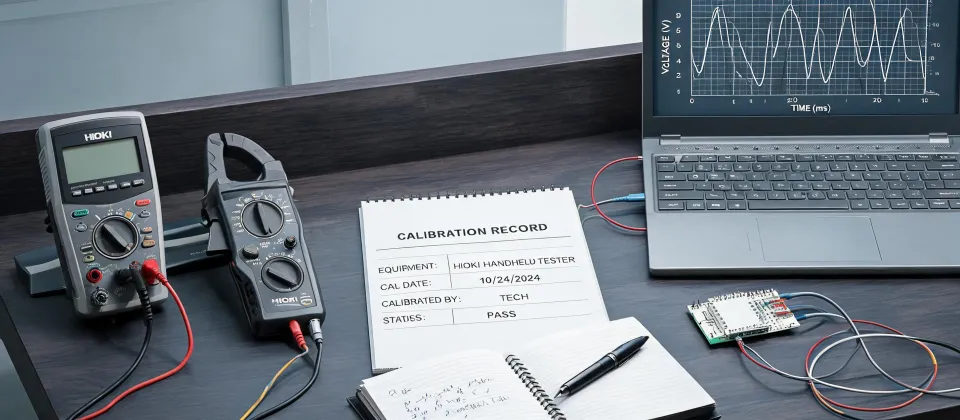
Your Test Equipment Is Outdated. Stop Pretending Otherwise.
Let me say this plainly: if your electrical troubleshooting toolkit hasn't changed since 2015, you're missing faults. Not might be missing them. You are missing them. I've watched it happen on enough site visits that I've stopped being polite about it.
In my role as a field engineer handling emergency electrical failures, I've been on 200+ urgent calls across manufacturing plants, data centers, and commercial buildings. Last year alone, we processed 47 emergency requests. In 31 of those cases, the root cause was invisible to the client's existing test equipment. Not hidden. Invisible.
The industry evolved. Your measurement strategy probably hasn't.
Power quality: the problem you don't know you have
Here's something vendors won't tell you: the accuracy specs on power quality analyzers are measured under ideal lab conditions—clean power, stable temperature, no interference. Real panel rooms? Different story. But that's actually the least of your problems.
The bigger issue is that most facilities don't own a power quality analyzer at all. They've got a multimeter and a clamp meter, and they expect those two tools to catch everything from transient events to voltage sags to harmonic distortion. They can't. Physically can't. Those tools were never designed for that job.
The Hioki PQ3198 changed how I approach these investigations. When I first reviewed it, I'll admit I was skeptical. Another expensive analyzer with proprietary software? But the data quality won me over fast. The sampling rate catches transients I used to assume were simply impossible to capture in the field. The event waveform recording shows exactly what happened before, during, and after a disturbance—no guesswork. And the logging capacity lets me leave it connected to a distribution panel for two or three weeks without worrying about memory filling up.
In March 2024, a client called at 4 PM on a Thursday. Their production line had been tripping intermittently for three months. Two contractors had come and gone. Nothing found. Their maintenance team had tested everything with a multimeter and a thermal camera—both read fine.
We installed the PQ3198 on the main distribution board. Within 48 hours, it found the source: voltage sags down to 78% of nominal, lasting 250 milliseconds, triggered every time the neighboring facility's chiller kicked on. The fault was on the utility side, outside the client's building entirely. Their old equipment couldn't see those sags. The PQ3198 caught it, quantified it, and showed us the direction it was coming from.
So glad we brought the analyzer that day. Almost left it in the van to save time, which would have meant another week of chasing ghosts.
Clamp meter specifications actually matter
When the Hioki CM4376 clamp meter specifications first crossed my desk, I rolled my eyes. Another True RMS clamp meter? There are dozens. The category is crowded. What could this one possibly do differently?
Then I used it side by side with an old averaging-response meter on the same conductor. The difference was not subtle.
The motor was drawing 47A per the CM4376. The old meter said 31A. Same wire. Same load. Same moment in time.
Thirty-four percent low. That's the kind of error that changes decisions. A cable at 80% of ampacity can be tolerated. A cable at 120% ampacity is a fire risk. Without True RMS capability, you literally can't tell the difference in a facility with VFDs, LED lighting, or switching power supplies—which is every modern building.
What most people don't realize is that non-linear loads create harmonic currents that confuse averaging circuitry. The CM4376 handles this with true RMS measurement, plus a low-pass filter for times when you specifically want the fundamental frequency. And it's CAT IV rated, which matters when you're working at the service entrance where fault currents are highest.
Yeah, it costs more than that $80 meter in your drawer. It also gives you numbers you can actually rely on.
Insulation testing: trends, not snapshots
Insulation resistance testing is where I see the most stubborn resistance to change. The old habit: grab a simple megohmmeter, hold it on the cable for 60 seconds, check if the number clears some threshold, and move on.
Old habit. Not best practice.
The Hioki 1555 insulation tester changed how I think about this entirely. It gives you the standard spot reading, sure, but it also calculates the dielectric absorption ratio and polarization index—measurements that show the trend of insulation condition, not just where it happens to be at one moment.
That distinction isn't theoretical. Last December, a food processing plant had two motors that both tested above 100 MΩ on a spot reading. Sounds fine, right? But the 1555's PI function showed one motor at 3.5—excellent—and the other at 1.2, which indicates absorption and moisture. Six weeks later, the second motor failed catastrophically.
The spot reading said everything was fine. The trend said the truth.
Thermal imaging: not optional anymore
This one's quick: if you don't carry a thermal camera, you're working blind.
The Hioki C5 compact thermal imaging camera is the easiest equipment upgrade I can recommend. It's small enough to keep in a tool bag. It's simple enough that a first-year apprentice can use it correctly. And it catches what electrical measurements can't show you: the heat signature of a loose connection or overloaded conductor before it turns into a failure.
Last summer, I did a routine thermal scan on a client's switchgear. Found a single lug at 87°C while its adjacent connections sat at 34°C. That lug was perhaps two weeks from catastrophic failure. The client's alternative was a $50,000 unplanned shutdown plus lost production. Ten minutes with a C5 caught it.
There's something satisfying about catching a problem before it becomes an emergency instead of cleaning up the aftermath.
"But my old tools still work fine"
I get this response a lot. Honestly, I understand it. Test equipment is expensive, and if a meter still turns on and displays numbers, most people assume it's doing its job.
But consider this: a mechanical Starrett micrometer from 1975 still measures dimensions. It's a quality instrument, and knowing how to use a Starrett micrometer properly—checking calibration, using the ratchet stop for consistent tension, reading the vernier scale carefully—is a legitimate skill that still produces reliable results.
Nobody argues it's useless. But nobody uses a micrometer to measure surface finish or geometric runout either. The measurement landscape evolved. The old tool remains fine for some jobs and genuinely insufficient for others.
Electrical testing is the same situation exactly. Your old equipment works fine for simple voltage checks and basic continuity tests. But the electrical environment has fundamentally changed—non-linear loads, harmonics, variable frequency drives, sensitive electronics, distributed generation. The tools have evolved to match that reality. Whether you evolve with them is a decision you get to make.
Where that leaves us
The fundamentals haven't changed: you still need to verify voltage, current, resistance, and insulation integrity. But the execution has transformed. Power quality analyzers like the Hioki PQ3198 reveal events that were invisible a decade ago. Modern True RMS clamp meters like the CM4376 deliver readings you can actually trust in today's load environment. Diagnostic testers like the 1555 look at trends, not isolated snapshots. Thermal cameras like the C5 have moved from "nice to have" to "why don't you own one yet."
At least, that's how it looks from where I stand—and I stand in a lot of panel rooms.
The industry moved. Your tools can either catch up, or you can keep missing the faults that cost you production time, repair budgets, and unplanned downtime.
Your call.
