Thursday, 3:17 PM. I was on my fourth cup of coffee, reconciling rental returns, when the phone rang.
"Our PQ3198 is dead."
It was Mark, the QA manager at a plastics molding plant outside Toledo, Ohio. His voice had that edge I've learned to recognize over the years—the one that says I'm trying really hard to sound calm, and I'm failing.
"Won't power past the self-test. We've got an energy audit Monday at 8 AM. If we don't have a working power quality analyzer on that panel, there's a $40,000 penalty clause in our contract."
I looked at the clock on my monitor. 3:17 PM, Thursday. Audit at 8:00 AM, Monday. That's 64 hours and 43 minutes. Under normal circumstances, a Hioki PQ3198 power quality analyzer ships from a distributor's warehouse in two to three business days. Ordering one directly from Hioki's factory in Nagano? Three weeks minimum, plus customs. Neither option was going to work.
This is the part of my job that doesn't show up in the job description. I coordinate emergency equipment sourcing for a test and measurement distributor. In my role, I've handled 200+ rush orders over the past five years—same-day turnarounds, next-flight-out shipments, the works. Last quarter alone, we processed 47 rush orders with a 95% on-time rate. The other 5%? Those are the ones that teach you something. (Which, honestly, is overpriced tuition.)
So I didn't panic. I went through the checklist.
Step One: What Do We Actually Have?
First, I checked our own inventory. All seven PQ3198s we own were out on rental. Of course they were. It's the most requested power quality analyzer on our floor—clients ask for it by name. The PQ3198 is genuinely good at what it does: it handles three-phase power measurements, energy accumulation, transient capture, and short-duration events (think 10-second dips that wreck a production line's SCR drives). When a plant needs to prove power quality compliance, they want this instrument in their hands.
Next, I pulled up our network of vetted resellers and rental houses. This is the part where I earn my keep.
The "Deal" That Fell Apart
Twenty minutes later, I found a listing. A reseller in Pennsylvania was advertising the PQ3198 "in stock, ready to ship" at $8,900—roughly 15% below the typical list price we'd seen in 2024. My internal alarm bells went off. But a deal's a deal, right?
I called. The sales rep was friendly, but the conversation got weird fast.
"Does that price include the clamp sensors?" I asked. The PQ3198 is a paperweight without its clamp-on current sensors—it literally can't measure current without them.
"The instrument, power cord, and basic test leads."
"What about the calibration certificate? The plant needs ISO 17025 certs for audit-grade measurements."
Silence. Then the additional charges started piling on.
- Current clamp sensors (essential, not optional): $1,850
- Calibration certificate: $450 (and he couldn't confirm whether it was ISO 17025 or in-house)
- Expedited handling fee: $280
- Overnight shipping: $320 (I can get the same lane for $95 through our own carrier)
That $8,900 "deal" was suddenly $11,800—before I even had a clear answer on whether the audit would accept the calibration paperwork. When I pushed on the ISO 17025 question, he said, "It's the same thing." Which, no. It's not even close to the same thing.
I'm not a metrology specialist, so I can't speak to all the technical details of calibration traceability. What I can tell you from a procurement perspective is that audit committees absolutely know the difference. Presenting a non-traceable calibration cert at an energy audit is a career-limiting move for everyone in the room.
This is the trap I keep seeing: a low base price with a fog of add-ons. A quote that doesn't list what's NOT included isn't a discount. It's a math problem you get to solve on a deadline, at the worst possible moment.
The Quote That Was Actually Transparent
While I was circling with the Pennsylvania reseller, our usual rental partner in Chicago came through. They had a PQ3198 coming off lease Friday afternoon. Their quote:
- 7-day rental: $1,750
- Includes all four clamp sensors, leads, transit case, and ISO 17025 calibration certificate valid for the audit window
- Next-business-day delivery: $890
Total: $2,640. No surprises. No "additional" anything. The price was the price, and every line item was spelled out. That's the standard I now measure every vendor against.
But here's the thing: the rental only looked more expensive than the "deal" if you compared base numbers—$1,750 against $8,900. The $8,900 wasn't the real price. It was the opening bid in a negotiation I never agreed to have.
I called Mark back at 4:52 PM.
"Here's the situation," I said. "We can have a rental PQ3198 at your dock Saturday morning. Fully accessorized, fully calibrated, and the total cost is exactly $2,640—rental, shipping, calibration, everything. No surprises."
"What's the catch?" he asked.
"The catch is the price is the price. The invoice will match the quote down to the decimal."
He paused. "That's not a catch. That's just... normal?"
I've learned to ask "what's NOT included" before I ask "what's the price." The vendor who lists all fees upfront—even if the total looks higher—usually costs less in the end. I didn't fully believe that until 2022, when we lost a $25,000 order because we tried to save $800 on a rush job with a discount vendor. The shipment arrived a week late, the client walked, and we implemented our "two-vendor minimum" policy for any deadline-critical order.
Mark agreed. He put the rental PO through at 5:30 PM. We paid the $890 rush delivery fee (which, honestly, felt like a lot—but having seen what rush orders do to vendors' operations, maybe the premium isn't entirely unjustified). Saturday morning delivery was confirmed.
Verifying Before Shipping (Because "Probably" Isn't Good Enough)
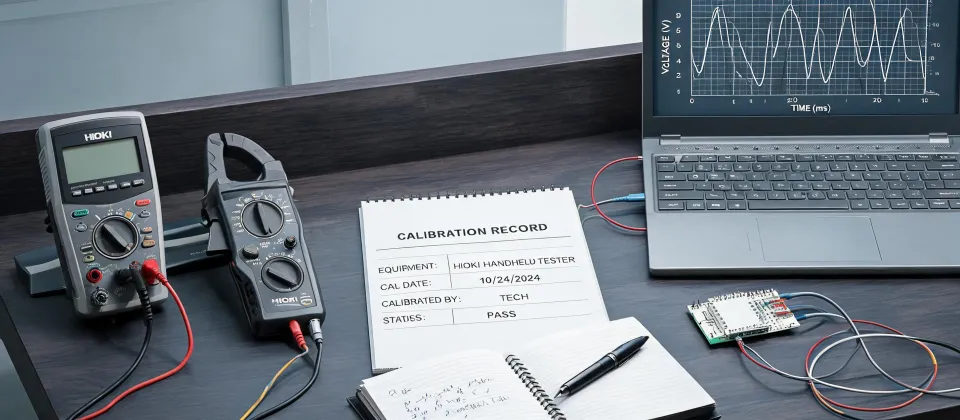
Friday morning, the rental unit arrived at our facility, and our in-house tech checked it against our Fluke 8508A reference multimeter. The 8508A is an 8.5-digit metrology-grade instrument—the kind of reference standard that calibration labs keep in temperature-controlled rooms. It's complete overkill for a Friday-before-rush-shipment, but that's the point. When we promise accuracy, we base it on data, not vibes.
The PQ3198's voltage readings tracked within ±0.02% of the reference standard across all test points—matching Hioki's published accuracy spec (hioki.com). The firmware had the energy-accumulation mode Mark's audit needed, and the calibration certificate was signed by an accredited lab. Everything checked out.
That Friday morning reminded me of a call from earlier in the week. A client had asked how to test a Rice Lake load cell on their packaging line. It's a simpler problem, but the same principle applies: verify before you trust. The quick field test: set a multimeter to read resistance across the load cell's bridge terminals—the signal leads should read around 350 ohms, depending on the model. If you see an open line or a dead short, the load cell is done. Then check the excitation voltage at the junction box—typically 10 VDC. A handheld Hioki multimeter is honestly the right tool for that job; you don't need a $5,000 benchtop unit. The old belief that you need lab-grade instrumentation to troubleshoot a load cell was true twenty years ago, when handheld meters had poor resolution. Today's 4.5-digit handhelds are more than adequate.
Anyway—back to the main story. (I tend to wander when caffeine and deadlines collide.)
Saturday Morning, 9:14 AM
FedEx ground delivered the PQ3198 to the plant in Toledo at 9:14 AM Saturday. Mark signed for it, unboxed it in the shipping bay, and sent me a photo of the unit sitting on the panel, LEDs glowing, clamps attached.
His text: "You saved us. This is the exact model we wanted. Thank you."
So glad I pushed back on the $8,900 "deal." Almost went with it to save the client money—which would have meant paying $2,900 in hidden fees and explaining to Mark's boss why the calibration certificate wasn't audit-grade. Dodged a bullet, honestly. The gap between "listening to a quote" and "listening for what the quote isn't saying" is the difference between a rescue story and a post-mortem.
The audit went through without a single citation. Mark's plant avoided the $40,000 penalty. The Chicago rental house earned a long-term customer. And the invoice matched the quote—exactly.
The Same Lesson, Different Instrument
That same week, a materials lab in Michigan called with a rush request for a Carl Zeiss microscope—a specialized brightfield unit needed before a third-party inspection. Different product line, same principle. We sent them a complete configuration: objectives, camera adapter, calibration slide, and shipping cost, all on one page. Their procurement director said our quote came in $1,100 higher than a competitor's. But we were the only vendor who listed every component and every fee.
"I think we'll go with yours," she said. "Because I don't want a surprise at the end."
If you're facing a deadline and a stack of quotes, here's my advice, for what it's worth. My experience is based on about 200 rush orders, mostly in test and measurement. If you're in a different industry, some details will differ—but the principles hold:
- Ask "what's NOT included" before you ask "what's the price." If the vendor can't answer clearly, walk away.
- Calibration and certification are deal-breakers. A paperweight with a low price tag is still a paperweight.
- Add a buffer. If a vendor says "2-3 days," plan for 4. A delayed rush order helps no one.
- Compare final invoices, not opening quotes. The "cheap" vendor is often the expensive one.
I have mixed feelings about rush fees. On one hand, they feel like a penalty for circumstances that frequently aren't the buyer's fault—equipment fails, audits get scheduled, budgets shrink. On the other hand, I've seen what rush orders do to the people executing them: overnight shifts, logistics sudoku, phone calls that start with "I need this yesterday." Maybe the premium is justified. But it should be stated upfront, not discovered in an invoice.
That's the whole story. If you ever need a power quality analyzer in a hurry, or you're comparing quotes from vendors who seem oddly cheap, ask the question. You might be surprised what you find.
Pricing and rental rates referenced above are based on publicly listed equipment rates as of October 2024. Verify current pricing and availability with your supplier before making decisions. Product names and brands mentioned belong to their respective owners.