-
Who this checklist is for
-
Step 1: Get the actual measurement job in writing
-
Step 2: Check safety category and calibration before brand
-
Step 3: Read reviews for failure modes, not scores
-
Step 4: Do not forget the boring mechanical stuff
-
Step 5: Check the accessory ecosystem—especially for iPhone thermal cameras
-
Step 6: Plan consumables by condition, not calendar
-
Step 7: Run a five-point vendor check before you hit send
-
Common mistakes and notes
Who this checklist is for
I am the office administrator for a 120-person industrial services company. I manage MRO and lab supply ordering—roughly $180K annually across 14 vendors. I report to both operations and finance. This checklist is for admin buyers who get requisitions like 'need a clamp meter' or 'order more HPLC columns' and have to turn them into purchase orders that do not bounce. It has 7 steps. Not a technical manual. A purchasing process.
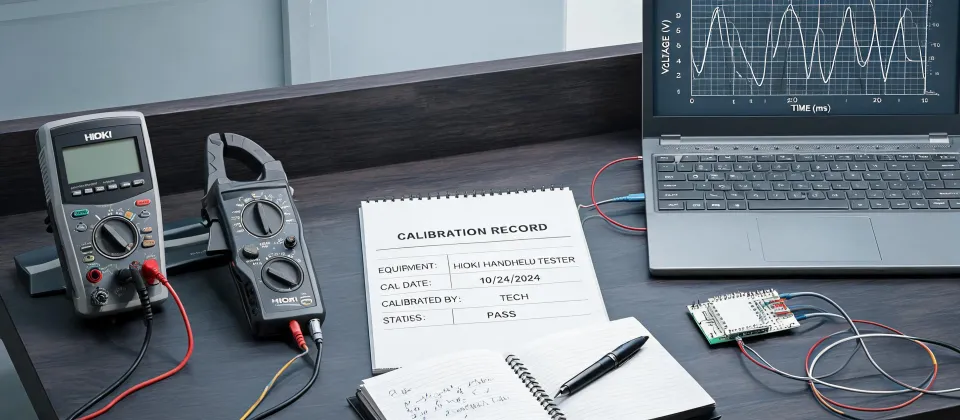
Use it when ordering electrical test instruments such as Hioki or others, pressure gauges, thermal camera iPhone accessories, and HPLC consumables. If you are an engineer specifying your own gear, you will likely skip some steps. That is fine.
Step 1: Get the actual measurement job in writing
Most bad orders start with a vague request. 'We need a clamp meter.' What for? Troubleshooting 480V feeders? Checking motor inrush? That determines current range, CAT rating, and jaw size. For example, if someone asks about the Hioki CM4376 clamp meter current range, do not just Google the number. Confirm the range needed: 600 A? 1000 A? AC/DC? The CM4376 is a 1000 A AC/DC clamp meter, I believe, but verify the exact spec sheet as of January 2025. Specs can change by region or firmware.
Write the job in one sentence: 'Measure AC current up to 600 A on 480 V feeders in a CAT IV environment.' Then match. If you cannot write that sentence, you are not ready to order.
Step 2: Check safety category and calibration before brand
For electrical testers, safety category matters more than brand. Per IEC 61010-1, measurement categories (CAT II, CAT III, CAT IV) define where the instrument can be used. A cheap meter with the wrong CAT rating is a liability. I learned that the hard way.
I knew I should verify the CAT rating on a multimeter we ordered for field service. But I thought 'what are the odds they will use it on a panel?' Well, they did. The meter was CAT III 600 V, not CAT IV. It did not fail, but our safety officer flagged it. We had to return it and eat shipping. Now I verify CAT rating and calibration certificate before PO.
Also check calibration. ISO/IEC 17025 traceable calibration is often required for ISO 9001 or customer audits. If the vendor cannot provide it, finance may reject the expense. Or worse, operations cannot use the tool.
Step 3: Read reviews for failure modes, not scores
When someone asks for Hioki PQ3198 power quality analyzer reviews, do not just sort by stars. Look for patterns. What fails? Battery life? Software? Clamp accuracy at low currents? One reviewer complaining about a menu is noise. Five reviewers mentioning the same firmware bug is a signal.
I do not have hard data on how many reviews are fake, but based on our 5 years of vendor management, my sense is that 10-15% of B2B reviews are either incentivized or written by someone who never used the product. So I read the 2- and 3-star reviews first. They tend to be more specific. The 5-star reviews say 'great.' The 2-star reviews say 'the Bluetooth drops when the battery gets below 20%.' That is actionable.
Also check the review date. A 2019 review of a 2024 firmware version is useless. Look for reviews within the last 12-18 months.
Step 4: Do not forget the boring mechanical stuff
Pressure gauges are not exciting. But they cause more invoice disputes than almost any other MRO item. Why? Because people order the wrong thread, the wrong range, or the wrong accuracy class. A 0-100 psi gauge with 1/4 inch NPT is not the same as 0-100 psi with 1/4 inch BSP. If the requisition just says 'pressure gauge,' send it back.
Ask: What is the process fluid? What is the normal operating pressure? What is the connection size and type? Does it need a glycerin fill for vibration? Does it need a diaphragm seal for corrosive fluid? If you do not know, call maintenance. Ten minutes now saves a return later. Not ideal, but avoidable.
Step 5: Check the accessory ecosystem—especially for iPhone thermal cameras
Thermal camera iPhone attachments are a good example of why you check the whole system. A FLIR or Seek thermal camera that plugs into an iPhone may be perfect for one technician and useless for another if the iPhone case blocks the connector. Or if the team uses Android. Or if the app requires a subscription.
Before ordering a thermal camera iphone model, verify: connector type (Lightning vs USB-C), app compatibility, minimum iOS version, and whether the camera needs calibration. Also check if the company phone policy allows personal devices. I have seen a $400 thermal camera sit in a drawer because IT would not install the app on company phones.
Put another way: the camera is only half the purchase. The phone, app, and case are the other half.
Step 6: Plan consumables by condition, not calendar
How often to change your columns hplc agilent? The honest answer: not on a fixed schedule. Agilent column care guides generally recommend monitoring system suitability, peak shape, retention time, and backpressure. Replace when performance drops below your method's acceptance criteria—not because it is the first Monday of the month.
I wish I had tracked column usage more carefully from the start. What I can say anecdotally is that our lab was replacing columns too often because the guard column was not being changed. Once we fixed that, column life went from about 400 injections to 800-1000. Maybe 900, I would have to check the logs.
For purchasing, set a reorder point based on lead time and usage rate, not a calendar reminder. If lead time is 2 weeks and you use one column every 3 weeks, keep one spare. Simple. But most admin buyers learn this after a lab shutdown.
Step 7: Run a five-point vendor check before you hit send
This is the step most people skip. Before you create the PO, confirm:
- Invoicing capability. Can they send a proper invoice with PO number, tax ID, and itemized lines? If not, finance may reject it.
- Lead time in writing. A verbal 'should ship next week' is not a lead time. Get an email.
- Return policy. Restocking fees? Return window? Who pays shipping?
- Calibration and documentation. Does the price include a certificate? Is it traceable? Is it extra?
- Warranty terms. Length, what is covered, and who handles shipping for repairs.
I still kick myself for not documenting a vendor's verbal promise on a Hioki clamp meter order. They said 'we will include the calibration certificate.' The invoice added $180 for it. We had no grounds to dispute. Now I get it in writing. Every time.
Common mistakes and notes
Mistake 1: Ordering the premium model when the mid-range works. In my opinion, the extra cost is justified for safety-critical electrical work. For general pressure gauges or bench multimeters, it is often not. Know the difference.
Mistake 2: Ignoring the total cost of ownership. A Hioki PQ3198 power quality analyzer might cost more upfront than a no-name logger. But if it comes with better software, calibration support, and a local service network, the TCO can be lower. I have only worked with mid-size industrial companies. I cannot speak to how this applies to a one-person lab or a Fortune 500 with a dedicated metrology team.
Mistake 3: Forgetting the accessories in the PO. Clamp meters need leads. Thermal cameras need cases. HPLC columns need fittings. Pressure gauges need snubbers. Add them before the order ships, not after.
Mistake 4: Not checking if the item is in stock. 'In stock' on a website can mean 'in stock at the manufacturer, ships in 6 weeks.' Call or chat to confirm. As of January 2025, lead times for some test equipment are still longer than pre-2020. Verify current availability at the vendor's site.
This checklist will not make you a metrologist. It will keep your POs clean, your finance team happy, and your operations team from waiting on the wrong part. That is the job.