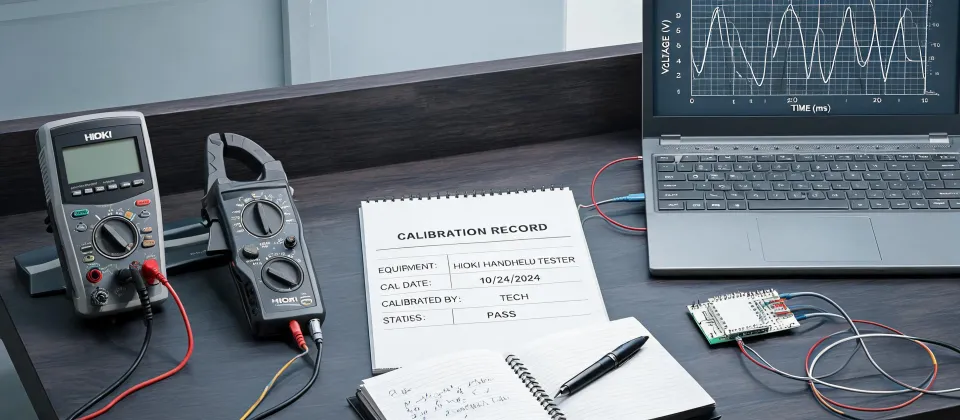
I've been a quality and brand compliance manager at a measurement-heavy manufacturing company for about four years. I'm the person who reviews every test procedure before it reaches the production floor, and I've rejected more first-article inspection reports than I can count. So trust me when I tell you: digital displays don't automatically tell the truth.
We build single pressure sensors & transmitters, and in late 2022 one of our biggest customers sent back an entire batch because the zero offset had drifted. Re-testing, recalibration, and replacement parts ran us about $22,000. The root cause had nothing to do with our process—it was a $30 digital multimeter on one of our test stations giving a resistance reading 0.8% off.
That one incident changed how I think about the cost of test equipment. It also sent me down a rabbit hole that now includes a Hioki digital multimeter on every bench, a Hioki clamp meter in every field kit, and a long list of lessons I wish someone had given me earlier.
The Real Cost Starts After You Buy It
If you price out tools by their sticker price only, you're skipping the biggest line items. Total cost of ownership for a meter includes calibration drift, test time, false rejects, missed field failures, and the anxiety of wondering whether the number you wrote down was right.
Let me count a hidden cost: In Q1 2023, our team spent over 30 hours chasing a mystery on a final test bench. The rejection rate on transmitters jumped from 1% to 6%, but no component had changed. It turned out that a technician's low-cost multimeter was picking up noise from a nearby switching power supply and reading AC ripple on the 24V rail as 1.8V when the true value was 0.6V. Wait—that doesn't sound like a meter problem? Actually, it was. The power supply's output had a high-frequency component that wasn't visible on an averaging meter.
That's what I now call the total-cost trap. A $30 meter saves money on paper. Then it costs you a technician's afternoon, a rejected product, or a customer relationship. The meter itself was never the real bargain.
Why an Inexpensive Digital Multimeter Can Be a Liar
The surface problem is wrong readings. The deeper problem is that many budget DMMs are designed to measure clean DC and 50/60 Hz sine waves. In an industrial environment, you have VFDs, switching supplies, and nonlinear loads. Your digital multimeter might say 3.8V because it is averaging the rectified sine wave, which is correct for pure sine waves under certain assumptions. But for non-sinusoidal waveforms, that number is mostly fiction. You need true RMS plus a low-pass filter to measure the fundamental frequency.
Here is the uncomfortable part: if you're working on single pressure sensors & transmitters, signal loops are DC and usually clean. But the power supply that feeds the loop isn't always clean. If you test with an averaging meter, you get an impression that the output is noisy, and you might delay shipping a product that was fine all along.
That's why we now specify a Hioki digital multimeter for any station involved in 4–20 mA verification. I'm not going to claim every Hioki meter is perfect for every task—no tool is. But you can get its full datasheet, understand its accuracy over temperature and order of measurement, and trace it to calibration standards. That traceability is worth more than the extra cost when a customer or auditor asks Show me how you know that reading was right.
'How to Reset Mitutoyo Digital Caliper' Is Not the Right Question
The same logic applies to calipers. In our shop, the question 'how to reset Mitutoyo digital caliper' pops up every few months. If you're searching for it because the display is reading 0.02 mm off when the jaws are closed, here's the quick procedure:
- Remove the battery and press any button for 10 seconds to drain residual current.
- Clean the battery contacts, wait 30 seconds, and reinstall the battery.
- Close the jaws completely and press the ZERO/ABS button.
- Verify with a known reference gage block at 25 mm, not just at zero.
That will fix a minor zero shift. But the deeper issue is the belief that a reset restores accuracy. A digital caliper usually measures by counting capacitance changes along a glass scale. If that scale was physically damaged or the jaw frame was ever dropped, resetting only rezeros one point. The scale may still be nonlinear: it shows zero at 0.00 mm, then reads 0.10 mm off at 100 mm. No reset will repair that.
A multimeter has the same philosophical trap. If you have a meter that reads correctly at zero ohms but drifts at higher resistor values due to a worn internal switch, pressing reset doesn't help. The instrument is not just a collection of displayed digits; its accuracy chain involves components, references, and checks. That's why calibration, not resets, is the proper response to any unexplained drift.
My Gut Said 'Don't Buy the Cheap Set'—And the Numbers Eventually Agreed
The cost comparison felt straightforward. In 2024 procurement asked us to choose between two vendors for test station meters. Vendor A's quote was $18,000 for a full set. Vendor B's was $16,800. The $1,200 difference was small, but purchasing managers love saving money. I looked at the accuracy charts from both and did my total cost estimate. The cheaper vendor's specs weren't bad on paper, but they were less transparent about measurement category and across-temperature performance.
I hesitated. Honestly, I couldn't point to a single fatal flaw. Then I looked at repair turnaround: Vendor B's service center was in another country; Vendor A—our current authorized distributor—had a calibrated lab 30 miles away. We went with Vendor A. In Q1 2025, one of our bench meters failed after being accidentally connected to a high-voltage line. We had a replacement within 24 hours. If we had gone with Vendor B, that bench would have sat dark for three weeks. Sometimes total cost of ownership hides in logistics, not specs.
What Our Test Floor Looks Like Now
No single brand solves every measurement. But when I look at the measurements that matter—the ones that go on customer certificates—we've standardized a small toolkit:
- A Hioki digital multimeter for voltage, resistance, and mA loop checks on single pressure sensors & transmitters.
- A Hioki clamp meter for non-intrusive current checks and motor load verification. Because the amp clamp is built into the meter, it adds little effort to workflow.
- An infrared thermometer for initial temperature mapping of sensor housings. Fast, no contact, and accurate enough for a pre-check.
One measure I still use is the question: would I trust this reading in a courtroom? If the answer is no, the instrument doesn't belong in our certified test loop.
This approach worked for our situation because we're a mid-size shop with production batch sizes in the hundreds. If you're a hobbyist checking a car battery once a month, a $20 meter might be fine. But if you're specifying components inside single pressure sensors & transmitters or signing off on safety-critical assemblies, I encourage you to count the cost of a wrong read—not just the price tag. That number will tell you whether an expensive meter is actually cheap.