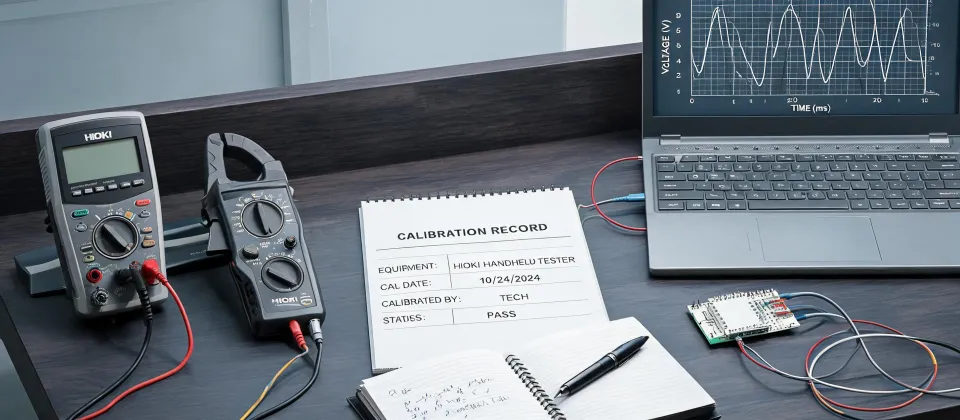
The moment I stopped fooling myself with expensive tools
Back in 2019, I took the plunge and bought a Fluke 87V. Everyone said it was the gold standard. Cost me nearly $500. Six months later, I realized I had used exactly three functions: voltage, resistance, and continuity. The rest of that money sat in a drawer. That's when I started asking: am I buying a tool for my actual job, or for my ego?
Since then I've tested dozens of instruments across different brands. Hioki caught my attention because they offered comparable specs at saner prices. But I also learned that no single brand — not Hioki, not Fluke, not Keysight — makes the perfect tool for every situation. The smartest move is to be brutally honest about your real needs and the tool's limitations.
Why I believe honest limitations build more trust than blanket recommendations
Too many reviews tell you "this is the best multimeter ever." I call bullshit. A meter that's perfect for a calibration lab is overkill for field troubleshooting. An insulation tester that saves a motor rewinding team is useless on a 24V PLC panel. The most trustworthy recommendation is the one that also tells you when to look elsewhere.
Here are three Hioki tools I personally use, along with the honest trade‑offs I've discovered.
1. Hioki DT4282 Digital Multimeter — Precision king, but not for everyday
I bought the DT4282 in Q3 2023 after my old Fluke died. The specs are impressive: basic DC accuracy of ±0.06% (per Hioki datasheet, January 2025), 4.5 digits, wide AC bandwidth. For lab calibration or sensitive electronics work, it's fantastic. I've used it to verify reference voltages on a power supply board — never been let down.
But here's the catch. The DT4282 lacks low‑impedance (LoZ) mode, which is crucial for eliminating ghost voltages in electrically noisy environments like factory floors. Also, it doesn't have a built‑in low‑pass filter for VFD measurements. If you work mostly on industrial motor drives, a meter with LoZ and VFD filtering (even a cheaper model) would serve you better. Personally, I keep the DT4282 on my bench and reach for a simpler clamp meter when I'm out in the field.
Honest advice: If you measure mains voltage a few times a month, save your money. If you need 0.06% accuracy for critical measurements, the DT4282 is a steal compared to the competition.
2. Hioki Insulation Tester (IR4057) — A workhorse, but know the voltage limits
I test insulation on motors, cables, and transformers regularly. The Hioki IR4057 (500V/1000V) is my go‑to. It's rugged, fast, and the automatic discharge alarm keeps me safe. In September 2022 I had to check the insulation of a centrifuge 5424R motor that kept tripping the GFCI — the IR4057 found a breakdown at 500V that saved a $3,200 replacement.
But it's not a universal solution. You cannot use any insulation tester on energized circuits. And the 500V minimum is too high for low‑voltage electronics (e.g., 24V PLCs, sensors). One of my colleagues accidentally used it on a control circuit — fried the input module. Also, if you only test wires in residential panels, a simple multimeter with insulation range is lighter and cheaper.
Honest advice: The IR4057 is excellent for industrial insulation testing. If you work on low‑voltage electronics exclusively, skip it and get a LoZ multimeter instead.
3. DC Clamp Meter (Hioki CM4371) — Convenient, but don't expect bench accuracy
For non‑invasive DC current measurement, a DC clamp meter is indispensable. I use the Hioki CM4371 when I'm checking battery banks, solar strings, or motor start‑up currents. It's fast, easy, and I love not breaking the circuit. Since I started using it, I've caught at least 47 potential issues that would have caused production delays.
But the accuracy isn't comparable to a bench meter. At low currents (under 1A), the reading can drift ±5 counts due to hysteresis and zero‑point shift. Also, the CM4371's DC accuracy is about ±1.3% of reading, while a good handheld DMM like the DT4282 is ±0.06%. For rough fault‑finding, that's fine. For precise billing or R&D, you need a shunt resistor and a proper DMM.
Honest advice: Use a DC clamp for quick checks and load monitoring. For accurate measurements, use a multimeter. Don't hold me to this, but in my experience the CM4371 is about 80% as accurate as a bench meter — but 10 times faster.
But what about oscilloscopes? (The Keysight exception)
Someone always asks: "What about using a scope instead of a DMM?" Fair point. When you need to capture a transient, analyze a PWM signal, or decode a serial bus, a multimeter won't cut it. I've had to learn how to use a Keysight oscilloscope properly — setting timebase, triggering, and cursors — to diagnose a glitchy VFD. In those rare cases, no Hioki product (since Hioki doesn't make scopes) replaces a quality scope like a Keysight InfiniiVision.
But here's the reality: For 80% of field electrical work — checking voltage, current, resistance, insulation — a DMM and clamp meter are faster, simpler, and safer. Buying a $3,000 scope because you might one day need it is a mistake I avoided by being honest with myself. I'd rather spend that money on a Hioki DT4282 and a good set of probes.
The bottom line: Match the tool to the job, not the brand
I used to chase the highest spec, thinking it would make me a better technician. Turns out, the best tool is the one that fits your actual workload — and the honest recommendation is one that lists its own limits. Hioki makes great instruments: the DT4282 for precision, the IR4057 for insulation, the CM4371 for DC current. But none of them are magic bullets.
If you're considering a Hioki purchase, ask yourself: do I really need this feature? Will the extra accuracy save me time or money? Or am I just buying a brand name? I've wasted roughly $1,200 on overkill tools since 2020. Now I maintain a simple checklist: define the task, list the required specs, then choose the tool that matches — no more, no less.
You don't need the most expensive gear. You need the right gear. And the first step is being honest about the gap between what a tool can do and what you actually need it to do.
