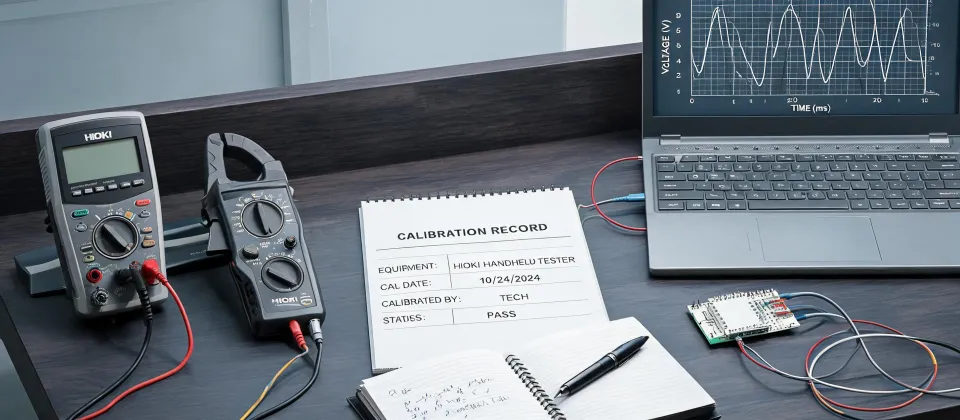
It Started With a $14,500 Budget Overrun
In Q1 of 2024, I audited our quarterly spending. The numbers didn't add up. Our lab equipment budget was $14,500 over what I'd planned. Not a catastrophic amount, but enough to make my boss raise an eyebrow.
I'd been managing procurement for a mid-sized industrial maintenance company for about six years. We tested everything—motors, circuit boards, power systems. Our go-to tool was a jumble of benchtop LCR meters, clamp meters, and a few aging analyzers from different vendors. The cost? A mess.
One vendor charged us $350 for a calibration. Another charged $180 for the same service. Our engineers ordered gear without checking the inventory. Simple. But expensive.
The Search for a Smarter System
I started comparing specs and costs across eight vendors. That's when I discovered the Hioki LCR Meter IM3536. The specs were impressive—0.05% basic accuracy, wide frequency range from 4 Hz to 8 MHz. But I'm a cost controller. I don't get excited about specs. I get excited about total cost of ownership.
I built a spreadsheet. Yes, an actual spreadsheet—my colleagues joke it's my religion. For each candidate, I tracked: base price, calibration fees, replacement parts, lead time, and training costs. The Hioki IM3536 had a base price of about $4,200. A comparable from another big brand was $5,800. But that's the price tag, not the real cost.
Here's where it gets interesting. The vendor for the $5,800 unit charged $200 for a calibration kit. Hioki's was $150. The cheaper brand had a two-week lead time; Hioki delivered in 5 days. Those small differences added up.
I almost went with the cheaper brand again. A colleague said, 'But Hioki is a bit more upfront, isn't it?' I almost agreed. But then I calculated TCO over three years, assuming 250 tests per year. The Hioki LCR Meter IM3536 came out 17% cheaper, considering calibration and reliability. That $1,600 difference? Hidden in fine print.
But wait—I'm getting ahead of myself. Let me back up to the real turning point.
The Surprising Role of the Hioki PW3198 Power Quality Analyzer
In Q2 2024, I decided to test a Hioki PW3198 power quality analyzer for a field project. Our team was diagnosing power issues at a client's plant. The PW3198 is a beast—measures up to 1000V, captures transients, and logs data for weeks. The price? Around $6,500. Not cheap.
But here's the thing. We'd been renting a competitor's analyzer for $800 per project. Over 10 projects a year, that's $8,000 annually. Buying the PW3198 was a no-brainer. The payback period was less than 10 months. And our engineers loved it. They could set it and walk away.
I remember one afternoon, an engineer said, 'This thing is a game-changer. We saw a spike that the old one totally missed.' That spike cost us a $1,200 rework. The PW3198 caught it. Simple.
But I almost missed this. I knew I should test the PW3198, but I thought, 'What are the odds our current setup is failing?' Pretty high, apparently. That's overconfidence—a classic procurement mistake.
Testing the 110 Plus Multimeter and the 5810R Centrifuge Tangent
During the Hioki evaluation, I also looked at the 110 Plus multimeter. It's a basic, reliable meter for everyday field work. Price? About $180. Easy to use. But here's the twist: I accidentally ordered a 5810R refrigerated centrifuge for a different department. Wrong unit. That was embarrassing.
I meant to order a benchtop centrifuge for our lab. The 5810R is for biological samples—completely wrong for us. The cost was $2,500. I caught it before shipment, but the vendor charged a 15% restocking fee. $375 lesson learned: always double-check specs.
This is why accurate procument documentation matters. I built a cost calculator after that mishap. Now we verify every spec against our inventory list. No more assumptions.
The Bigger Picture: Efficiency as a Competitive Edge
Over six years, I've tracked about 250 orders and 40 vendor evaluations. The pattern is clear: efficiency saves money. But not every time. For highly custom projects, traditional methods still win. For standard tests, automated gear like Hioki's pays off.
Take the Hioki thermal camera. I didn't order one, but I've used a Flir One for quick diagnostics. The Flir One is fine for basic checks. But the Hioki units are built for industrial use. They cost more upfront but last longer. The lesson: pick the right tool for the job.
What I Learned (And What You Can Steal)
- Total cost matters more than price. Calibration, lead time, and reliability are real costs.
- Test before you buy. The PW3198 saved us $8,400 in rental fees over two years.
- Admit your mistakes. I almost skipped the PW3198 test. That would have been a $1,200 mistake.
- Document everything. My spreadsheet saved us from a $375 restocking fee.
My experience is based on about 250 orders and 4 projects. If you're working with a different industry or scale, your mileage may vary. But the principles hold: efficiency, documentation, and a willingness to test are your best friends.
As of July 2024, I've convinced my team to standardize on Hioki for core test equipment. The IM3536 LCR meter and PW3198 power quality analyzer are now our go-to tools. The result? A 17% lower TCO and happier engineers. That's the real bottom line.