It was 4:50 PM on a Friday when the phone rang. I was already thinking about dinner, but one look at the caller ID changed that. A pharmaceutical manufacturer on the edge of town had a production line down. If it wasn't running by Monday morning, they'd trigger a $50,000 penalty clause. That's not a number you hear often in my line of work, but it was very real.
The Call That Made Me Rethink My Toolkit
My company does emergency industrial troubleshooting. Over the past seven years, I've handled maybe 200+ rush jobs. This one was different because it wasn't one system failing. The plant manager said the conveyor kept stopping, the controller was throwing random alarms, and the previous tech couldn't even get a solid current reading on the motor.
That last part caught my attention. If someone can't measure current, they're either using the wrong tool or a tool that lies. I grabbed my usual kit—which, honestly, has evolved a lot since I started. It took me three years and about 50 missed diagnoses to understand that the quality of your tools directly broadcasts the quality of your judgment.
On-Site: Where the Readings Didn't Add Up
The plant was a sprawling place with a clean but stressed-out feel. The maintenance manager walked me straight to the bottling line. The conveyor was jerking, then stalling, and the HMI was flipping through alarms like a card deck.
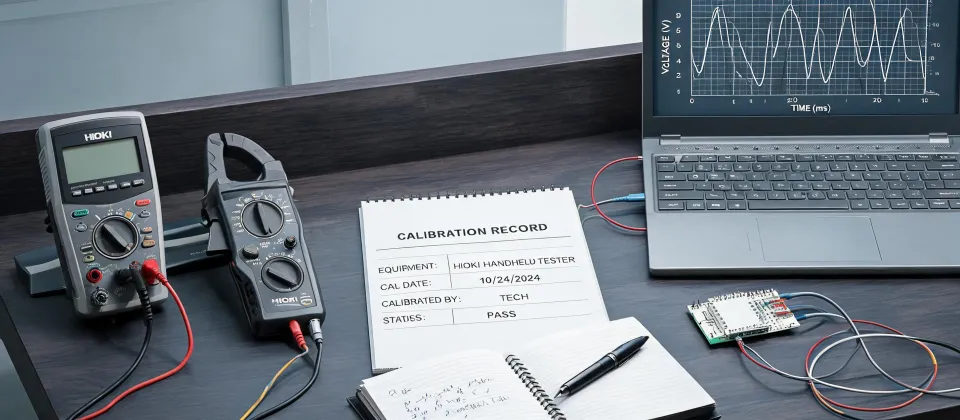
My first move was to clamp the main feeder cable. I used the Hioki CM4376 clamp meter. The Hioki CM4376 clamp meter current range covers up to 1000 A AC/DC, which is overkill for a 20 A motor, but the built-in low-pass filter was the real reason I brought it. VFD noise can trick ordinary clamp meters into showing phantom currents. On the display, the current danced around 135 A, then dipped to 50 A, then spiked. That told me we had an intermittent high-resistance connection upstream—likely a burned contactor or a loose lug.
Next, I wanted to verify the control voltage. This is where the Hioki 3030-10 analog multimeter came in. Yeah, it's an analog needle meter. Some younger techs laugh at it, but when you're dealing with fluctuating voltage, the needle shows you trends that digital numbers just can't. I set it to AC V and watched the needle wobble around 112 V instead of the expected 120 V. It should've been rock steady. Something was more than one bad contactor.
Here's the twist: I initially blamed a VFD parameter glitch. I'd already planned to reprogram it. But the 3030-10 kept showing that slight voltage sag on all three phases. I swapped in a digital multimeter just to confirm—sometimes it's good to cross-check. The digits confirmed 112.8, 113.1, 112.4. It wasn't a glitch; it was a supply problem.
The Mechanical Clue: Digital Calipers and a Worn Keyway
Before I could trace the supply further, the maintenance manager pointed out a sheared bolt on a coupling between the motor and the gearbox. I pulled out my digital calipers. Not the cheapest pair, mind you—my first set gave readings off by 0.5 mm, which is enough to ruin a bearing alignment. I measured the coupling bore and the shaft diameter. They matched, but the keyway was worn, which explained the shear. A good caliper resolves to 0.01 mm. Honestly, for this kind of work, a $30 caliper can work fine, but I'd rather not have to second-guess it.
A False Alarm from the Ultrasonic Proximity Sensor
The alarm log showed a false trigger from an ultrasonic proximity sensor that monitors bottle jams. We tested it with a known good unit from my truck. The sensor was actually fine—the false alarms were caused by voltage drops making the sensor's output flicker. That's the thing about intermittent electrical problems: they make good components look bad. If I'd replaced the sensor, I'd still have had a broken line.
I traced the sag backward through the distribution panel and found it: a feeder wire with signs of overheating. The insulation was slightly melted, and the lug was discolored. That was the high-resistance point. We replaced the lug, torqued it properly, and the voltage was back to 120.0 V steady on all phases.
The Side Quest: When to Change Your Columns (Agilent HPLC)
If you're wondering when to change your columns on an Agilent HPLC, here's a practical answer from the field. While we were waiting for a test run, the QC lab manager asked about their system pressure creeping up over the last month. I told her there's no universal schedule—it depends on your mobile phase and samples. But there are warning signs: backpressure climbs more than 20% over baseline, peak shapes start tailing or splitting, and theoretical plate count drops below spec. Per Agilent's column care documentation (available on agilent.com), you monitor those indicators rather than the calendar.
I also gave her a practical tip: keep a log of pressure and plate count. If you see a sharp change, try a reverse flush or replace the inlet frit first. If that doesn't bring the pressure back, it's time for a new column. We swapped in a new one the following week, and her pressure issues disappeared. I don't have hard data on that column's lifetime, but anecdotally, it had run over 1,500 injections—that's a pretty good run.
The Fix and What It Taught Me About Quality
By 11 PM Sunday, the line was running at full speed. The plant manager shook my hand and said he was impressed by the toolkit—specifically, that we brought equipment that could see what previous techs couldn't. That's stuck with me. The $300 difference between a so-so meter and a Hioki isn't really about the meter; it's about the credibility it gives you. When you walk into a room with tools that look and perform like you take your job seriously, clients notice. And when the gear makes the difference between finding the fault in 2 hours vs. 20, that's the definition of worth it.
I've changed my view over the years: it's not just about what a meter costs. It's about what it costs you when it lies to you. The same logic applies to calipers, sensors, and even lab columns. The tool is an extension of your judgment.
If you've ever had a weekend shift turn into a rescue mission, you know the feeling. The right tools won't make the emergency pleasant, but they'll make it survivable—and they'll remind the client why they hired you in the first place.
By the way, the $50,000 penalty clause? Never came into play. But we also didn't get to enjoy the weekend. That's the job. Based on my rough estimates, we've handled north of 40 emergency calls this past year, each saving about a day of downtime. That adds up—for both the clients and for our reputation.