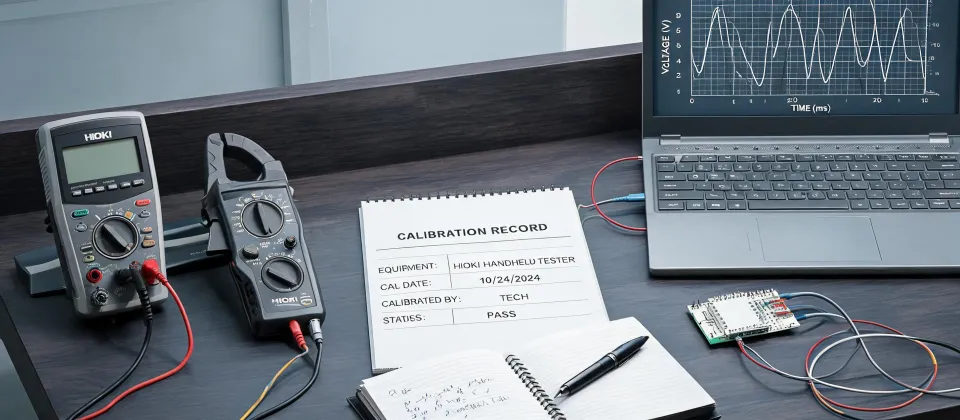
When I took over purchasing for our office in 2020, I thought I had it figured out. Buy the cheapest clamp meter that meets the specs, get the data logger with the most features for the price, and move on. I was wrong. Actually, I was way wrong.
Here’s the thing: as an administrator handling orders for a 40-person B2B services company, I’m not an engineer. I don’t geek out on harmonic distortion or transient capture. I care about whether the instrument works when the technician needs it—and whether my boss questions me about the invoice.
That’s the surface problem. A technician says they need a clamp multimeter. You search, find a cheap one, order it. It arrives, it works—for a week. Then the readings start drifting. The technician complains. You go back to the vendor, but the return window closed. Now you’re stuck with a paperweight and a pissed-off employee who, honestly, you needed to keep happy.
That’s the surface problem. The real one? You didn't know what to look for, and the vendor didn't care to tell you.
So, What’s Really Going On?
Behind every failed purchase I’ve made—and I’ve made a few—there’s a pattern. It’s not about the price. It’s about the match between what you need and what you bought.
When I compared our Q1 and Q2 results side by side—same vendor, different specifications—I finally understood why the details matter so much. The instrument that failed wasn’t the cheapest overall. It was the one that was spec’d for a different use case. A general-purpose clamp meter might be fine for checking a breaker panel, but not for troubleshooting a VFD. A data logger without enough channels? You’re back on site next week, doing it all over again.
But the deeper problem is this: our purchasing process treats all orders the same. Whether you’re buying a hioki clamp multimeter for a one-off job or a hioki data logger lr8450 for a long-term monitoring project, we tend to pick based on one or two specs and the price tag. We don’t consider the context—the environment, the user, the frequency of use. And vendors? They’re happy to sell you a box that technically meets the written requirements, even if it’s the wrong tool for the task.
We also carry the assumption that the more expensive option is a rip-off. That’s not always true. Sometimes you’re paying for reliability, support, or a warranty that actually gets honored. Sometimes you’re paying for a brand that (honestly) has earned its reputation through decades of field testing. But we don’t know that until we’ve been burned.
What Happens When You Get It Wrong?
Let me give you a concrete example. In late 2023, I approved the purchase of a "budget-friendly" thermal camera for one of our field techs. It was from a brand I’d never heard of, but the specs looked good on paper: decent resolution, good temperature range, and it connected to iOS. The tech wanted a one thermal imaging camera for ios for quick spot checks. It seemed like a no-brainer. The price was half of what we’d pay for a known brand.
It worked for about two months. Then the app started crashing. The calibration drifted. The tech stopped using it. I had to buy a replacement—this time, a proper unit from a reputable supplier. Total cost: the original purchase ($180), the wasted labor (about $500 in time), and the new camera ($400). I could have just bought the right one from the start.
That’s the direct cost. The indirect cost is worse: lost trust. The tech thought I was cheaping out. My boss wondered why I kept ordering replacement gear. I spent two months trying to get a refund from a vendor who didn’t have a proper returns policy (surprise, surprise).
In another case, I ordered a data logger without checking the channel count carefully. The LR8450? We needed 10 channels. I bought a 5-channel unit. When the project expanded, we had to buy a second unit—and then scrap the first.
This is how small orders snowball into big losses. And the worst part? The vendor who sold you the wrong equipment won’t tell you it’s wrong. They’re just moving boxes. You’re the one who has to deal with the fallout.
The Real Root: We’re Buying for the Wrong Reasons
I’ve come to realize that my purchasing decisions were driven by three flawed instincts:
- Price anchoring: "I can get a comparable meter for $50 less. Why not?" — The answer: because "comparable" on a spec sheet doesn’t mean comparable in the field.
- Deadline pressure: "The tech needs it by Friday. I’ll just order the fastest-shipping option." — That rush order cost me $200 in markup and a paperweight that lasted six weeks.
- Lack of product knowledge: I don’t know what makes a durability of ifm photoelectric sensors vs others different from a basic sensor. And I don’t need to. But the vendor should be able to translate for me. If they can’t, I move on.
These issues aren’t about me being a bad buyer. They’re about a system that expects buyers to be experts in everything. And when you’re a small company ordering small quantities, you often get treated like a second-class citizen. Vendors don’t want to spend time explaining the differences between 5 products when you’re only buying 2.
But the ones who do? They earn your loyalty. I still use the vendor who helped me pick the right hioki data logger lr8450 even though I could have saved $30 elsewhere. Why? Because they asked about my use case first. That conversation saved me from buying the wrong device—a mistake that would have cost me hours of troubleshooting and a frustrated technician.
The One Change That Saved Us
After our 2024 vendor consolidation project, I had to rethink how we buy test equipment. Here’s what worked:
1. I stopped treating all orders alike. A $200 clamp meter for a routine check doesn’t get the same process as a $800 data logger for a critical project. The former? Amazon with a decent return policy. The latter? I call a specialist supplier who can answer questions about channel counts, sensor compatibility, and software integration.
2. I started buying from vendors who respect small orders. I went back and forth between a big distributor and a smaller specialist for about a week. The big distributor had better prices (by about 15%), but the small specialist spent 20 minutes on the phone with me. They explained why the hioki clamp multimeter CM3286-01 was a better fit than the CM4371 for our needs. The CM4371 is a great meter—just terrible for a tech who only needs AC current measurements. The specialist saved me from overbuying. (Honestly, that call made me feel like I wasn’t wasting their time with a small order.)
3. I asked for (and got) a reference. For our first major data logger purchase, I asked the vendor for a case study. They sent me a write-up from a similar-sized company using the LR8450 for HVAC monitoring. That might not sound like a big deal, but it gave me confidence that I wasn’t buying the wrong tool.
This approach isn’t perfect. I can only speak to our situation—a mid-size B2B company with predictable ordering patterns and no extreme environmental factors. If you’re in heavy industry or mobile repair, your needs will differ. Your mileage may vary if you’re dealing with wet environments, extreme temperatures, or high-vibration settings. But the principle holds: find a supplier that takes your small order seriously.
So, What Should You Actually Do?
I don’t have a magic checklist. But I can tell you what I’ve learned from a few years of trial and error:
- If a vendor treats your $200 order like it matters—they’ll treat your $2,000 order the same. That’s a green flag.
- If a vendor can explain why one data logger model is better than another for your use case—they know their product line. That’s gold.
- If a vendor can’t provide a proper invoice or returns policy—run. I learned this the hard way in 2023.
Small orders don’t mean small problems. And the right equipment—even if it costs a bit more—saves you time, frustration, and a ton of awkward conversations with your team.
I still buy from a mix of suppliers. But the ones who earned my trust when I was a small-budget buyer? They’re the ones I turn to first. That’s not loyalty born from discounts. It’s loyalty earned through respect.