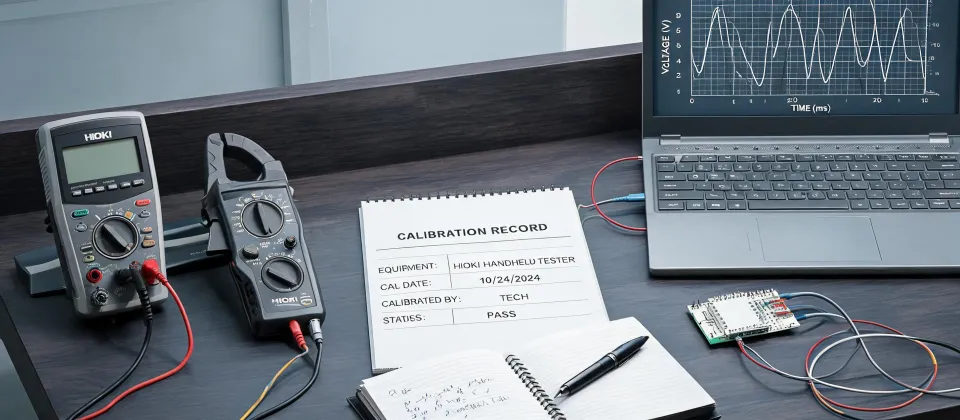
If you've ever had a critical test result come back wrong—hours before a client deadline—you know that stomach-drop feeling. I sure do. Last October, I was on-site for a factory startup, using what I thought was a reliable insulation resistance tester. The reading said everything was fine. Spoiler: it wasn't. Twenty-four hours later, we found a major breakdown that the meter had missed. The client's alternative? A $50,000 penalty clause and losing their biggest contract.
From the outside, it looks like the problem is just a faulty tester. But the reality goes deeper. Over the years, I've seen the same pattern repeat: people assume all multimeters or insulation testers are basically the same, so they grab whatever's cheapest or fastest. That assumption is costing real projects.
The Surface Problem: Unreliable Readings at the Worst Time
You're measuring motor insulation, checking a power quality issue, or verifying a digital multimeter's accuracy on a new installation. The reading seems fine. Then, days later, a component fails, or a safety inspector flags a violation. Sound familiar?
People assume the lowest-priced tester is efficient. What they don't see is which costs are being hidden or deferred: rework time, safety risks, lost credibility. I've handled over 200 rush orders in five years, and the most common emergency call isn't about missing a deadline—it's about a failed test that forces a complete redo.
Why does this happen? Because measurement errors are rarely random. They follow predictable patterns—and the first pattern is misunderstanding what your instrument can actually do.
The Deeper Cause: Precision Isn't Just a Spec Sheet Number
Here's what I've learned the hard way: the accuracy printed on a cheap clamp meter or LCR meter is measured under ideal conditions. Real-world conditions—temperature, humidity, lead resistance, electromagnetic interference—can throw that off by 5%, 10%, even more. I knew I should always verify with a second instrument, but thought, 'What are the odds?' Well, the odds caught up with me when I trusted a budget multimeter on a 480V panel and got a false pass.
Take insulation resistance testers. A good one (like Hioki's models) applies a stable test voltage and compensates for leakage current. A cheap one might give you a number that looks fine but is actually 30% low under high humidity. That's the difference between catching a degrading cable and having a short circuit during operation.
The same goes for thermal cameras. I've been asked, 'Can thermal cameras see through walls?' I'll be honest: no, they can't. That's a common misconception. FLIR makes excellent cameras, but they detect surface temperature only. You need other tools—like a power quality analyzer or a precise digital multimeter—to confirm what's happening inside a panel. Relying solely on one tool is like using only a micrometer digital gauge to measure a whole assembly: it's precise for one feature, but misleading for the whole picture.
The Real Cost: More Than Just Rework
In Q1 2024, a client called at 4 PM needing a revised test report for a 7 AM delivery the next day. Normal turnaround is three days. The problem wasn't the report—it was that the original measurements from their cheap multimeter were wrong. We had to re-test everything. We found a vendor with a rush calibration service, paid $400 extra in rush fees (on top of the $1,200 base cost), and delivered on time. The client's alternative was losing a $75,000 order.
Small companies often feel they can't afford premium test equipment. But here's the truth: small doesn't mean unimportant—it means potential. When I was starting out, the vendors who treated my $200 orders seriously are the ones I still use for $20,000 orders. The same logic applies to equipment. A $300 tester might save you $200 now, but one failed test can cost you $2,000 in rework and reputation. Over five years, the total cost of a cheap meter is often higher than a quality one that never fails you.
Our company lost a $50,000 contract in 2022 because we tried to save $150 on a standard insulation tester instead of getting a rugged one with proper accuracy. The cheap unit gave inconsistent readings during a crucial factory acceptance test. The client lost confidence. That's when we implemented our 'test twice, buy once' policy.
The Simple Fix: Choose Equipment That Matches Your Work
I'm not going to give you a 10-step checklist—because by now, you already see the pattern. The solution is straightforward:
- For general electrical troubleshooting: A solid digital multimeter like the Hioki DT4282. It's not the cheapest, but its 0.025% DC accuracy and wide measurement range mean you'll rarely doubt a reading. I've seen electricians keep one for a decade without issue.
- For insulation testing: Get a dedicated insulation resistance tester that can handle high voltage and gives you leakage current info. Hioki's IR4056 is a workhorse for field work.
- For power quality: A power quality analyzer is not optional if you deal with variable-frequency drives or sensitive electronics. Hioki's PQ3198 captures transients others miss.
- For small shops or startups: Don't buy a full lab right away. Start with a reliable clamp meter and a basic multimeter (Hioki's CM series and DT4256 are budget-friendly but still accurate). You can add an LCR meter or data logger later.
And yes, thermal cameras have their place—but not for seeing through walls. Pair a good thermal imager (like FLIR's E series) with your electrical testers for a complete picture.
The bottom line: measurement errors are predictable, and they're almost never the instrument's fault—they're the user's trust in the wrong spec. Take it from someone who's triaged over 200 emergency test situations: spend the extra $100–200 on a verified, reputable brand. Your deadlines, your clients, and your sleep schedule will thank you.
Pricing as of January 2025; verify current rates with authorized distributors. Instrument specifications vary; always consult official datasheets.