How I Got Here: The Multi-Vendor Experiment
Back in early 2023, I walked into our quarterly planning meeting with a spreadsheet that had 14 tabs and a feeling I was about to win an argument. Our department—a mid-sized industrial maintenance crew—had been buying test equipment from four different brands for years. The logic was simple: pick the best tool for each job, get the lowest price on each item. It sounded smart. It sounded like what any self-respecting procurement person should do.
I was the one pushing for a change, though. Not to consolidate everything under one roof, but to prove that our fragmentation was costing us. I had a hypothesis: all those individual savings were getting eaten alive by inefficiencies. I just needed the data to prove it.
We had our standard list: a few high-end multimeters from one company, our go-to power quality analyzers from another (I remember the first Hioki PQ3100 we got, it was a beauty), and a handful of clamp meters and insulation testers from a third. I was proud of the diversity. It felt like we were playing the market.
The Turning Point: The Inventory Audit that Hurt
The first crack in my multi-brand thesis came during an inventory audit in Q3 2023. I was tracking down a specific LCR meter that my senior tech swore he had ordered. I checked our system. The order went through six months ago, from Vendor A. But the unit was nowhere to be found.
“It must have been delivered,” the tech said, shrugging. “I think I put it in the main cabinet? Or maybe in the shop. I don’t know.”
After two hours of searching, we found it. It was sitting, unopened, in a box on a shelf in a different building. It had been mis-addressed by Vendor A’s shipping system, and since it wasn't a brand our technicians recognized instantly, they had just… ignored it. That box of “Company X” gear looked like someone else’s mistake. That was a $1,800 paperweight for six months.
That was the moment. I started digging deeper.
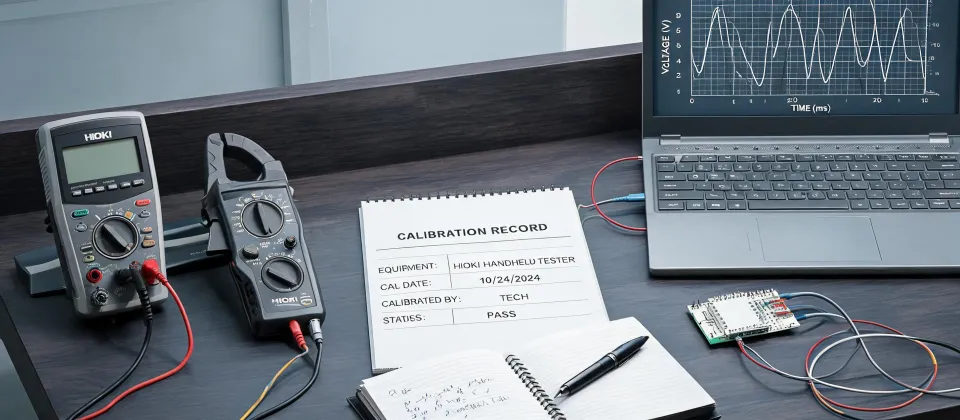
I looked at our calibration records. Each brand had its own recall schedule, its own certified technicians, its own paperwork. We were paying for three separate calibration contracts. I looked at our spare parts. The fuses for one brand didn't fit another. The leads were incompatible. I found an order for $400 worth of specialized test leads for one set of meters that would have been included in the box if we had bought from a single line.
I wish I had tracked the exact number of tech-hours we lost to confusion. I don't have hard data on that. But anecdotally, it was at least a full day per quarter, per technician. For a crew of 12, that's three weeks of lost productivity a year.
The Math that Finally Made Me Switch
So, in Q1 2024, I ran a comparison. I had a specific project coming up: we needed to re-outfit two new maintenance vans. The standard kit included a power quality analyzer, a clamp meter, a digital multimeter, and an insulation tester. I got quotes for two approaches.
Option A (Multi-Brand): I sourced the best prices from our four existing vendors. The power quality analyzer from Vendor B, the multimeter from Vendor C, the insulation tester from Vendor D.
Option B (Single-Brand, Hioki): I sourced a complete package from our Hioki distributor. The PQ3100 (which we already had a good track record with), a CM3286-50 clamp meter, a DT4256 multimeter, and an IR4056-20 insulation tester.
At first glance, the unit prices on Option A were lower. Total for the instrument list: $8,900. The Hioki package quote came in at $9,400. That $500 difference looked like a failure. But I knew better.
Then I added the TCO:
- Calibration: Option A: three contracts, total $1,200/year. Option B: one contract, $350/year.
- Accessories: Option A: we'd need two different lead sets and a carrying case for each brand. Option B: one set of leads works across the line, and the case came with the analyzer. Savings: $600 on the initial order.
- Training: Option A: we would have to run two separate one-hour training sessions on how to use the different menuing systems. Option B: one session, 45 minutes. Tech time saved: ~$200.
- Inventory risk: Option A: a year ago, we lost a different brand's unit for 6 months. Let's say that loss happens at half the rate with a single-brand. That's a potential $900/year risk. Option B: near-zero.
When I added the TCO over 3 years? Option A ran $20,100. Option B? $16,950. That’s a 15.7% difference hiding in the fine print. I was shocked. I had expected a gap, but not that big. So glad I built that spreadsheet. I almost presented the initial unit price and declared failure. Dodged a bullet.
The Pragmatic Takeaway: Not a Universal Rule
Does this mean I think every company should go single-brand? No. To be fair, it depends on scale. If you have a one-person operation and you only need one meter, then, fine, go for the cheapest one you can find. But for any team that needs a cohesive set of tools—especially in a field where instruments are cross-referenced and shared—the fragmentation tax is real.
I have mixed feelings about the whole thing. On one hand, I hate the idea of being locked into one ecosystem. What if a new, better, cheaper product comes out? But then I look at the operational drag. The complexity of managing four sets of manuals, charger cables, and software updates—part of me wants that simplicity more than the flexibility.
I made the switch for those two vans. We’re about six months in. The techs grumbled at first—change is always annoying—but they’ve adapted. The biggest win? They can swap a multimeter from one van to the other and the team already knows how it works. No learning curve. That feeling of invisibility is worth something. What was best practice in 2020—cherry-picking from every vendor—may not apply in 2025. The fundamentals haven't changed, but the execution has transformed.