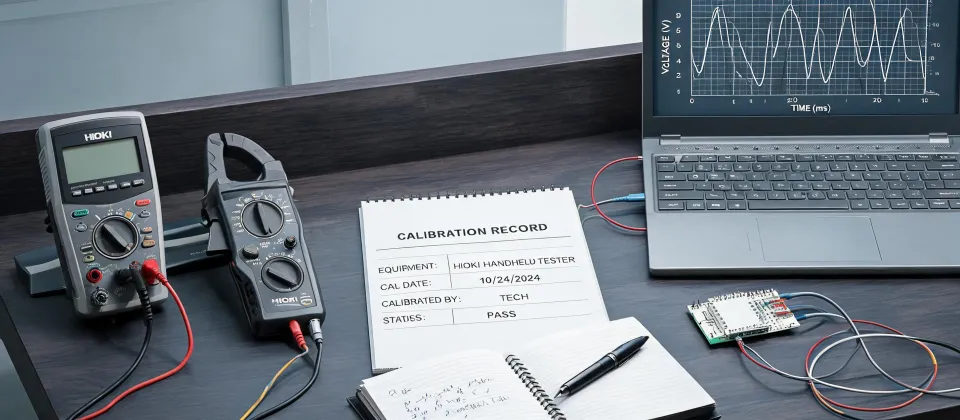
I've spent the last 12 years specifying test instruments. In that time, I've personally made and documented 23 significant buying mistakes, totaling roughly $31,000 in wasted budget. Not all of that was faulty gear. Most of it was me choosing the wrong category of tool.
What I'm comparing and why
These tools are not rivals. A clamp meter measures current without breaking the circuit. That's essential for live panels, motor starters, and power quality checks. An LCR meter measures inductance, capacitance, resistance, and impedance at a selected test frequency. That's for component-level work: verifying caps, checking coils, matching sensors.
I compared them using four criteria that matter in real jobs:
- Measurement integrity
- Workflow
- Cost per use
- Long-term trust
I also threw in a digital angle finder as a control test. It sounds unrelated, but it taught me more about repeatability than any expensive meter did. More on that in a minute.
Dimension 1: Accuracy is not the same as repeatability
The Hioki IM3523 LCR meter has 0.05% basic accuracy. A typical clamp meter is around 1% to 2% basic accuracy, depending on the model and range. On paper, the LCR meter wins. But here's the thing: paper accuracy only matters if your measurement conditions match the calibration conditions.
I learned this while testing a batch of replacement capacitors. I assumed the same capacitance value meant the same result across instruments. Didn't verify. Turned out the clamp meter wasn't designed for component-level impedance at the frequency I needed, so my readings looked stable but were meaningless in context. The IM3523 gave me repeatable numbers because I could set and control the test frequency.
Then the angle finder surprised me. A cheap digital angle finder with a magnetic base repeated a 30-degree measurement within 0.1 degrees ten times in a row. The more expensive model I compared it to drifted by 0.3 degrees after a few minutes. Cost didn't predict consistency. That comparison changed my rule from “buy the highest accuracy” to “verify the repeatability.”
Verdict on dimension 1: For component-level testing, the IM3523 is the right instrument. For field current and voltage checks, the clamp meter is the appropriate tool. Accuracy is a spec; repeatability is proof.
Dimension 2: Workflow, where the real cost hides
A Hioki clamp meter is built for speed. Open the jaws, clamp around a conductor, read the current. You can do that in seconds without powering down the equipment. That's why it is my default tool for breaker panels and load checks.
The IM3523 is not that. It's a bench-oriented instrument. You need to connect leads or a fixture, select the measurement mode, set the frequency, and sometimes run an open or short calibration before taking a reading. It's deliberate. Skilled, but deliberate.
Here's the issue: most of my “accuracy problems” were actually workflow problems. On a live 480V panel, I don't need 0.05% accuracy. I need to know whether the phase current is 42A or 61A. A clamp meter answers that in 20 seconds. Setting up an LCR meter on a live panel would be dangerous and ridiculous.
When I compared our emergency repairs with planned maintenance over a full year, we were spending roughly 40% more on after-hours callouts than on scheduled work. Not because the failures were harder, but because we didn't have the right meter on the truck. We had a precision instrument sitting in the lab while people made educated guesses with a screwdriver.
If you're reading thermal camera news today, you'll see more low-cost thermal imagers than ever. Some are genuinely useful. But the workflow lesson still applies: a thermal camera can show you a hot connection, but it won't tell you the current flowing through it. You still need a clamp meter to measure the load. The camera points at the problem; the clamp meter quantifies it.
Verdict on dimension 2: For portable troubleshooting, the clamp meter wins by a mile. For component evaluation, the IM3523 is worth the setup time.
Dimension 3: Cost per use and small customers
Here's where I get defensive about small orders. When I started out, a vendor treated my $200 instrument order like it mattered. They answered my questions, suggested a lower-priced option, and didn't push a bench LCR meter on someone who mostly did field troubleshooting. A few years later, my company placed a much larger order with the same distributor. That relationship started with a clamp meter, not a flagship LCR meter.
Small doesn't mean unimportant. It means potential. I remember that whenever I hear a procurement person dismiss a single-meter request as not worth their time. The person buying one Hioki clamp meter today might be building a maintenance program tomorrow.
Small doesn't mean unimportant—it means potential.
Cost per use matters more than sticker price. A precision LCR meter used twice a year can cost more per measurement than a good clamp meter used every week. Take the measurement frequency into account before you spend.
Dimension 4: Long-term trust
The final comparison is about trust. A clamp meter lives in a toolbox, gets dropped, gets dusty. An LCR meter lives on a bench, gets calibrated, and rarely sees weather. Both need calibration, but the clamp meter probably needs more frequent checks because of the physical abuse.
When I read a spec sheet, I also try to remember that the FTC requires advertising claims to be truthful and substantiated. That's a legal requirement, and it's useful. But it doesn't protect me from misapplying a spec. A meter can be honestly marketed and still be the wrong tool for my test setup. What I mean is: substantiation is not the same as relevance.
According to FTC business guidance at ftc.gov, claims must be truthful and supported by evidence. Good. My job is to check whether the evidence applies to my measurement.
A side lesson: how to read a Sensus digital water meter
I almost didn't include this. But it fits the comparison theme. One of the most useful “meter reading” lessons I've had wasn't on a lab instrument. It was learning how to read a Sensus digital water meter during a building audit.
With an old analog water meter, the odometer rolls continuously. With a Sensus digital meter, the display refreshes in steps. If you look at it at the wrong moment, you might think the reading jumped. It didn't. The display was just updating.
What helped me: check the unit label on the screen before writing anything down. Sensus digital meters often show gallons, cubic feet, or imperial gallons depending on configuration. Then, if the model has one, press the button to cycle through the readings. You want the totalizer, not the flow rate or leak indicator. I once recorded a flow rate as a totalizer reading and thought the building was using three times its normal water. Not ideal. The meter was fine; my assumptions weren't.
Which should you choose?
Choose the Hioki IM3523 LCR meter when you're measuring components: capacitors, inductors, transformers, sensors. You need controllable test frequency, repeatable setup, and a stable bench environment.
Choose the Hioki clamp meter when you're working on live circuits and need current, voltage, and power checks fast. It's built for the truck, not the bench.
And whenever a spec sheet is tempting you, remember the angle finder lesson. The most expensive tool isn't automatically the most consistent one. Run the same measurement ten times. Compare readings side by side. Learn to read the display before you trust it.
My experience here is based on roughly 200 field jobs and a small in-house component testing lab. If you're doing metrology-grade calibration or RF work, your requirements will be different. That said, the decision process is the same: define the measurement question first, then choose the instrument category, then compare models.
Look, I'm not saying the LCR meter is always overkill. I'm saying the right tool is the one that fits the question. It took me $31,000 in documented mistakes to stop buying impressive specs and start buying answers.