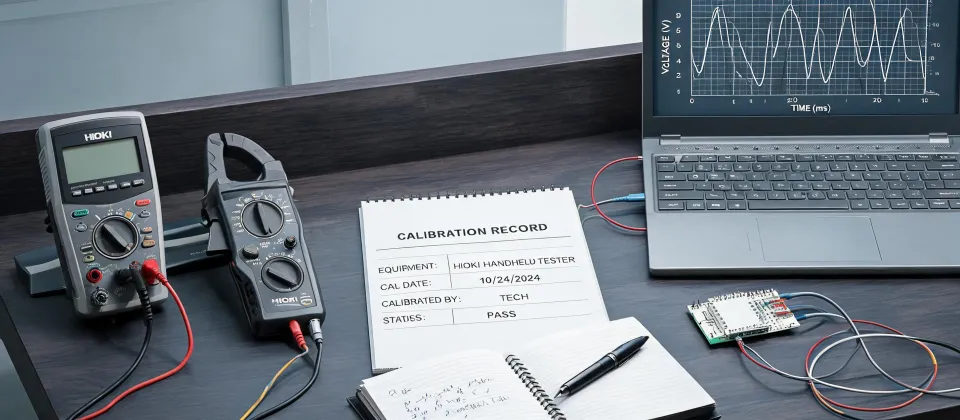
From the outside, picking a clamp meter or multimeter looks simple: find the one with the right specs, compare prices, and order it. The reality is different—especially when you're not an engineer, and you're just trying to get the right tool for the maintenance team without a headache.
I'm an office administrator for a mid-sized manufacturing plant, managing about $150,000 annually in MRO purchases across 10-12 vendors. When our facilities team needed a new power quality analyzer, I had to figure out which one to get, fast. I learned that a good checklist—not a spec sheet—is what really helps. Here's a 4-step checklist I now use for any Hioki test equipment order. It's saved me time, money, and a few embarrassing conversations with my VP.
Step 1: Confirm What You're Actually Buying For
This sounds obvious, but it's where most of my early mistakes happened. The team might say 'we need a multimeter,' but that's too broad. Is it for a solar panel installation (needs DC, high voltage)? Is it for a motor repair (needs true RMS, inductance)? Or is it just for basic troubleshooting around the facility?
I now ask three questions before anything else:
- What's the primary voltage and current? (AC, DC, or both? Up to 600V or 1000V?)
- What's the environment? (Indoor panel, outdoors, near heavy machinery?)
- What certifications do they need? (CAT III/IV for safety is non-negotiable for us.)
Don't just take a brand name request at face value. I once had someone ask for 'a Fluke 1587.' When I asked why, they admitted they just saw it in a YouTube video. The actual job needed an insulation tester, but a different model was better suited. Knowing the job first saves you from buying the wrong tool.
Step 2: Build a 'Total Cost of Ownership' Model, Not Just a Price Comparison
I still kick myself for my first big order. I found a Hioki CM4376 clamp meter at a great price from a new vendor—$210 less than our usual supplier. I ordered five. The invoice wasn't proper (handwritten receipt only). Finance rejected it, and I had to eat the cost out of my department budget. Now, before I compare unit prices, I check three things:
- Total cost: Unit price + shipping + any setup/calibration fees. I've seen 'free shipping' vendors charge a $45 'handling fee.'
- Accessories: Does the price include the test leads, case, or software? Some Hioki models come bare-bones; the accessories can add 20-30%.
- Warranty and support: A 10% cheaper price means nothing if the vendor won't help with a defective unit. We had a data logger fail after 8 months; our cheaper vendor didn't respond. It took weeks to get a replacement from Hioki directly.
I've saved more money by avoiding bad vendors than by hunting for the lowest price. (Honestly, that's a lesson I learned the hard way.)
Step 3: Verify the Vendor, Not Just the Product
This is the step most admin buyers ignore. I've gotten calls from engineers saying 'I need the Hioki CM4376 specs.' I can pull up the product page in seconds. But the real question isn't the specifications—it's whether the vendor is authorized and reliable.
Here's my quick check:
- Are they an authorized Hioki distributor? Hioki has an online list. I check it. Counterfeit instruments are a real problem in industrial testing.
- What's their return policy? I've had vendors who charge a 25% restocking fee for a meter that was returned unopened. That's not acceptable.
- What's their lead time? A distributor who says '2 days' but ships in 2 weeks wastes everyone's time. I ask for a written commitment.
Our operations team needed a specific LCR meter for a new project. The cheapest vendor wasn't an authorized dealer. The mid-price one was. We went with the mid-price one and got a unit that was properly calibrated and supported. The price difference was $80—a small cost for peace of mind.
Step 4: Think About the Future (This Is the 'Anti-Intuitive' Step)
Most checklists stop at 'order the thing.' But in my experience, the best purchases are the ones that make future orders easier. What was best practice in 2020 may not apply in 2025. The fundamentals haven't changed—you still need a reliable tool for the job—but the execution has transformed.
I now ask: Will this vendor or model work for us in 6–12 months?
- Is the model part of a standard line? Hioki updates models, but their major lines (like the 4282 data logger series) have good backward compatibility. A discontinued model with a great price might be a dead end if a part fails.
- Do they have a good records system? I need invoices with PO numbers, line items with serial numbers, and clear contact info. A vendor who can't provide this is a nightmare for our accounting team. One vendor cost us $2,400 in rejected expenses because they couldn't provide proper invoicing.
- Can I order online easily? We switched to vendors with online portals where I can see past orders, get instant quotes, and download invoices. It saved our accounting team about 6 hours a month. (Not that I track that obsessively or anything.)
I once consolidated orders for 400 employees across 3 locations. The vendor that made it easy to re-order? They kept our business. The one that required a phone call every time? We dropped them.
Final Notes and Common Mistakes
I've processed orders for Hioki multimeters, clamp meters, and testers dozens of times. Here are three mistakes I see admin buyers make:
- Trusting the 'too good to be true' price. If a clamp meter from a non-authorized distributor is 40% off, it's likely a counterfeit or a gray market unit. The risk isn't worth the savings.
- Making assumptions based on one bad experience. I had a vendor ship the wrong model once. I blacklisted them. Then I found out it was a one-off mistake (new warehouse person) and they were otherwise excellent. Now I give vendors a chance to fix problems before walking away.
- Not asking 'why this brand?' If someone says 'I need this specific Fluke model,' ask why. They might be biased by a personal preference or a YouTube review. The actual job might be better served by a different tool altogether.
Also, the fundamentals of picking a vendor don't change much: proper invoices, clear lead times, and responsive support. Those are the basics. Get those right, and the specific model becomes a much smaller decision. Good luck—you won't regret having a checklist.