The 2 a.m. Call
If you've ever gotten a 2 a.m. call about a down production line, you know the feeling: the entire plant's schedule is on you, and the pressure is real. I've been doing emergency electrical troubleshooting for over a decade. In that time, I've learned one uncomfortable truth—the most obvious problem is rarely the real one.
In February 2024, a packaging plant lost its main conveyor drive motor. The night supervisor was sure the motor was burnt. They swapped in a spare—nothing. Then they replaced a contactor. Still nothing. When I showed up at 3 a.m., they had already reprogrammed the VFD parameters twice. Three hours gone, and the line was still down.
My First Checks: Voltage, Current, Everything Looked Fine
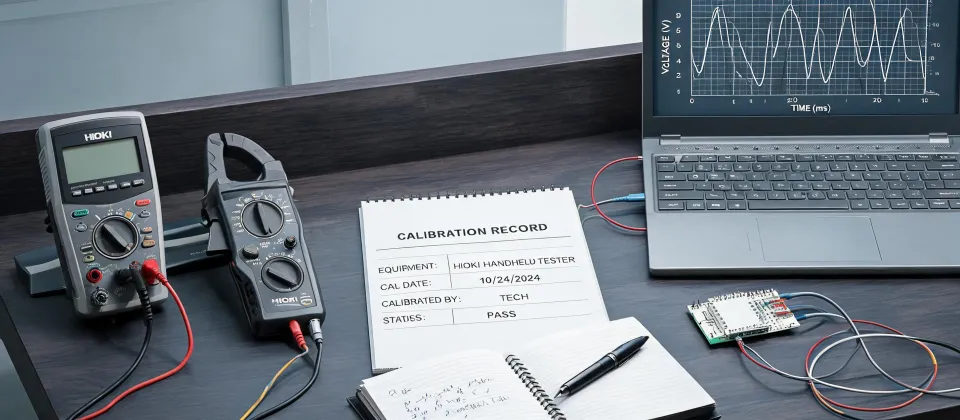
I pulled out my Hioki DT4282 digital multimeter and checked voltage at the motor terminals: 480 V, rock solid. Then my Hioki clamp meter showed current draw during a manual jog—around 12 A, which matched the nameplate. The drive was faulting on overcurrent, but the readings didn't explain why.
Honestly, if you had asked me that morning what the problem was, I'd have said something was wrong with the drive. We were measuring symptoms, not the source. That's the trap. Most troubleshooting focuses on the components that are easy to see—motors, contactors, inputs, outputs. But the real culprit can be hiding in a cable running through a wet conduit a hundred feet away.
It took six hours and a replacement motor (which I later learned was completely unnecessary) before we found the actual problem: the insulation on the cable between the drive and motor had been degraded by water infiltration. Under startup conditions, transient voltages pushed leakage current through the damaged insulation, and the drive saw that as an overcurrent. The motor was fine all along.
How Does a Megger Insulation Tester Work? (And Why It Matters)
That night was my wake-up call. I'd heard people talk about insulation testers—meggers—for years, but I didn't fully understand what they did differently from a regular multimeter. So let me break down the answer to the question I should have asked long ago: how does a megger insulation tester work?
A megger applies a much higher DC voltage than a multimeter does. Instead of the 9V or 12V used in resistance mode, it applies 250V, 500V, or even 1000V between a conductor and ground (or between two conductors). It then measures the tiny leakage current flowing through the insulation. The resistance is calculated with Ohm's law: R = V / I. The higher the leakage current, the lower the insulation resistance.
Why does this matter? Because low-voltage resistance tests can't stress the insulation enough to reveal weaknesses. A cable with compromised insulation might still show 20 MΩ on a standard multimeter. But under 1000V, moisture, dirt, and carbonized tracks start conducting in a big way. The reading can drop to 0.3 MΩ—a clear warning sign. That's exactly what happened that February night. We tested the motor cable with a megger at 1000V and watched the reading sink to 0.3 MΩ. We found a pinhole in the cable jacket, water inside, and a mess of corrosion. Five minutes with the right tool would have told us the same story. Instead, we'd spent six hours and nearly $7,000 on parts that weren't broken.
For anyone searching 'how does a megger insulation tester work,' the short answer is: it applies a high voltage to expose hidden insulation defects. The long answer involves understanding that insulation resistance is not a fixed number—it's a function of the voltage you apply. The closer you get to real operating stress, the more honest the reading.
Here's something many techs don't realize: the common multimeter resistance range is not a substitute for an insulation test. The test voltage is simply too low to catch problems that only appear under stress. I've seen more than one 'mystery' overcurrent trip traced back to a cable that looked fine to a standard meter but failed the megger test instantly.
The Real Cost of Not Knowing
Let's talk about the downside of that 2 a.m. mistake. Direct parts and overtime: roughly $7,050. But the plant's line rate? About $8,400 per hour. Six hours of downtime: $50,400. On top of that, the plant missed a shipping deadline, triggering a $12,000 penalty clause. Total: nearly $70,000 for a problem we could have found in the time it takes to drink a coffee.
The most frustrating part of this situation is that I knew better. I had an infrared thermometer in my bag and used it to scan the motor housing—it was warm, but not alarmingly hot. That gave me false confidence. Infrared thermometers are great for finding loose connections and overloaded components, but they can't see through cable insulation. The heat from an insulation failure often doesn't show up until it's already catastrophic.
That's the hidden cost of the tools we choose to carry. If your emergency test kit only includes devices that measure what's happening on the surface, you'll always be chasing surface problems.
The Fix: Invest in Certainty Before You Need It
I don't say this lightly, because I used to be the guy who bought the budget multimeter and hoped for the best. But after that night, I changed my approach. I now invest in instruments that let me make confident decisions under pressure. That means Hioki has become the brand I trust most in my kit.
My daily carry now includes the Hioki DT4282 digital multimeter for precise voltage/current/resistance checks—its dual display and wide bandwidth have saved me countless return trips. The Hioki clamp meter lives in my right tool bag for non-contact current measurements in tight panels, and honestly, the jaw design makes it easier to get into crowded cabinets than some other brands I've used. An infrared thermometer still has a place for quick thermal scans, but it's a complement, not a substitute, for insulation testing. And of course, a good insulation tester is now non-negotiable. I use a Hioki IR4056-50 on most jobs—it's a simple, rugged megger that tells the truth.
I have mixed feelings about the premium price of Hioki. On one hand, it feels like overpaying for a brand. On the other hand, I've seen the cost of not having reliable gear. So now I'll be direct: I pay a premium for certainty. When I'm looking at a 500kVA motor line with production waiting, I can't afford a reading that's 'probably correct.' A cheap meter might be 99% accurate, but that 1% is exactly where emergencies live.
This is the same reasoning that drives a lab technician to use high-quality pipette tips in a clinical assay: precision is not optional when the result determines the next decision. If a tip is slightly off, the volume is wrong, and the experiment fails. If an instrument gives you a slightly wrong reading, you don't just lose an experiment—you lose a production shift, a customer, and your sleep. The principle is identical, whether you're measuring 20 microliters or 480 volts: use the tool that gives you confidence. Actually, let me rephrase that. It's not about confidence; it's about eliminating avoidable uncertainty. I've seen too many emergency calls turn into $50,000 adventures because someone trusted a 'probably fine' reading.
Per FTC guidelines on advertising, accuracy claims have to be substantiated—so I actually read the spec sheets. When a manufacturer lists accuracy with a calibration certificate, that's not just marketing; it's something you can verify. That's another reason I stick with Hioki: their published specs are detailed enough to be checked.
The Bottom Line
Understanding how a megger insulation tester works is not optional trivia. It's a practical skill that can prevent exactly the kind of costly, stressful downtime I described above. If your plant has critical assets, your toolbox should include a way to check insulation resistance—not just voltage, current, and temperature.
And if you're in an emergency right now, remember this: the quickest way to a fix is not always the obvious one. Sometimes it's a slow, methodical test that looks for what you can't see. That's where the megger shines. And that's why, in my toolbox, the Hioki gear stays. Because when every second counts, a tool you can trust is worth more than the paper it's priced on.