I'm the procurement manager at a 42-person industrial services company. I've managed our instrument budget—about $60,000 annually—for six years, negotiated with ten-plus vendors, and logged every order in an equipment tracking spreadsheet. The spreadsheet is not fancy. It's the reason I don't trust first impressions.
The multimeter problem you think you have
A $63 Klein MM400 sits in our test-equipment room. A Hioki DT4282 multimeter sits in a tech's service bag. If you compare the prices on paper, you see a gap of almost $400 and think, 'That's the cost of the brand.' You'd be wrong. Or rather, you'd be right about the price and wrong about the cost.
It's tempting to think a multimeter is a multimeter. The cheaper one reads voltage and resistance. The expensive one reads voltage and resistance. So what's the difference?
The difference isn't on a bench. It's in front of a variable-frequency drive output, on a 4-20 mA loop, or at an intermittent fault that only shows up when the panel is under load. That's where the price difference starts earning its keep.
Why 'Hioki vs Klein multimeter' is the wrong comparison
Search for 'hioki vs klein multimeter' and you'll get specs side by side. Specs don't tell you that both meters are right—in different rooms.
Klein's MM400 is a solid, honest meter for residential and light commercial electrical work. It's rated CAT III 600V under IEC 61010-1, it's cheap, and it rides in a pouch without tears. We use one for quick checks on lighting circuits. I wouldn't use it to validate a 0-10 V sensor signal on a production line. That's not because it's bad; it's because its resolution and stability weren't designed for that task.
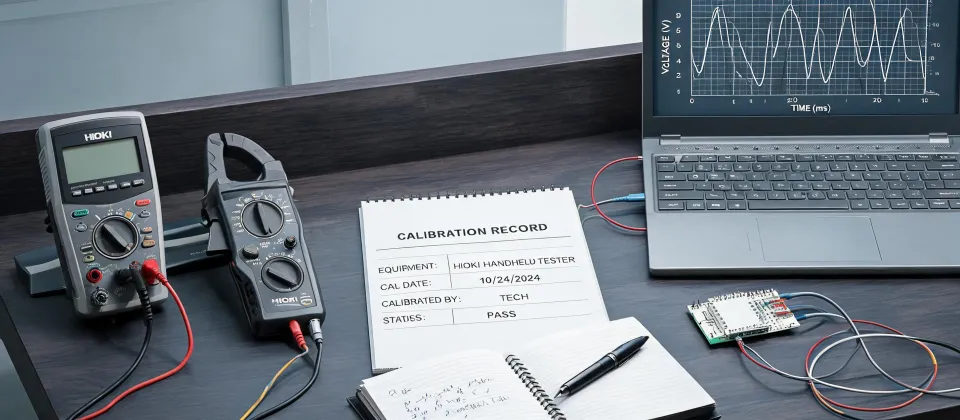
Hioki measuring instruments, especially the DT4282, are built for a different layer of troubleshooting. The manufacturer's spec sheet lists basic DC accuracy around 0.025% of reading, plus a digit count. On a 3.000 V signal, a meter with that spec sees small changes that a general-purpose 0.5% meter smooths over. That matters when you're chasing a threshold, not just checking for voltage.
The assumption nobody challenges: 'expensive' vs 'cheap'
People assume expensive instruments do more accurate work. Actually, instruments that deliver stable, repeatable readings can charge more because they prevent bigger costs. The price follows the savings, not the other way around.
I learned that in 2023. One of our techs was sent to a composting facility where a conveyor drive kept throwing an overcurrent fault. The $65 meter he grabbed showed a clean, balanced output. He ordered a replacement drive—$4,200 plus labor. The fault came back.
Then he brought the Hioki DT4282. It showed a slightly unbalanced waveform on the motor terminals. With the low-pass filter active, the phase-to-phase difference was obvious. The drive was fine. The motor winding was failing due to moisture ingress. The 'overcurrent' was the drive trying to protect a dying motor.
That one misdiagnosis cost us the $4,200 drive, a $1,100 motor evaluation, and about $900 in truck rolls and downtime. No—call it $6,400 when you add the rental meter and the extra tech hours. The price difference between the meters? Four hundred and change. The cheaper meter wasn't cheap. It was the most expensive thing in the room.
The '45 multimeter' legend still costs money
Every year, I see a purchase request for a '45 multimeter.' Usually, they mean the old Fluke 45 dual-display bench meter. I like that instrument. It's stable, readable, and for bench work, it's still useful. But it's a bench meter. It's not built to hang from a strap while you troubleshoot a drive in a dusty cabinet.
When someone asks me if a Fluke 45 can replace a field meter, I say no—not because the Fluke 45 is bad, but because it's a specialist. Same with the Hioki DT4282. It's a specialist for precision and industrial signal work, not a replacement for every meter in the truck.
A two-minute lesson on how to use a FLIR ONE thermal camera
Thermal imaging shows up in the same purchase cycle as multimeters for a reason. A FLIR ONE thermal camera is not a substitute for a meter. It's the fastest way to find which connection is about to become a problem. You scan the panel, find a hot breaker terminal, then bring in the DMM to confirm.
Here's a practical answer to 'how to use FLIR ONE thermal camera' that usually gets buried in marketing:
- Attach it, launch the app, and wait twenty seconds for the sensor to calibrate.
- Set emissivity around 0.95 for insulated wire and electrical tape. Leave it there unless you're shooting bare metal or shiny surfaces.
- Hold the phone perpendicular to the target, not at an angle. Off-axis readings lie.
- Let it focus. A blurry heat blob is not a diagnosis.
- Capture a still, then write down the load current at that moment. You'll want it later.
Why does this matter to someone with a budget? Because a thermal scan can save an unnecessary second truck roll. One missed hot connection can create a $1,400 emergency service call. The FLIR ONE costs about $200. Same economics as the DT4282.
What to actually buy
I don't have a universal answer, and I'm wary of any vendor that does.
If you do mostly residential, new construction, or light commercial, a Klein MM400 or similar CAT III tool is a reasonable choice. It's not an insult to say it fits that class of work. It should not be your first instrument for a process plant.
If you troubleshoot drives, analog loops, or sensitive electronics, the Hioki DT4282 is the right class of instrument. Its accuracy, filtering, and stable readings reduce risk. If you can't justify the DT4282, buy the best meter you can from an established instrument maker—then buy a spare, because someone will drop it.
And don't ask one tool to do everything. A vendor who says, 'This isn't our strength, here's who does it better,' earns my trust for everything else. Specialists can charge because they know where to stop.
The bottom line
The real procurement question isn't 'Hioki vs Klein multimeter,' or 'What does a 45 multimeter cost?' It's this: What is the cost of being wrong in your environment?
Our tracking system says the same thing every year: for high-risk electrical work, the meter is the cheapest part of the job. Not because it's cheap, but because it decides whether you do the job once or twice.
Buy for the worst condition you'll encounter. The invoice may look higher. The rework will not.