When I first took over purchasing in 2020, I assumed measuring tools were commodities. A clamp meter measures current. A multimeter measures voltage. They all come in a molded case with a screen and two leads, and the price gap just meant you were paying for branding.
That assumption cost us about $3,400 in September 2024.
It Started With a Breaker That Kept Tripping
I manage purchasing for a 200-person manufacturing facility — roughly $1.8M a year across 40–50 vendors. I report to both operations and finance, which is another way of saying I'm the one who explains why things cost more than expected.
In late summer 2024, our maintenance shop started tripping breakers. Not constantly — maybe once a week, at random times. The maintenance lead asked me to get a clamp meter so they could start measuring loads. I found a budget model online, scanned the reviews (4.5 stars), and ordered it. ~$90. Arrived in two days.
The readings it produced looked fine. Individual circuits were pulling what seemed like reasonable current; nobody could find an obvious overload. So we called an electrician.
The electrician arrived, looked at our readout, and asked a question I'll never forget:
"What did you take these with?"
He pulled out his own instrument and re-tested the same circuits. Different story. One of the CNC machines was injecting harmonic distortion back into the line. The fundamental current was within its breaker rating, but the distorted waveform was causing the breaker to overheat and trip intermittently. The $90 meter couldn't see it — the harmonics were outside the meter's frequency response, which was (in hindsight) right there in the spec sheet I never read.
The final bill: $1,850 in electrician visits, $900 in replacement breakers that were never faulty, and a full day of lost production. Total: roughly $3,400.
The Real Problem: You Can't Tell When a Measuring Tool Is Lying
It took me months to understand the deeper issue, so I'll explain it slowly.
If you buy a cheap stapler, you see it jam. If you buy a noisy compressor, you hear it struggle. But a measuring instrument that's outside its accuracy spec looks exactly like a good one. The $90 clamp meter displayed a number with all the confidence of a $500 instrument. Unless you know what to verify, you have no reason to doubt it.
The conventional wisdom says "you get what you pay for," and I used to roll my eyes at that. Now I think it undersells the point. With measuring tools, you don't just get what you pay for — you also get to pay for whatever the tool missed.
That hidden cost appears everywhere in instrument buying. People search "how much is a FLIR thermal camera" when the real question is what resolution and thermal sensitivity they need to see the problem they're hunting for. Let me give you a concrete example. Search that phrase in early 2025 and you'll find entry-level models around $1,200, professional units at $5,000 and up. A Zeiss Primo Star microscope gets quoted in the $1,800–$3,000 range depending on configuration. Those figures are from public listings I've reviewed and they change all the time. The number that matters, though, isn't what the tool costs — it's what the wrong tool costs.
I've had internal requests asking for a "Primo Star microscope price" — the model had already been picked, but nobody had asked what the QC lab actually needed to see. It worked out that time because we got lucky. Lucky isn't a strategy, though.
There's also a safety layer I didn't know about until after the incident. For electrical tools, the CAT rating (defined under IEC 61010) tells you what voltage transients an instrument can safely withstand. I won't pretend to be an electrical engineer, so here's the simplified version: the budget meter I'd ordered was rated CAT II — fine for measuring outlets in a clean office. Our maintenance shop panel? That's a CAT III environment. I'd sent our team to troubleshoot industrial electrical gear with a tool designed for lighter duty. That's both a measurement problem and, frankly, a safety problem.
The Cost Never Shows Up on the Purchase Order
Here's the part that makes me angriest in hindsight. When the finance team looks at our spending, the $90 clamp meter is a tidy line item under "tools and equipment." The $3,400 in investigation costs? It's scattered across contractor invoices, replacement parts, and lost production days. Nobody connects those dots.
So the budget review shows "tools: $90" and it looks like a responsible spend. It never reveals the $3,400 that followed.
I've processed 60–80 orders annually since 2020 and managed relationships with dozens of vendors. This hidden-cost pattern shows up across all kinds of purchases — but it's worst with measuring tools because the failure mode is invisible. Poor quality in physical goods reveals itself quickly. Poor measurement capability just keeps generating decisions based on incomplete data.
The 5-Question Checklist That Fixed It
After the September incident, I sat down and built a checklist. Every instrument purchase over $200 now has to clear these five questions:
- What exactly do we need to measure? — range, resolution, environment, frequency.
- What accuracy does this application actually require? — not "best available," what's justified.
- What safety rating does the environment demand? — CAT rating, insulation class, certifications.
- Can this tool be calibrated, and is there a traceable certificate?
- What happens if this measurement is wrong?
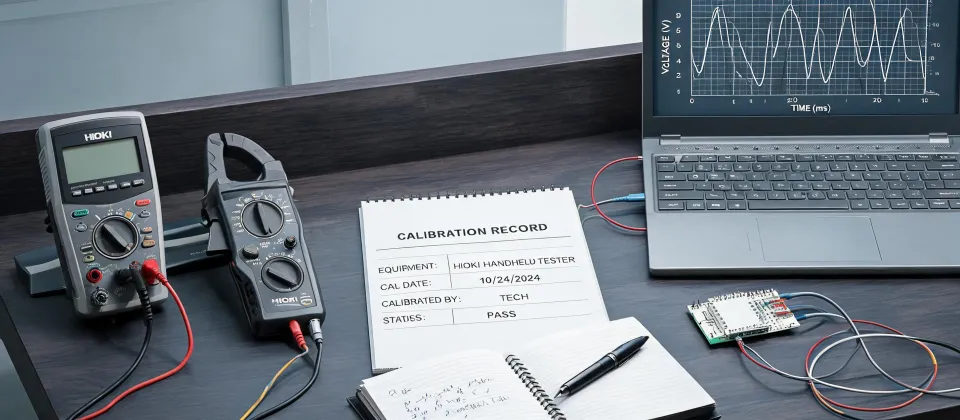
That fifth question is the one that changes everything. "What happens if this measurement is wrong?" For our maintenance clamp meter, the answer was clear: another $3,400 mistake, minimum. At that point, spending $360 or so on a Hioki CM4376 clamp meter was obviously the right move. It has the CAT IV rating, better accuracy, inrush current measurement, and the frequency response the maintenance team actually needs. It's not the cheapest tool in the catalog, but it's the cheapest tool that does the job correctly.
We also picked up a Hioki 3196 power quality analyzer — the same model the electrician had been using that day. It's not the newest unit on the market, but it does what we need: logging waveform data over time, which is how you catch intermittent problems like harmonics. Buying it from a reputable reseller cost us a fraction of what the September mistake cost.
The thermal camera is still on the wishlist, by the way. I ran the request through the checklist and realized we'd need a higher-resolution model than the one I'd initially shortlisted. That's money we haven't spent yet, which is nice.
Five Minutes of Verification Beats Five Days of Correction
I still see internal search requests like "how much is a FLIR thermal camera" or "Primo Star microscope price" from our team. I understand why. Price is the natural first question when you're spending someone else's budget.
But the question that saves money is the harder one: "What does this need to measure, and what happens if it's wrong?"
That's the difference between 5 minutes of spec-checking and 5 days of chasing an invisible problem. Between $90 and $3,400. Between a tool that looks right and a tool that actually handles the job.
I still kick myself for not reading the full spec sheet on that first clamp meter. The limitations were right there in the manual. If I'd spent ten minutes verifying instead of ten minutes scrolling reviews, we'd have skipped the whole episode.
The good news: we haven't repeated that mistake. The CM4376 already caught an inrush issue we'd have missed with the old meter. The checklist has become habit, not formality.
So here's my advice, from one non-engineer to another: don't chase the cheapest price on measuring tools. Chase the measurement first, verify the spec, then let the price talk. Your future self — and your budget review — will thank you.